
الموارد
استكشف مجموعة واسعة من الموارد القيمة حول تعليم المواطنة العالمية لتعميق فهمك وتعزيز البحث والمناصرة والتعليم والتعلم.
تم العثور على 875 نتيجة
 [Resumen] Re|pensar las políticas culturales: creatividad para el desarrollo, Convención de 2005 Informe Mundial 2018: resumen سنة النشر: 2017 المؤلف المؤسسي: UNESCO Concebida para efectuar el seguimiento de la aplicación de la Convención de la UNESCO sobre la Protección y la Promoción de la Diversidad de las Expresiones Culturales (2005), esta serie de Informes Mundiales también proporciona pruebas de cómo el proceso de aplicación de esta Convención contribuye a la consecución de las metas fijadas en los Objetivos de Desarrollo Sostenible de la Agenda para 2030 de las Naciones Unidas.En el Informe Mundial 2018 se examinan los progresos realizados en la aplicación de la Convención de 2005 desde la publicación del primer Informe en 2015.Basándose en un análisis de los informes periódicos cuadrienales presentados por las Partes en la Convención, así como en los resultados pertinentes de recientes investigaciones, el presente Informe muestra cómo la Convención de 2005 ha contribuido a hacer evolucionar las políticas culturales a nivel nacional y mundial en diez ámbitos. En el Informe se formula un conjunto de recomendaciones sobre esas políticas con vistas al futuro, abordando la cuestión de su adaptación a la rápida evolución del universo digital sobre la base del respeto de los derechos humanos y las libertades fundamentales.Las dos ediciones de 2015 y 2018 del Informe Mundial proporcionan conjuntamente toda una serie de datos recientes y valiosos que aportan información para la elaboración de políticas culturales y contribuyen al progreso de la creatividad para el desarrollo.
  Human Right and Encryption سنة النشر: 2016 المؤلف: Wolfgang Schulz | Joris van Hoboken المؤلف المؤسسي: UNESCO This publication follows UNESCO’s new approach to Internet issues, as endorsed in November 2015 on the occasion of its 38th General Conference. Our 195 Member States have adopted the CONNECTing the Dots Outcome Document, in which 38 options for future action from UNESCO are set out; and the Internet Universality principles (R.O.A.M.),which advocates for a Human-rights-based, Open and Accessible Internet, governed by Multi-stakeholder participation.Encryption is a hot topic in the current global discussion on Internet governance. This research delves into the subject, to outline a global overview of the various means of encryption, their availability and their potential applications in the media and communications landscape. The research explains how the deployment of encryption is affected by different areas of law and policy, and it offers detailed case studies of encryption in selected jurisdictions.It analyzes in-depth the role of encryption in the media and communications landscape, and the impact on different services, entities and end users. Built on this exploration and analysis, the research provides recommendations on encryption policy that are useful for various stakeholders. These include signaling the need to counter the lack of gender sensitivity in the current debate, and also highlighting ideas for enhancing “encryption literacy”.
  Meeting on Learning to Live Sustainably in Cities in Latin America and the Caribbean, Villa María, Argentina (26-28 April 2017): Meeting Report سنة النشر: 2017 المؤلف المؤسسي: UNESCO Villa Maríia, the first Argentinian city to join the UNESCO Global Network of Learning Cities (GNLC), co-hosted the first GNLC meeting in the region, titled ‘Learning to live sustainably in cities in Latin America and the Caribbean’. This three-day event was a joint effort of the City of Villa Maríia, the UNESCO Institute for Lifelong Learning (UIL), UNESCO Headquarters, and the UNESCO Regional Bureau for Education in Latin America and the Caribbean (OREALC/UNESCO Santiago). Participants explored new ways to implement sustainable solutions at the local level, as well as increase awareness and training related to Education for Sustainable Development (ESD). More than 170 city representatives from over 40 cities and 20 countries (including mayors and deputy mayors, experts, authorities and practitioners) were welcomed by the host city. The first day of the meeting was composed of plenary sessions; the second day consisted of two parallel workshop sessions: (1) a regional workshop on the Global Action Programme (GAP) on ESD and Cities, and (2) a regional workshop on learning cities. Aprender a Vivir de Manera Sostenible en Ciudades de América Latina y el Caribe, Villa María (Argentina), 26-28 de abril de 2017: informe de la reunión سنة النشر: 2017 المؤلف المؤسسي: UNESCO Villa Maríia, la primera ciudad argentina que entróo a formar parte de la Red Mundial de Ciudades del Aprendizaje de la UNESCO, fue una de las organizadoras de la primera reunióon de esta Red en la regióon, titulada “Aprender a vivir de manera sostenible en ciudades en Améerica Latina y el Caribe”. Este acto, de tres díias de duracióon, fue una iniciativa conjunta de la ciudad de Villa Maríia, el Instituto de la UNESCO para el Aprendizaje a lo Largo de Toda la Vida (IUAL), la Sede de la UNESCO y la Oficina Regional de Educacióon de la UNESCO para Améerica Latina y el Caribe (OREALC/UNESCO Santiago). Los participantes estudiaron nuevas formas de poner en práactica soluciones sostenibles a escala local, asíi como de fomentar una mayor sensibilizacióon y formacióon en materia de educacióon para el desarrollo sostenible (EDS). Villa Maríia acogióo a máas de 170 representantes de máas de 40 ciudades y 20 paíises, entre los que se encontraban alcaldes y tenientes de alcalde, expertos, autoridades y profesionales. Durante la primera jornada de la reunióon tuvieron lugar reuniones plenarias y la segunda jornada se dividióo en dos sesiones paralelas de talleres: 1) un taller regional sobre el Programa de Accióon Mundial de EDS y las ciudades, y 2) un taller regional sobre las ciudades del aprendizaje.
 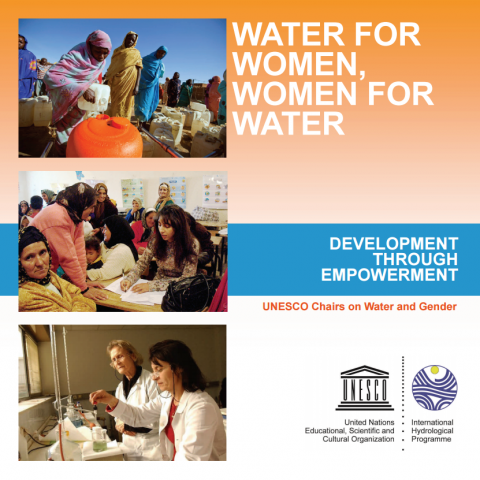 Water for Women, Women for Water: UNESCO's Chairs on Water and Gender سنة النشر: 2014 المؤلف المؤسسي: UNESCO The access to sufficient, safe and affordable water is a basic human right. It calls for governments, institutions, corporations and public and private organizations involved in the water sector to eliminate various forms of discrimination in the access, management and decision‐making processes involving water resources. Within the framework of the UNITWIN/UNESCO Chairs Programme, UNESCO has established five Chairs seeking to promote the engagement of women in sustainable development and water resource management. These Chairs integrate the UNESCO Water Family, consisting of the International Hydrological Programme (IHP), water‐related Centers’, the UNESCO‐IHE Institute for Water Education, the World Water Assessment Programme (WWAP), and a total of 35 UNESCO Chairs and UNITWIN Networks.Located in Brazil, Côte d’Ivoire, Morocco, Togo and the Dominican Republic, the Chairs are based in institutions of research and higher education, working actively to develop human resources, build solutions, and share scientific and practical knowledge. They work in partnership with other academic institutions, as well as public and private organizations. They also pave the way for the research and higher education communities to join forces with UNESCO in an effort to achieve internationally agreed Development Goals and targets. With a high appreciation for the Chairs’ great potential for impact, IHP has strongly encouraged their projects and initiatives, as well their involvement in other focal areas of the Eighth Phase of IHP, in order to strengthen water security, enhance tertiary and technical water education and respond to the needs of communities, with a special focus on women’s needs. With their inception in 2006, the UNESCO Chairs on Water and Gender have built a remarkable combination of knowledge and experience in their area of expertise. Through their actions, the Chairs have successfully fostered cooperation and exchange of information among different institutions of higher education; conducted research and training activities on gender‐related issues, water and natural sciences; established networks between professionals, governmental, non‐governmental and private organizations; created new approaches to deal with the water‐related needs of local communities and succeeded in increasing participation, leadership and the role of women in the water sector.As a general goal, the Chairs strive to enhance women’s capacities through motivation, engagement, development of skills and education. They have been active in organizing learning courses, training sessions, workshops, conferences and a diverse range of research and community projects. The following pages present a detailed overview of the five Chairs and their goals, activities, and initiatives.
  Ensinando sobre o Holocausto na Escola : Informações e Propostas para Professores dos Ensinos Fundamental e Médio سنة النشر: 2014 المؤلف: Nilton Mullet Pereira | Ilton Gitz المؤلف المؤسسي: UNESCO This textbook aims at helping teachers of primary and secondary education to address the Holocaust theme in their classes. This book contains suggested activities, lists of books and films references to help pupils to make connections between the Holocaust and others genocides but also to develop critical thinking and respect for human rights.
  Educational Policy Recommendations Based on TERCE سنة النشر: 2016 المؤلف: Ernesto Treviño, Cristóbal Villalobos, Andrea Baeza المؤلف المؤسسي: UNESCO Recommendations for Educational Policies in Latin America based on TERCE have been elaborated on request of the Regional Office of Education for Latin America and the Caribbean, OREALC/UNESCO Santiago. This publication is aimed at educational policy makers. For LLECE, decision-making is based on evidence and anchored to conceptual models that allow for the adequate interpretation of reality. This document fulfills this purpose, since it has the fundamental characteristic of translating the conclusions drawn from the TERCE into policy and educational practice. In this sense, the empirical evidence provided by the study shows the main factors that influence the achievement of learning, which represent concrete challenges of educational policy. Recomendaciones de Politicas Educativas en base al TERCE سنة النشر: 2016 المؤلف: Ernesto Treviño, Cristóbal Villalobos, Andrea Baeza المؤلف المؤسسي: Organización de las Naciones Unidas para la Educación, la Ciencia y la Cultura (UNESCO) Recomendaciones de Políticas Educativas en América Latina en base al TERCE ha sido elaborado por encargo de la Oficina Regional de Educación para América Latina y el Caribe, OREALC/ UNESCO Santiago. La presente publicación se encuentra orientada a hacedores de política educativa. Para el LLECE, la toma de decisiones debe estar basada en evidencia y anclada a algunos modelos conceptuales que permitan interpretar de manera adequada la realidad. Este documento cumple con este propósito, puesto que posee la característica fundamental de traducir las conclusiones extraídas de la evidencia del TERCE en política y la práctica educativa. En este sentido, la evidencia empírica que aporta el estudio muestra los principales factores que influyen en el logro de los aprendizajes, los cuales representan desafíos concretos de política educativa.
  Citizenship and Culture of Peace in Educational Reform سنة النشر: 2005 المؤلف: Raúl Zepeda López, María del Rosario Toj, Edgar Florencio Montúfar المؤلف المؤسسي: UNESCO The concern raised by the themes and contents of civic education and the culture of peace in childhood and youth are issues that are felt in various academic sectors, in social organizations and educational authorities that sometimes translate into articles in the media, where, among other things, one speaks of "the loss of values", generally having as reference to the young generations and making invisible that this loss is mainly present in the adult generations, which are responsible for this situation. These concerns, in spite of that conscious ambiguity, are not gratuitous. They can be a starting point to become aware of the need to develop new capacities and values, the absence of which young Latin Americans identify in their political and social leaders, as has been pointed out in cited studies, carried out by UNICEF for Latin America and for Beatriz de Cazali for Guatemala. The need to respond to this concern is also present in the participants in the dialogues and municipal consensus (2000), as well as among authorities and curriculum developers of MINEDUC in the last five-years. Ciudadanía y cultura de paz en la reforma educativa سنة النشر: 2005 المؤلف: Raúl Zepeda López, María del Rosario Toj, Edgar Florencio Montúfar المؤلف المؤسسي: UNESCO La preocupación planteada por los temas y contenidos de la formación ciudadana y la cultura de paz en la niñez y la juventud son cuestiones sentidas en diversos sectores académicos, en organizaciones sociales y autoridades educativas que algunas veces se traducen en sendos artículos en los medios de comunicación en donde, entre otras cosas, se habla de “la pérdida de valores” a secas, generalmente teniendo como referencia a las jóvenes generaciones e invisibilizando que esta pérdida principalmente está presente en las generaciones adultas, las cuales son responsables de esta situación. Estas inquietudes, a pesar de aquella consciente ambigüedad, no son gratuitas. Pueden ser punto de partida para tomar conciencia de la necesidad de desarrollo de nuevas capacidades y valores, cuya ausencia, los jóvenes latinoamericanos identifican en sus dirigentes políticos y sociales, como ha quedado antes señalado en estudios citados, realizados por UNICEF para América Latina y por Beatriz de Cazali para Guatemala. La necesidad de responder a esta preocupación está presente, además, en los participantes en los diálogos y consensos municipales (2000), así como entre autoridades y curriculistas del MINEDUC en los últimos quinquenios.