
الموارد
استكشف مجموعة واسعة من الموارد القيمة حول تعليم المواطنة العالمية لتعميق فهمك وتعزيز البحث والمناصرة والتعليم والتعلم.
تم العثور على 2,162 نتيجة
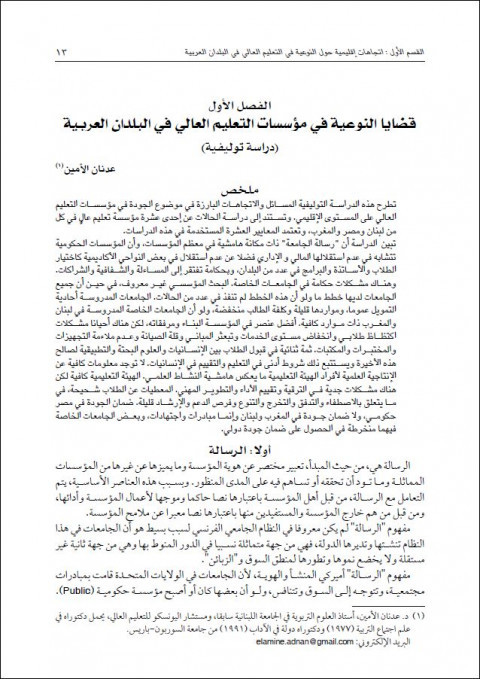 Quality Issues in Higher Education Institutions in Arab Countries: Synthesis Study سنة النشر: 2014 المؤلف: الأمين،عدنان المؤلف المؤسسي: Lebanese Association for Educational Studies (LAES) This synthesis study addresses outstanding issues and trends concerning quality in higher education institutions at the regional level. It is based on case studies from eleven higher education institutions in Lebanon, Egypt and Morocco and on the ten standards used in these studies.The study shows that "the mission of the university" has a marginal position in most institutions; that government institutions are similar in their lack of financial and administrative independence; that there is a lack of independence in some academic respects such as the selection of students, faculty and programs in a number of countries; and that governance is lacking accountability, transparency and partnerships. Indeed, there are governance problems in private universities. Institutional research is not evidently known while all universities have some relevant plans even though these plans have not been implemented in a number of cases.The universities that are under study are generally unilaterally funded, their resources are scarce and the cost per student is low, however; private universities that were subject to this study in Lebanon and Morocco have sufficient resources. The most satisfactory element of the institution is the buildings and annexes thereto.However, at times, there are problems in terms of student overpopulation, poor level of services, scattered buildings, lack of maintenance and inadequate equipment, laboratories and libraries. There is a duality in student admission between Humanities and the Physical and Applied Sciences disciplines in favor of the latter which causes lower conditions in the education and assessment of the Humanities discipline.There is not enough information about the scientific productivity of faculty members, which reflects the marginality of scientific activity. The number of faculty staff is sufficient but there are serious problems regarding their promotion, performance assessment and professional development. Data on students are scarce in terms of students’ selection, influx, graduation and diversity; and support and guidance opportunities remain scarce.Quality assurance in Egypt is a governmental responsibility and there is no such thing in Morocco and Lebanon instead there are some initiatives and attempts. Some private universities in Morocco and Lebanon are engaged in obtaining quality assurance from international bodies.
  [Video] Socio-emotional Learning - the Key to Building Global Citizenship سنة النشر: 2018 المؤلف: Nandini Chatterjee Singh المؤلف المؤسسي: Mahatma Gandhi Institute of Education for Peace and Sustainable Development (MGIEP) Dr. Nandini Chatterjee Singh, Programme Specialist, UNESCO MGIEP speaks about 'Socio-emotional Learning: the Key to Building Global Citizenship' as part of Association for Childhood Education International (ACEI)'s online learning event for educators, titled 'Breakthroughs in Education: Innovations in Equity, Access & Quality.
  Teaching for Global Competence in a Rapidly Changing World سنة النشر: 2018 المؤلف: Richard Lee Colvin | Virginia Edwards المؤلف المؤسسي: Asia Society | Organisation for Economic Co-operation and Development (OECD) Educators and education systems worldwide are reassessing the knowledge, skills, and dispositions students need for success in today's rapidly changing and complex world. In a remarkable moment of global consensus, the member states of both the United Nations (UN), through its adoption of the Sustainable Development Goals (SDGs) in 2015, and the Organisation for Economic Co-operation and Development (OECD), through its Programme for International Student Assessment (PISA) in 2018, prioritized education for global citizenship and global competence.The OECD and the Center for Global Education at Asia Society have worked with academics, educators, and stakeholders in the global education field over several years to define global competence for primary and secondary education. The Center also has extensive experience supporting educators to integrate global competence into their teaching.A new publication from both organizations, entitled Teaching for Global Competence in a Rapidly Changing World, sets forward a new framework for global competence developed by OECD, which aligns closely with the definition developed by the Center for Global Education, and provides practical guidance and examples of how educators can embed global competence into their existing curriculum, instruction, and assessment.
  Éducation à la citoyenneté à l'école : Politiques, pratiques scolaires et effets sur les élèves (Rapport scientifique avril 2016) سنة النشر: 2016 المؤلف: Géraldine Bozec المؤلف المؤسسي: Conseil natiional d'évaluation du système scolaire (CNESCO) Ce rapport de recherche, commandé par le CNESCO, constitue une revue de la littérature à la fois française et internationale portant sur l’éducation à la citoyenneté. Il vise à avancer dans la compréhension d’un objet de recherche encore délaissé à ce jour dans les études françaises et à identifier des pistes de recherche qui pourraient s’avérer fécondes à l’avenir. Il privilégie les travaux mobilisant des données empiriques. Le rapport dresse d’abord un état de lieux de l’apprentissage de la citoyenneté à l’école française, à partir d’une analyse des politiques, des programmes et des pratiques scolaires (Partie I). Il met ensuite en perspective le cas français en resituant ses spécificités et les points communs qu’il partage avec d’autres cas nationaux en matière d’éducation à la citoyenneté (Partie II). Enfin, il présente un bilan des recherches visant à évaluer les effets de l’éducation à la citoyenneté sur les représentations, les attitudes et les pratiques des élèves (Partie III). En conclusion, des orientations de recherche qui apparaissent, à l’issue de cet état des lieux, comme encore peu explorées et potentiellement fructueuses, sont identifiée.
  Education à la citoyenneté en RDCONGO : Quelles strategies et pour quelle éducation à la démocratie en R.D.C? سنة النشر: 2008 المؤلف: Abbé Louis Mpala Cette brochure se veut une introduction générale à toutes les brochures qui seront consacrées à chaque type d'éducation proposé. Ce projet ne peut être réalisé que si Dieu le permet et si je trouve un mécène.Cet écrit peut servir d'un instrument de travail à toute personne soucieuse de voir notre pays avoir des fils dont le cour est circoncis. Comme tout travail humain, ma brochure a des limites. A vous de la parfaire. Destiné à être exposé aux journées scientifiques organisées par l'Institut Supérieur Pédagogique de Lubumbashi (I.S.P.), ce texte est mis à la disposition de tout éducateur. Cet écrit a mes empreintes d'agrégé de l'Enseignement Secondaire Degré Supérieur (E.S.D.S.)pour le cours de philosophie. Voilà qui justifie mon souci de voir les objectifs éducationnels opérationnels.A vous lectrice et lecteur engagés dans un groupe d'encadrement familial, politique ,scolaire, socio-culturel etc., je confie ma brochure.
  Inspiring Citizenship: Ontario's Careers/Civics Curriculum سنة النشر: 2009 المؤلف المؤسسي: Ontario Student Trustees' Association This publication is the culmination of over a year's work in research and collaboration on the part of student leaders from across Ontario. It seeks to celebrate the past years that the civics and careers curriculum has in the province while also challenging the system to do more.As the only province in Canada that has a recognized curriculum devoted to civic education system for responding to the need to nurture active, engaged citizens to tomorrow today. However, while implementation is one matter, delivery is another - and the two must go hand-in-hand. Stimuler la citoyenneté: Le curriculum de l'Ontario, le cours de Carrières/Citoyenneté سنة النشر: 2009 المؤلف المؤسسي: Ontario Student Trustees' Association Cette publication est l'aboutissement de plus d'un an de travail de recherche et de collaboration de la part d'élèves leaders à travers l'Ontario. Elle cherche à célébrer les années précédentes au cours desquelles le curriculum de carrières et citoyenneté a existé dans la province, tout en stimulant le système d'aller un peu plus loin.
  SDG 4 Data Book: Global Education Indicators 2018 سنة النشر: 2018 المؤلف المؤسسي: UNESCO Institute for Statistics (UIS) This publication presents the global monitoring indicators used by countries and the international development community to monitor progress towards Sustainable Development Goal 4 (SDG 4) on education. The indicators were produced by the UNESCO Institute for Statistics (UIS), based on the latest available data.The UIS is the official source of internationally-comparable education data and the custodian agency for SDG 4 data.This mandate reflects the trust of the international community in UIS data and its proven track record in methodological work and standard-setting with national statistical offices, line ministries and technical partners in every region.This publication presents a snapshot of the data used to monitor progress towards the global education goal and targets. It complements the UIS Quick Guide to Education Indicators for SDG 4, which provides more detailed information on the development, interpretation and use of the indicators.
 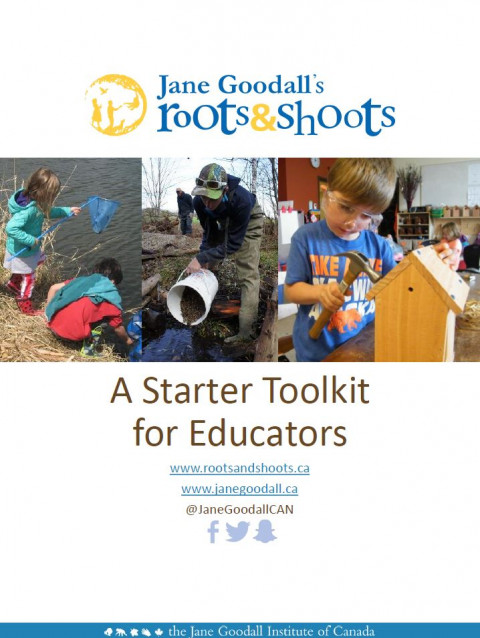 Jane Goodall's Roots & Shoots: A Starter Toolkit for Educators سنة النشر: 2016 المؤلف المؤسسي: Jane Goodall Institute of Canada This toolkit (Jane Goodall's Roots and Shoots) is designed to assist you as you guide young people on their Roots & Shoots journey. Whether you’re an educator, parent or trusted adult, you’ll find something useful to inspire the youth around you to make a positive difference for people, animals and the environment we all share.Jane Goodall’s Roots & Shoots is humanitarian and environmental education and youth empowerment program of the Jane Goodall Institute and is active in 87 countries. The program inspires and prepares young people to become compassionate conservation leaders who are globally mindful and locally active by guiding them through youth-led, community projects that help people, other animals and the environment. This toolkit will help educators or parents looking to inspire young people to make a positive difference in the community or young people wanting to lead the change themselves.
 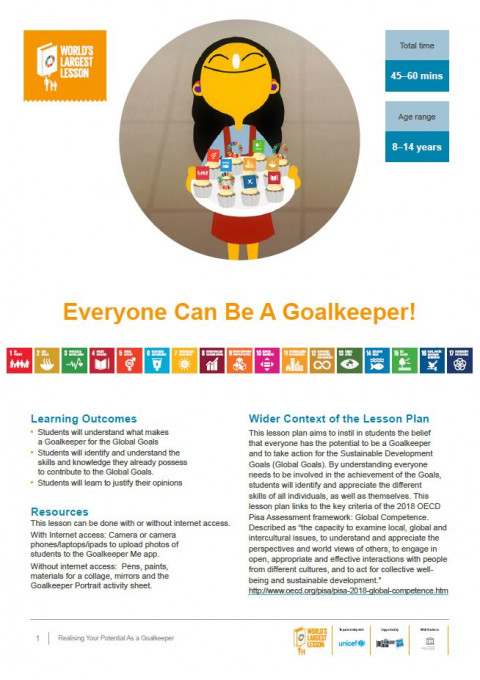 Everyone Can Be a Goalkeeper! المؤلف المؤسسي: World’s Largest Lesson Learning Outcomes• Students will understand what makes a Goalkeeper for the Global Goals• Students will identify and understand the skills and knowledge they already possess to contribute to the Global Goals.• Students will learn to justify their opinions Resources This lesson can be done with or without internet access.With Internet access: Camera or camera phones/laptops/ipads to upload photos of students to the Goalkeeper Me app.Without internet access: Pens, paints, materials for a collage, mirrors and the Goalkeeper Portrait activity sheet. Wider Context of the Lesson PlanThis lesson plan aims to instil in students the belief that everyone has the potential to be a Goalkeeper and to take action for the Sustainable Development Goals (Global Goals). By understanding everyone needs to be involved in the achievement of the Goals, students will identify and appreciate the different skills of all individuals, as well as themselves. This lesson plan links to the key criteria of the 2018 OECD Pisa Assessment framework: Global Competence.Described as “the capacity to examine local, global and intercultural issues, to understand and appreciate the perspectives and world views of others, to engage in open, appropriate and effective interactions with people from different cultures, and to act for collective wellbeing and sustainable development.”