
الموارد
استكشف مجموعة واسعة من الموارد القيمة حول تعليم المواطنة العالمية لتعميق فهمك وتعزيز البحث والمناصرة والتعليم والتعلم.
تم العثور على 2,162 نتيجة
 Transitions from School to Work: UNICEF Technical Note سنة النشر: 2019 المؤلف المؤسسي: United Nations Children's Fund (UNICEF) This report provides guidance on ways that UNICEF can support governments and partners to help adolescents to make a smooth transition from school to decent work. To prepare them for life, work, citizenship and life-long learning, UNICEF encourages governments and partners to expand access to learning and skills development for all children and adolescents – from pre-primary to upper-secondary age, and particularly for the most marginalized. UNICEF further advocates strengthening systems to enable them to develop a breadth of skills across the life course and through multiple learning pathways, such as formal, non-formal, on the job and community based.
  تعزيز التدريس في التعليم العالي: مقاربات جديدة لتحسين تعلم الطلاب سنة النشر: 2012 المؤلف: Peter Hartley | Amanda Woods | Martin Bell المؤلف المؤسسي: Al-Obeikan Publishing يضم هذا الكتاب مجموعة من الأفكار المحفزة والتقارير المتحدية المستمدة من محاضري وممارسي التعليم العالي الذين يستخدمون الأساليب البحثية والمتكررة لتحسين تعلم وتدريسه . وهو يوجز ـ حين يعرض وصفًا واقعيًا ومتاحًا للتطورات الجديدة ـ كيفية تطبيق نظرية التعلم والممارسة الفضلى في عملية التدريس اليومية ، ويقدم النصح والمشورة فيما يتعلق بمغالبة مشكلات التنفيذ والأدلة مستمدة من المشروعات المملولة والممارسين المبتكرين في سلسلة واسعة من التخصصات والخلفيات ، وتشمل مجالات تضم مقاربات للتعلم ، والعمل مع الطلاب ، وتعزيز تقدمهم وتطورهم ، ودعم ممارسات محاضرين وتنميتها . يتناول ( تعزيز التدريس في التعليم العالي ) القضايا الرئيسية المتعلقة بالتعلم والتدريس في التعليم العالي هذه الأيام ، وسيكون مصدرًا موثوقًا يعول عليه للنصح والإرشاد والأفكار للمحاضرين الجدد والمتمرسين الذين يريدون تحسين تعلم طلابهم . Strengthening Teaching in Higher Education: New Approaches to Improving Student Learning سنة النشر: 2012 المؤلف: Peter Hartley | Amanda Woods | Martin Bell المؤلف المؤسسي: Al-Obeikan Publishing This book includes a collection of motivational ideas and challenging reports from the lecturers and practitioners of higher education who use research methods and repeated to improve learning and teaching.In presenting a realistic and accessible description of new developments, it summarizes how to apply learning theory and best practice in the daily teaching process, and provides advice on overcoming implementation problems.
  The Ontario Curriculum, Grades 11 and 12 : Canadian and World Studies سنة النشر: 2015 المؤلف المؤسسي: Ontario (Canada). Ministry of Education In Canadian and world studies, students develop skills, knowledge and understanding, and attitudes that will serve them both inside and outside the classroom, including in the world of work and as responsible citizens in the various communities to which they belong.The focus of teaching and learning in the Canadian and world studies curriculum is the development of ways of thinking and of transferable skills that students need in order to acquire and apply knowledge and understanding. Students apply these ways of thinking and skills in a variety of contexts to examine information critically; to assess the significance of events, developments, and processes; to develop an understanding of and respect for different points of view; to reach supportable conclusions; and to propose solutions to, and courses of action to address, real problems.Citizenship education is an important facet of students’ overall education. In every grade and course in the Grade 11 and 12 Canadian and world studies curriculum, students are given opportunities to learn about what it means to be a responsible, active citizen in the community of the classroom and the diverse communities to which they belong within and outside the school. It is important for students to understand that they belong to many communities and that, ultimately, they are all citizens of the global community. Le curriculum de l'Ontario, 11e et 12e année : Études canadiennes et mondiales سنة النشر: 2015 المؤلف المؤسسي: Ontario (Canada). Ministry of Education Le présent document Le curriculum de l’Ontario, 11e et 12e année – Études canadiennes et mondiales, édition révisée, 2015 est destiné aux écoles de langue française; il remplace Le curriculum de l’Ontario, 11e et 12e année – Études canadiennes et mondiales, 2005 et Le supplément du curriculum de l’Ontario de la 9e à la 12e année – Études canadiennes et mondiales, 2008.À compter de septembre 2015, tous les cours d’études canadiennes et mondiales de 11e et 12e année seront fondés sur les attentes et les contenus d’apprentissage énoncés dans cette édition révisée du programme-cadre.LES ÉCOLES SECONDAIRES AU XXIe SIÈCLE Les écoles secondaires de l’Ontario offrent à chaque élève un programme d’études varié et planifié de grande qualité. Ce programme vise la réussite de tous les élèves dans la destination de leur choix. La mise à jour du curriculum de l’Ontario, de pair avec un élargissement des options d’apprentissage offertes à l’extérieur de la salle de classe traditionnelle, intègre l’apprentissage des compétences essentielles pour réussir au XXIe siècle et respecte les champs d’intérêt, les points forts ainsi que les besoins de chaque élève.Le programme-cadre révisé prend en compte le fait qu’aujourd’hui comme demain, la littératie critique sera fondamentale afin de synthétiser l’information, de prendre des décisions réfléchies, de communiquer de manière efficace et d’évoluer dans une communauté mondiale en continuel mouvement. Il est important que les élèves se sentent concernés par le curriculum établi, qu’ils se reconnaissent dans ce qui est enseigné et dans la méthode d’enseignement, et qu’ils réalisent comment leur apprentissage s’applique au monde qui les entoure. Le programme tient compte des besoins variés des élèves; il les aide à enrichir leurs connaissances et à développer leurs habiletés, et leur offre les perspectives dont elles ou ils ont besoin pour devenir des citoyennes et citoyens informés, productifs, bienveillants, responsables, en bonne santé et actifs au sein de leurs communautés et dans le monde.
 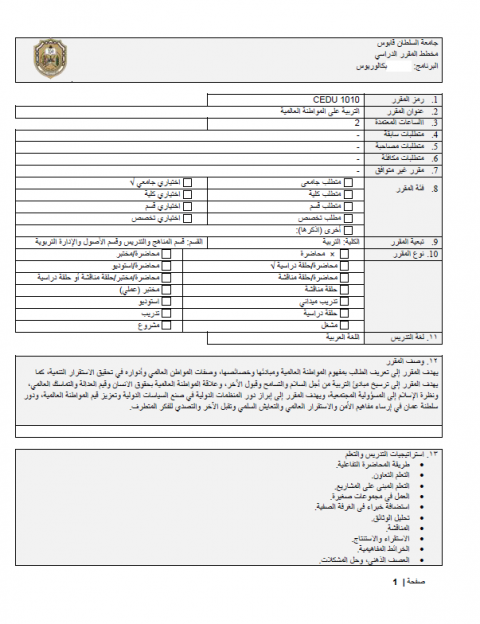 مقرر التربية على المواطنة العالمية سنة النشر: 2019 هذا المقرر قام بوضعه مجموعة من الاساتذة بكلية التربية في جامعة السلطان قابوس، وقد جاء هذا المقرر كفكرة بالتعاون بين الجامعة ومكتب اليونسكو ببيروت وأيضا مركز أسيا والمحيط الهادي للتربية من أجل التعاون الدولي. ويهدف المقرر إلى تعريف الطالب بمفهوم المواطنة العالمية ومبادئها وخصائصها، وصفات المواطن العالمي وأدواره في تحقيق الاستقرار التنمية، كما يهدف المقرر إلى ترسيخ مبادئ التربية من أجل السلام والتسامح وقبول ألآخر وعلاقة المواطنة العالمية بحقوق الانسان وقيم العدالة والتماسك العالمي، ونظرة الإسلام إلى المسؤولية المجتمعية، ويهدف المقرر إلى إبراز دور المنظمات الدولية في صنع السياسات الدولية وتعزيز قيم المواطنة العالمية، ودور سلطنة عمان في إرساء مفاهيم الأمن والاستقرار العالمي والتعايش السلمي وتقبل الآخر والتصدي للفكر المتطرف. Global Citizenship Education Course سنة النشر: 2019 This course was developed by a number of academicians at the College of Education at Sultan Qaboos University. The idea of offering the course came as a collaboration between Sultan Qaboos University and UNESCO Beirut as well as the Asia-Pacific Center of Education for International Understanding. The aim of the course is to introduce global citizenship concept, its focuses, basics, aims, and characteristics to students. The attributes of the global citizens and their roles in the sustainable development are also defined framed in the course. Moreover, the course is an attempt to reinforce the values of global citizenship, peace education and the acceptance of others. In more deep focus, the course outline the relationship between global citizenship and some other concepts such as justice, human rights, international understanding and peace. The course also shed light on the Islamic view of the social responsibility and the role of Islam in that. With regards to international organizations, the course focuses on the role played by international organizations in promoting global citizenship. Finally, the role of Oman as a model of tolerance, accepting others and peacefully living together will be discussed.
  Right to Education Handbook سنة النشر: 2019 المؤلف المؤسسي: Right to Education Initiative (UK) The ultimate aim of this handbook is to facilitate the realization and universal enjoyment of the right to education. Its objective is not to present the right to education as an abstract, conceptual, or purely legal concept, but rather to be action-oriented. Where possible, practical guidance is given on how to implement and monitor the right to education along with recommendations to overcome persistent barriers. It seeks to do this by: Increasing awareness and knowledge of the right to education. This includes the normative content of the right to education, states’ legal obligations, the various sources of law regarding the right to education, what states must do to domestically implement the right to education, how to monitor the right to education, and how to increase accountability of the right to education. Providing a summary of current debates and issues regarding education and what human rights law says about them, including on forced migration, education in emergencies, the privatization of education, and the challenge of reaching the most marginalized. Providing an overview of the UN landscape and its mechanisms, including a clear understanding of the role of UNESCO and more generally the UN, as well as all relevant stakeholders in education, particularly civil society. UNESCO’s Strategy on standard-setting instruments in the field of education (2016-2021) encourages Member States of the Organization to use normative action in relation with the right to education as a strategic tool to implement and achieve SDG4. In line with this, this handbook – specifically foreseen by the Strategy– will also serve as a reference tool for the design and organization of training modules and workshops in the field of right to education. Finally, the handbook will also be an important reference for those working towards the achievement of SDG4, by offering guidance on how to leverage legal commitment to the right to education as a strategic way to achieve this goal.
 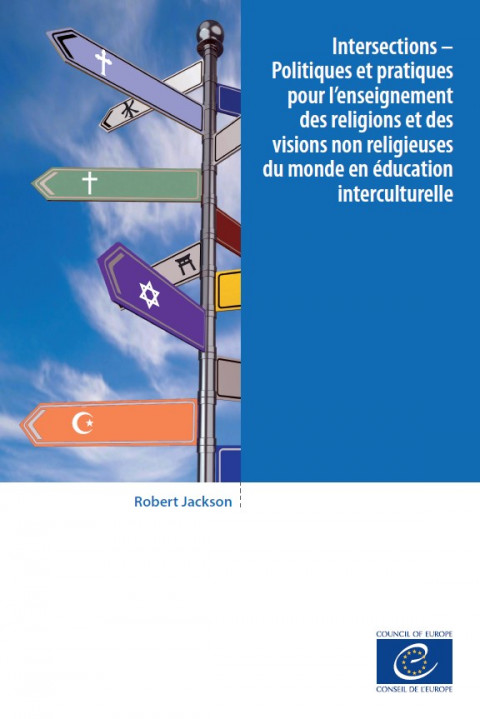 Intersections – Politiques et pratiques pour l’enseignement des religions et des visions non religieuses du monde en éducation interculturelle سنة النشر: 2015 المؤلف: Robert Jackson Que peut apporter l’étude des religions et des visions non religieuses du monde à l’éducation interculturelle des élèves européens ? Dans une importante recommandation, la Recommandation CM/Rec(2008)12 relative à la dimension des religions et des convictions non religieuses dans l’éducation interculturelle, le Comité des Ministres du Conseil de l’Europe explique la nature et les objectifs de cet enseignement.Intersections va beaucoup plus loin, car il s’agit ici d’aider les décideurs, les établissements scolaires (enseignants et équipe de direction) et les formateurs d’enseignants à relever au mieux les défis que soulève la recommandation. En tenant dûment compte de l’avis de responsables pédagogiques, d’enseignants et de formateurs d’enseignants des États membres du Conseil de l’Europe, Intersections fournit des conseils pour, par exemple, comprendre la terminologie employée dans cette forme d’enseignement; développer des compétences d’enseignement et d’apprentissage, et adopter différentes approches pédagogiques; créer en classe un « espace sécurisant » propice au dialogue entre élèves; aider les élèves à analyser les représentations des religions dans les médias; parler à la fois des visions non religieuses du monde et des points de vue religieux ; aborder les questions de religions et de convictions sous l’angle des droits de l’homme ; et tisser des liens entre établissements scolaires (de différents types) et entre l’école et son environnement.Intersections n’est ni un programme à suivre ni un manifeste politique. L’ouvrage vise à donner aux décideurs, aux établissements scolaires et aux formateurs d’enseignants des États membres du Conseil de l’Europe, ainsi qu’à toutes les personnes intéressées, les outils nécessaires pour résoudre les problèmes d’interprétation de la recommandation et adapter son message aux besoins propres à chaque pays. Intersections est le fruit du travail d’un groupe international d’experts réunis sous les auspices du Conseil de l’Europe et du Centre européen Wergeland. Il a été rédigé au nom du groupe par le professeur Robert Jackson.
  Interculturalité سنة النشر: 2018 المؤلف المؤسسي: Geotimoun Une valise pédagogique tout terrain pour partir à la découverte de soi et de l’autre Comment amener les enfants à enrichir leur vision de l’Autre ? Tel est l’objectif de notre valise pédagogique qui invite l’enfant à réfléchir pour lutter contre les stéréotypes traditionnellement véhiculés sur les populations du Sud et celles du Nord.La Valise Destinée aux enseignants et aux animateurs travaillant avec des jeunes entre 10 et 14 ans, cette valise pédagogique comprend divers outils et activités pour aborder les thèmes de l’identité, la multiculturalité, les droits de l’enfant, la philosophie à l’école et l’’apprentissage de la citoyenneté à l’école. Un carnet pédagogique vous guidera tout au long de vos projets.L’action Cette réflexion emmène l’enfant sur une route à six escales : Savoir qui je suis. Comprendre l’Autre. Me confronter à l’Autre pour m’amener à me poser des questions, à aiguiser ma curiosité et ma tolérance, à sortir de l’opinion toute faite et réfléchir à mes propres valeurs. Prendre connaissance des droits de l’homme et plus particulièrement des droits de l’enfant afin de les utiliser comme des outils fondateurs et garants de la dignité pour tous. Vivre à l’école une citoyenneté active et solidaire. Exercer mon Droit à la Participation en devenant acteur de changement.