
الموارد
استكشف مجموعة واسعة من الموارد القيمة حول تعليم المواطنة العالمية لتعميق فهمك وتعزيز البحث والمناصرة والتعليم والتعلم.
تم العثور على 3,451 نتيجة
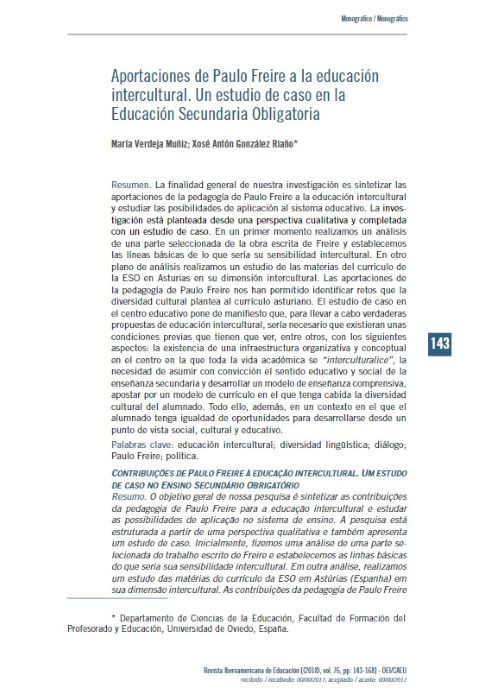 Aportaciones de Paulo Freire a la educación intercultural: Un estudio de caso en la Educación Secundaria Obligatoria (Revista Iberoamericana De Educación; vol.76) سنة النشر: 2018 المؤلف: Maria Verdeja Muniz | Xose Anton Gonzalez Riano La finalidad general de esta investigación es sintetizar las aportaciones de la pedagogía de Paulo Freire a la educación intercultural y estudiar las posibilidades de aplicación al sistema educativo. La investigación está planteada desde una perspectiva cualitativa y completada con un estudio de caso. En un primer momento se realizó un análisis de una parte seleccionada de la obra escrita de Freire y se establecen las líneas básicas de lo que sería su sensibilidad intercultural. En otro plano de análisis se realiza un estudio de las materias del currículo de la ESO en Asturias en su dimensión intercultural. El estudio de caso en el centro educativo pone de manifiesto que, para llevar a cabo verdaderas propuestas de educación intercultural, sería necesario que existieran unas condiciones previas que se describen en el artículo.
  Reaching Out to All Learners: A Resource Pack for Supporting Inclusion and Equity in Education سنة النشر: 2021 المؤلف المؤسسي: UNESCO International Bureau of Education (IBE) The Reaching Out to All Learners resource materials tackle the practicalities of addressing these challenges in schools and other education centres, including early years and further education provision. More specifically, the materials focus on three strategic questions:How can schools be developed in order to respond positively to student diversity?How can classroom practices be developed that will ensure that lessons are inclusive?How can practitioners engage families, partner schools and the wider community in their efforts to become inclusive and equitable? Llegando a todos los estudiantes: Una caja de recursos de la UNESCO-OIE para apoyar la inclusión y la equidad en la educación سنة النشر: 2021 المؤلف المؤسسي: UNESCO International Bureau of Education (IBE) El material de recursos LLEGANDO A TODOS LOS ESTUDIANTES aborda los aspectos prácticos de la solución a estos problemas. En concreto, estos recursos se centran en tres cuestiones estratégicas:¿Cómo pueden crecer las escuelas para responder positivamente a la diversidad de los estudiantes?¿Cómo pueden desarrollarse prácticas docentes en el aula que garanticen que las lecciones sean inclusivas?¿Cómo pueden las escuelas involucrar a las familias, a las escuelas asociadas y a la comunidad en general en sus esfuerzos por ser inclusivas y equitativas? Atteindre tous les apprenants: Outils pour soutenir l’inclusion et l’équité dans l’éducation سنة النشر: 2021 المؤلف المؤسسي: UNESCO International Bureau of Education (IBE) Les supports de référence du dossier ouvert Atteindre tous les apprenants abordent les aspects pratiques de la résolution de ces problèmes dans les écoles et autres centres d’éducation, et notamment dans l’enseignement préscolaire et supérieur. Ces supports se concentrent plus précisément sur trois questions stratégiques :Comment développer les écoles afin de s’adapter positivement à la diversité des élèves ?Comment développer des pratiques de classe qui garantissent que les cours sont inclusifs ?De quelle manière les écoles peuvent-elles impliquer les familles, les écoles partenaires et la communauté au sens large dans leurs efforts pour devenir inclusives et équitables ?
  Education for All Coalition: Toolkit سنة النشر: 2022 المؤلف المؤسسي: Education for All Coalition (EFAC) Education for All Coalition (EFAC), Inc. is a global organization that is dedicated to creating education opportunities and finding solutions that empower displaced and disadvantaged children in emergency situations, refugee camps and settlements around the world. We focus on advocacy, capacity building, climate education, and social-emotional learning to enhance the overall well-being of children. We promote the physical, social, and cognitive development of all children. Fostering healthy life habits and environmental sustainability are integral parts of our programs to improve conditions for all children so they can become thriving global citizens with global competencies and unlimited potentialThe goal of the “Where Friendship Blooms” resource guide is to foster a fun-filled program for early learners up to age 8 that will result in evidence-based positive outcomes. The package includes: Lesson plans Coping strategies Activities and play Breathing exercises Classroom Growth Chart Tool Classroom Climate Scale Tool Student Goal Setting Chart Measurement & Evaluation
 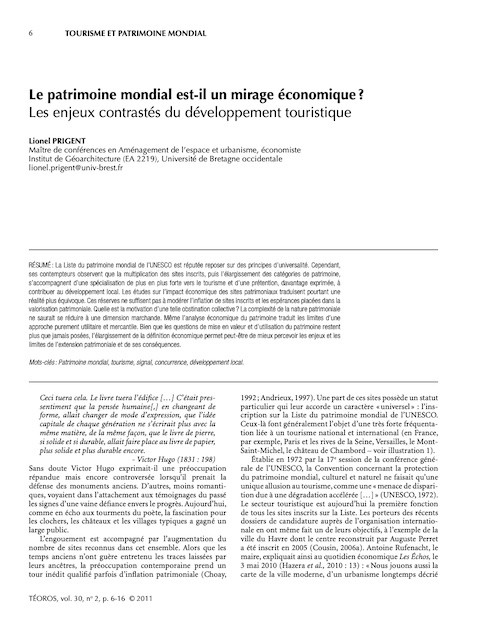 Is World Heritage an Economic Mirage? (Téoros; vol. 30, no. 2) سنة النشر: 2011 المؤلف: Lionel Prigent المؤلف المؤسسي: Université du Québec à Montréal (UQAM) The UNESCO World Heritage List is deemed to be based on principles of universality. However, its critics observe that the multiplication of listed sites, then the widening of heritage categories, is accompanied by an increasingly strong specialization towards tourism and a claim, more expressed, to contribute to local development. . Studies on the economic impact of heritage sites, however, reflect a more equivocal reality. These reserves are not enough to moderate the inflation of listed sites and the hopes placed in heritage enhancement. What is the motivation for such collective obstinacy? The complexity of the nature of heritage cannot be reduced to a commercial dimension. Even the economic analysis of heritage reflects the limits of a purely utilitarian and mercantile approach. Although the questions of enhancement and use of heritage remain more than ever raised, the broadening of the economic definition perhaps makes it possible to better understand the issues and the limits of the extension of heritage and its consequences. Le patrimoine mondial est-il un mirage économique? : Les enjeux contrastés du développement touristique (Téoros; vol. 30, no. 2) سنة النشر: 2011 المؤلف: Lionel Prigent المؤلف المؤسسي: Université du Québec à Montréal (UQAM) La Liste du patrimoine mondial de l’UNESCO est réputée reposer sur des principes d’universalité. Cependant, ses contempteurs observent que la multiplication des sites inscrits, puis l’élargissement des catégories de patrimoine, s’accompagnent d’une spécialisation de plus en plus forte vers le tourisme et d’une prétention, davantage exprimée, à contribuer au développement local. Les études sur l’impact économique des sites patrimoniaux traduisent pourtant une réalité plus équivoque. Ces réserves ne suffisent pas à modérer l’inflation de sites inscrits et les espérances placées dans la valorisation patrimoniale. Quelle est la motivation d’une telle obstination collective ? La complexité de la nature patrimoniale ne saurait se réduire à une dimension marchande. Même l’analyse économique du patrimoine traduit les limites d’une approche purement utilitaire et mercantile. Bien que les questions de mise en valeur et d’utilisation du patrimoine restent plus que jamais posées, l’élargissement de la définition économique permet peut-être de mieux percevoir les enjeux et les limites de l’extension patrimoniale et de ses conséquences.
 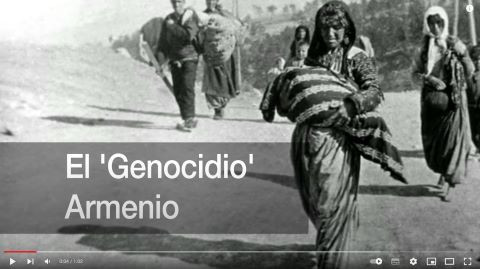 What is the Armenian "Genocide"? سنة النشر: 2015 المؤلف المؤسسي: BBC News World This video recounts how tens of thousands of Armenians died when the rulers of the then Ottoman Turkish Empire deported them en masse from the eastern Anatolia region to the Syrian desert and elsewhere in 1915-16. The Armenians were described as collaborators with Russia, a country that was facing the Ottomans in the Caucasus region. The total number of victims is in dispute. ¿Qué es el genocidio Armenio? سنة النشر: 2015 المؤلف المؤسسي: BBC News World En este video se narra cómo decenas de miles de armenios murieron cuando los responsables del entonces Imperio Turco Otomano los deportaron en masa desde la región de Anatolia oriental hacia el desierto de Siria y otras partes, entre 1915-16. Los armenios fueron calificados como colaboradores de Rusia, país que enfrentaba a los otomanos en la región del Cáucaso. El número total de víctimas está en discusión.
  Presentation: Sustainable Development and Higher Education in a Global World (Revista Iberoamericana De Educación; vol.73) سنة النشر: 2017 We cannot define the world of the 21st century without referring to it as globalized. Consequently, sustainable development and higher education are obliged to interact sustainably in their educational, research and social transfer dimensions. This document presents a monograph on the RIE in which the theory and practice of these concepts are addressed in a multidimensional way in different scenarios of the exercise. The works that are shown are of a high research quality, whose point of union is the inclusive approach and attention to the diversity of human beings as actors, no longer local, but planetary in the teaching and learning processes.