
الموارد
استكشف مجموعة واسعة من الموارد القيمة حول تعليم المواطنة العالمية لتعميق فهمك وتعزيز البحث والمناصرة والتعليم والتعلم.
تم العثور على 97 نتيجة
 Annual Report 2018 : UNESCO INSTITUTE FOR LIFELONG LEARNING سنة النشر: 2019 المؤلف المؤسسي: UNESCO Institute for Lifelong Learning (UIL) UIL’s 2018 Annual Report shows how, last year, our work contributed to fulfilling our mission to support better policy-making and strengthen the capacities of UNESCO Member States in the field of lifelong learning. UIL’s vision is for all children, youth and adults to benefit from quality lifelong learning, within the framework of sustainable development and peace, and we pursue it in the context of the United Nations 2030 Agenda for Sustainable Development, particularly Sustainable Development Goal (SDG) 4 on quality education and lifelong learning. Its publications are a valuable resource for education researchers, planners, policy-makers and practitioners.
  Optimising learning, education and publishing in Africa: the language factor; a review and analysis of theory and practice in mother-tongue and bilingual education in sub-Saharan Africa سنة النشر: 2011 المؤلف: Adama Ouane | Christine Glanz المؤلف المؤسسي: UNESCO Institute for Lifelong Learning (UIL) | Association for the Development of Education in Africa (ADEA) This analytical review consists of three sections. The first section lays the theoretical foundations and is covered by Ekkehard Wolff and Kathleen Heugh: 1) language politics and planning in the light of development and 2) theories of bi- and multilingual education models and their implementation in the African context. A second section analyses teaching practices and classroom interaction in schools in two chapters by Birgit Brock-Utne and Hassana Alidou. This is followed by a review of the use of African languages in literacy and non-formal education by Hassana Alidou1 . Next, a review study by Kathleen Heugh addresses the critical issue of costs by assessing the costs related to implementing mother tongue and strong bilingual education programmes. Finally, the third section explores the role of locally-based multilingual publishing in supporting and promoting African languages and developing the language industries and the creative sector. Here, Yaya Satina Diallo from Guinea and Peter Reiner2 from Namibia shed light on the promise and pitfalls of publishing in African languages.Each of these sections focuses on theoretical frameworks and specific strategies designed to optimise learning and education in multilingual Africa. The language issue is dealt with at the levels of: policy and development; costing and financing; educational reform and governance; education models; classroom interaction; formal and non-formal education settings; literacy and publishing. Optimiser l'apprentissage, l'éducation et l'édition en Afrique: le facteur langue; étude bilan sur la théorie et la pratique de l'enseignement en langue maternelle et l'éducation bilingue en Afrique subsaharienne سنة النشر: 2011 المؤلف: Adama Ouane | Christine Glanz المؤلف المؤسسي: UNESCO Institute for Lifelong Learning (UIL) | Association for the Development of Education in Africa (ADEA) This analytical review consists of three sections. The first section lays the theoretical foundations and is covered by Ekkehard Wolff and Kathleen Heugh: 1) language politics and planning in the light of development and 2) theories of bi- and multilingual education models and their implementation in the African context. A second section analyses teaching practices and classroom interaction in schools in two chapters by Birgit Brock-Utne and Hassana Alidou. This is followed by a review of the use of African languages in literacy and non-formal education by Hassana Alidou1 . Next, a review study by Kathleen Heugh addresses the critical issue of costs by assessing the costs related to implementing mother tongue and strong bilingual education programmes. Finally, the third section explores the role of locally-based multilingual publishing in supporting and promoting African languages and developing the language industries and the creative sector. Here, Yaya Satina Diallo from Guinea and Peter Reiner2 from Namibia shed light on the promise and pitfalls of publishing in African languages.Each of these sections focuses on theoretical frameworks and specific strategies designed to optimise learning and education in multilingual Africa. The language issue is dealt with at the levels of: policy and development; costing and financing; educational reform and governance; education models; classroom interaction; formal and non-formal education settings; literacy and publishing.
 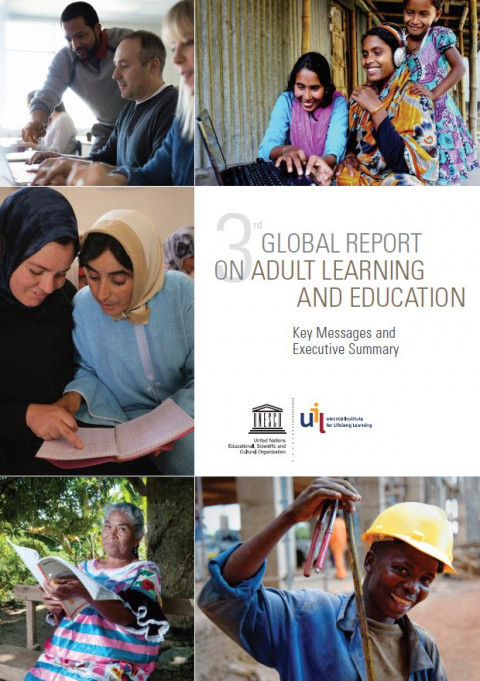 [Summary] 3rd Global Report on Adult Learning and Education: The Impact of Adult Learning and Education on Health and Well-being, Employment and the Labour Market, and Social, Civic and Community Life; Key Messages and Executive Summary سنة النشر: 2016 المؤلف المؤسسي: UNESCO Institute for Lifelong Learning (UIL) The third Global Report on Adult Learning and Education (GRALE III) draws on monitoring surveys completed by 139 UNESCO Member States to develop a differentiated picture of the global state of adult learning and education (ALE). It evaluates countries’ progress in fulfilling the commitments they made in the Belém Framework for Action, which was adopted at the Sixth International Conference on Adult Education (CONFINTEA VI) in 2009.In addition, the report examines the impact of ALE on three major areas: health and well-being; employment and the labour market; and social, civic and community life. GRALE III provides policymakers, researchers and practitioners with compelling evidence for the wider benefits of ALE across all of these areas. In so doing, it highlights some of the major contributions that ALE can make to realizing the 2030 Agenda for Sustainable Development. This report is guided by three goals: first, to analyse the results of a monitoring survey of UNESCO Member States, and to take stock of whether countries are fulfilling the commitments they made at CONFINTEA VI; second, to strengthen the case for adult learning and education with evidence of its benefits on health and well-being,employment and the labour market, and social, civic and community life; and third, to provide a platform for debate and action at national, regional and global levels. [Résumé] 3e rapport mondial sur l'apprentissage et l'éducation des adultes: l'impact de l'apprentissage et l'éducation des adultes sur la santé et le bien-être, l'emploi et le marché du travail, et la vie sociale, civique et communautaire, points à retenir et résumé exécutif سنة النشر: 2016 المؤلف المؤسسي: UNESCO Institute for Lifelong Learning (UIL) Le troisième Rapport mondial sur l’apprentissage et l’éducation des adultes (GRALE III) s’appuie sur les réponses de 139 Etats membres de l’UNESCO à l’enquête de suivi GRALE III et brosse un tableau nuancé de la situation de l’apprentissage et de l’éducation des adultes dans le monde. Le rapport évalue les progrès accomplis par les pays dans la mise en oeuvre des engagements qu’ils ont pris dans le Cadre d’action de Belém, document adopté lors de la sixième Conférence internationale sur l’éducation des adultes (CONFINTEA VI) en 2009.En outre, le rapport examine l’impact de l’apprentissage et de l’éducation des adultes sur trois domaines majeurs : la santé et le bien-être ; l’emploi et le marché du travail ; et la vie sociale, civique et communautaire. GRALE III fournit aux décideurs politiques, chercheurs et praticiens des preuves irréfutables des bénéfices élargis de l’apprentissage et l’éducation des adultes dans tous ces domaines et éclaire, de ce fait, les contributions essentielles qu’ils peuvent apporter à la réalisation du Programme de développement durable à l’horizon 2030.Ce rapport répond à trois objectifs : premièrement, analyser les résultats d’un suivi des États membres de l’UNESCO et établir si les pays remplissent les engagements pris à CONFINTEA VI ; deuxièmement, promouvoir l’apprentissage et l’éducation des adultes par des preuves de leurs effets positifs sur la santé et le bien-être, l’emploi et le marché du travail, ainsi que la vie sociale, civique et communautaire ; et troisièmement fournir une plate-forme de débat et d’action aux niveaux national, régional et international. [Resumen] 3do Informe mundial sobre el aprendizaje y la educación de adultos: el impacto del aprendizaje y la educación de adultos sobre la salud y el bienestar, el empleo y el mercado de trabajo, y la vida social, cívica y comunitaria, mensajes clave y resumen ejecutivo سنة النشر: 2016 المؤلف المؤسسي: UNESCO Institute for Lifelong Learning (UIL) El tercer Informe mundial sobre el aprendizaje y la educación de adultos (GRALE III) se funda en los estudios de monitoreo completados por 139 Estados Miembros de la UNESCO a fin de producir una visión diferenciada sobre el estado global del aprendizaje y la educación de adultos (AEA). Evalúa el progreso de los países en lo que respecta al cumplimiento de los compromisos que hicieron en el Marco de acción de Bélem, aprobado en la VI Conferencia Internacional de Educación de Adultos (CONFINTEA VI) en 2009.Además, el informe examina el impacto del AEA en tres áreas importantes: salud y bienestar; empleo y mercado de trabajo, así como vida cívica y comunitaria. El GRALE III brinda a los responsables de la formulación de política, investigadores y practicantes pruebas convincentes de los más amplios beneficio del AEA en todas estas áreas. Al hacerlo, destaca algunas de las contribuciones más importantes que el AEA puede hacer para realizar los objetivos de la Agenda 2030 para el Desarrollo Sostenible.El presente informe responde a tres objetivos: en primer lugar, analizar los resultados de una encuesta de seguimiento realizada entre los Estados Miembros de la UNESCO y determinar si los países están cumpliendo los compromisos que contrajeron en CONFINTEA VI; en segundo lugar, reforzar los argumentos en favor del aprendizaje y la educación de adultos con datos fehacientes sobre los beneficios que reportan en los ámbitos de la salud y el bienestar, el empleo y el mercado de trabajo y la vida social, cívica y comunitaria; y en tercer lugar, proporcionar un referente a partir del cual debatir y pasar a la acción a escala nacional, regional e internacional.
  Curriculum GlobALE: Competency Framework for Adult Educators سنة النشر: 2021 المؤلف المؤسسي: DVV International | German Institute for Adult Education, Leibniz Centre for Lifelong Learning | International Council for Adult Education | UNESCO Institute for Lifelong Learning (UIL) This publication introduces Curriculum globALE, a basic com- petence framework for the training of adult educators worldwide. By providing a modular, competency-based framework and cross-curricular approach, Curriculum globALE is unique in its aim to professionalize adult learning and education (ALE) on an international scale, via the competencies that support adult educators to work in any educational setting, field or form.It strives to ensure that educators’ knowledge, competencies, skills and attitudes are of a professional standard.Curriculum globALE is suitable to different contexts and its character and structure enables its inclusion in diverse national education systems.Curriculum globALE aims to: enhance the professionalization of ALE by providing a common reference framework for adult learning programmes and a suggested standard of competencies for adult educators; support ALE providers in the design and implementation of ‘train-the-trainer’programmes; foster knowledge exchange and mutual understanding between adult educators worldwide. Curriculum GlobALE: Un curriculum mondial sur l’apprentissage et l’éducation des adultes سنة النشر: 2021 المؤلف المؤسسي: DVV International | German Institute for Adult Education, Leibniz Centre for Lifelong Learning | International Council for Adult Education | Institut de l’UNESCO pour l’apprentissage tout au long de la vie (UIL) Cette publication présente Curriculum globALE, un cadre de compétences de base pour la formation des éducateurs d'adultes dans le monde. En fournissant un cadre modulaire basé sur les compétences et une approche interdisciplinaire, Curriculum globALE est unique dans son objectif de professionnaliser l'apprentissage et l'éducation des adultes (ALE) à l'échelle internationale, via les compétences qui aident les éducateurs d'adultes à travailler dans n'importe quel cadre éducatif, champ ou formulaire. Il s'efforce de veiller à ce que les connaissances, les compétences, les aptitudes et les attitudes des éducateurs soient d'un niveau professionnel. Curriculum globALE est adapté à différents contextes et son caractère et sa structure permettent son inclusion dans divers systèmes éducatifs nationaux. Curriculum globALE vise à : améliorer la professionnalisation de l'AEA en fournissant un cadre de référence commun pour les programmes d'apprentissage des adultes et une proposition de norme de compétences pour les éducateurs d'adultes soutenir les prestataires d'AEA dans la conception et la mise en œuvre de programmes de « formation des formateurs » favoriser l'échange de connaissances et la compréhension mutuelle entre les éducateurs d'adultes du monde entier.
  Learning Cities and the SDGs: A Guide to Action سنة النشر: 2017 المؤلف المؤسسي: UNESCO Institute for Lifelong Learning (UIL) This document is a Guide to Action for mainstreaming lifelong learning as a key driver to achieve the 17 Sustainable Development Goals (SDGs). The document seeks to facilitate the process of transforming global goals into local actions by showing concrete steps, which members of the UNESCO Global Network of Learning Cities (GNLC) have taken to promote green and healthy environments, equity and inclusion as well as decent work and entrepreneurship. This Guide to Action is closely linked to the Cork Call to Action for Learning Cities, adopted by the participants of the third International Conference on Learning Cities, which took place from 18–20 September 2017 in Cork, Ireland. Обучающиеся города и ЦУР: Руководство к действию سنة النشر: 2017 المؤلف المؤسسي: UNESCO Institute for Lifelong Learning (UIL) Документ «Обучающиеся города и ЦУР» является руководством к повсеместному внедрению обучения на протяжении всей жизни в качестве одного из основных факторов достижения 17 целей в области устойчивого развития (ЦУР). Данный документ призван содействовать преобразованию этих глобальных целей в практические действия на местном уровне путем демонстрации конкретных мер, принятых членами Глобальной сети обучающихся городов ЮНЕСКО (ГСОГ) для поддержки формирования «зеленой» и здоровой среды, обеспечения равноправия и социальной интеграции, а также создания возможностей для получения достойной работы и предпринимательской деятельности. Данное руководство к действию тесно связано с Коркским призывом к действиям в интересах создания обучающихся городов, принятым участниками третьей Международной конференции по обучающимся городам, которая прошла 18-20 сентября 2017 года в Корке (Ирландия).