
الموارد
استكشف مجموعة واسعة من الموارد القيمة حول تعليم المواطنة العالمية لتعميق فهمك وتعزيز البحث والمناصرة والتعليم والتعلم.
تم العثور على 2,781 نتيجة
 Inclusive Education سنة النشر: 2008 المؤلف المؤسسي: UNESCO International Bureau of Education (IBE) Inclusive education: the road to the future is the subject of the forty-eighth meeting of the International Conference on Education (CIE) to be held in Geneva from November 25 to 28, 2008. I believe that a genuine dialogue and a frank debate between Ministers and other education actors on this central theme and on the four related sub-themes: approaches, scope and content; public politics; systems, interfaces and transitions, and students and teachers, will be both timely and appropriate.
  VII Days of Educational Corperation with Iberian America on Special Education and Educational Inclusion: Secondary Education سنة النشر: 2011 المؤلف: Daniela Eroles المؤلف المؤسسي: UNESCO Santiago | Spain. Ministry of Education The publication that we deliver contains some of the main papers and reflections emanating from the VII Conference on Educational Cooperation with Ibero-America on Special Education and Educational Inclusion, organized by the Ministry of Education of Spain and the Regional Office of Education for Latin America and the Caribbean ( OREALC / UNESCO Santiago). This publication has the inclusion in secondary education as a central theme, since it was the axis of the VII Conference. It is a particularly critical issue in our region since it establishes the minimum level necessary to escape poverty, to access decent employment and to exercise citizenship. However, access to secondary education is still very low in some countries and is especially low in the case of the most vulnerable populations, being those who most require access to this level of studies to overcome their situation of inequality. VII Jornadas de Cooperación Educativa con Iberoamérica sobre Educación Especial e Inclusión Educativa: Educación Secundaria سنة النشر: 2011 المؤلف: Daniela Eroles المؤلف المؤسسي: UNESCO Santiago | Spain. Ministry of Education La publicación que entregamos contiene algunas de las principales ponencias y reflexiones emanadas de las VII Jornadas de Cooperación Educativa con Iberoamérica sobre Educación Especial e Inclusión Educativa, organizadas por el Ministerio de Educación de España y la Oficina Regional de Educación para América Latina y el Caribe (OREAL C/UNESCO Santiago). Esta publicación tiene a la inclusión en la educación secundaria como tema central, pues constituyó el eje de las VII Jornadas. Es un tema especialmente crítico en nuestra región ya que establece el nivel mínimo necesario para salir de la pobreza, para acceder a un empleo digno y para ejercer la ciudadanía. Sin embargo, el acceso a la educación secundaria todavía es muy bajo en algunos países y es especialmente bajo en el caso de las poblaciones en situación de mayor vulnerabilidad, siendo quienes más requieren acceder a este nivel de estudios para superar su situación de desigualdad. Educación Inclusiva سنة النشر: 2008 المؤلف المؤسسي: UNESCO International Bureau of Education (IBE) La educación inclusiva: el camino hacia el futuro es el tema de la cuadragésimo octava reunión de la Conferencia Internacional de Educación (CIE) que tendrá lugar en Ginebra del 25 al 28 de noviembre de 2008. Creo que un genuino diálogo y un franco debate entre los ministros y otros actores de la educación sobre este tema central y sobre los cuatro subtemas relacionados: enfoques, alcance y contenido; políticas públicas; sistemas, interfaces y transiciones, y alumnos y docentes, resultarán a la vez oportunos y apropiados. Education pour l'inclusion سنة النشر: 2008 المؤلف المؤسسي: UNESCO International Bureau of Education (IBE) L’auteur présente ce numéro spécial qui offre une sélection d’articles alliant recherche théorique et pratique sur la notion de l’éducation pour l’inclusion et sur les problèmes rencontrés dans l’élaboration de politiques et leur application pratique. Ces articles reflètent les approches diversifiées et à volets multiples de l’inclusion, eu égard aux aspects théoriques, disciplinaires et méthodologiques. Tout au long de ce numéro, l’inclusion est le principe de base qui oriente l’Éducation pour tous (EPT) de qualité —- c’est-à-dire, l’établissement de systèmes éducatifs tirant profit de la diversité et visant à édifier une société plus juste et plus démocratique.Ce numéro spécial est consacré au thème de la quarante-huitième session de la Conférence internationale de l’éducation (CIE) « L’éducation pour l’inclusion : la voie de l’avenir » (Genève, 25-28 novembre 2008).
  Jugendliche aus Einwandererfamilien und die Geschichte des Nationalsozialismus سنة النشر: 2003 المؤلف: V. B. Georgi Based on 55 interviews with young Germans with immigrant family background from the age of 15–20, Giorgi constructs a typology of how they position themesleves to the German Nazi past.
 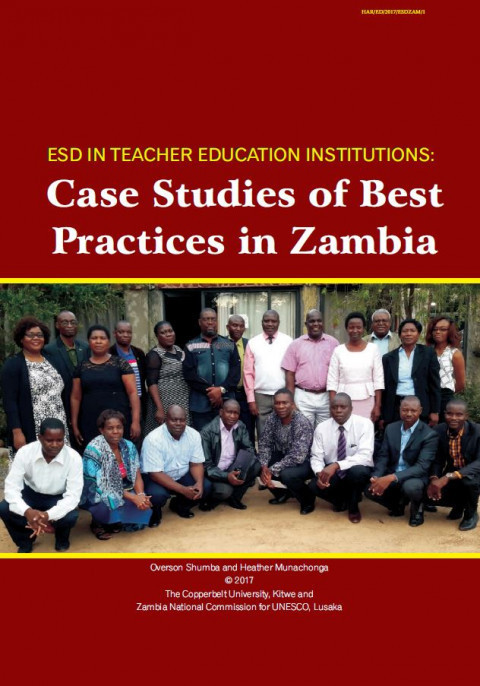 ESD in Teacher Education Institutions: Case Studies of Best Practices in Zambia سنة النشر: 2017 المؤلف: Overson Shumba | Heather Munachonga المؤلف المؤسسي: Zambia National Commission for UNESCO | Copperbelt University This book is a compilation of case studies on best practices in education for sustainable development in teacher education institutions in Zambia. It contributes to the dissemination of the best practices among the institutions and the wider society. It adds to examples of practices that are relevant to the UNESCO Global Action Programme on Education for Sustainable Development (GAP). The project was coordinated by Professor Overson Shumba at the Copperbelt university in Kitwe and Heather Munachonga, Programme Officer at the Zambia National Commission for UNESCO in Lusaka. The book was made possible with funding and support from UNESCO, Paris, the Ministry of General Education, the Copperbelt University, and the Zambia National Commission for UNESCO. All the institutions were supported by the teacher education institutions and their partners. The book illustrates some of the actions undertaken consistent with pursuit of the education SDG4 target 7. It is expected that this book will lead teacher educators and teachers to come up with further innovations and to integrate them in their professional work. Whole institution actions are encouraged so that best practices as found in this book can permeate and transform all aspects of the institution: the curriculum, teaching, assessment, research, extra-curricular activities, and operations, and must involve everyone, students, workers, lecturers, and the surrounding community.
 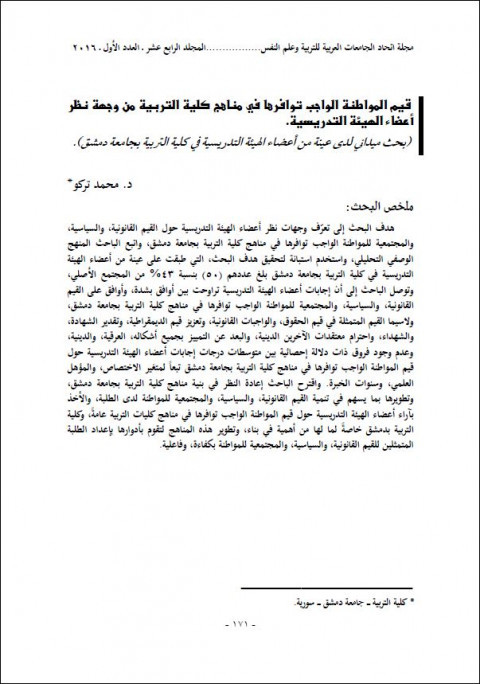 قيم المواطنة الواجب توافرها في مناهج كلية التربية من وجهة نظر أعضاء الهيئة التدريسية : بحث ميداني لدى عينة من أعضاء الهيئة التدريسية في كلية التربية بجامعة دمشق سنة النشر: 2016 المؤلف: Mohammad Turko المؤلف المؤسسي: Damascus University. Faculty of Education هدف البحث إلى التعرف إلى وجهات نظر أعضاء الهيئة التدريسية حول القيم القانونية والسياسية والمجتمعية للمواطمة الواجب توافرها في مناهج كلية التربية بجامعة دمشق. اتبع الباحث المنهج الوصفي التحليلي، واستخدم استبانة... طبقت على عينة من أعضاء هيئة التدريس...عددهم 50 بنسبة 43% من المجتمع الأصلي. توصل الباحث إلى أن الإجابات ترواحت بين أوافق بشدة ، وأوافق على القيم القانونية والسياسية والمجتمعية الواجب توافرها...ولا سيما القيم المتمثلة في قيم الحقوق، والواجبات القانونية، وتعزيز قيم الديمقراطية، وتقدير الشهاداة، والشهداء، واحترام معتقدات الآخرين الدينية، والبعد عن التمييز بجميع أشكاله العرقية، والدينية، وعدم وجود فروق ذات دلالة إحصائية بين متوسطات درجات الإجابات...تبعا لمتغير الاختصاص، والمؤهل العلمي، وسنوات الخبرة. اقترح الباحث إعادة النظر في بنية مناهج كلية التربية...وتطويرها بما يسهم في تنمية القيم القانونية، والسياسية، والمجتمعية للمواطنة لدى الطلبة والأخذ بآراء أعضاء الهيئة التدريسية حول قيم المواطنة الواجب توافرها في مناهج كليات التربية عامةً... لما لها من أهمية في بناء، وتطوير هذه المناهج لتقوم بأدوارها بإعداد الطلبة المتمثلين للقيم القانونية، والسياسية، والمجتمعية للمواطنة بكفاءة، وفاعلية. The Citizenship Values That Should Be Available in the Curricula of Faculty of Education from the Academic Staff Viewpoint : A Field Study on a Sample from the Academic Staff in Faculty of Education at Damascus University سنة النشر: 2016 المؤلف: Mohammad Turko المؤلف المؤسسي: Damascus University. Faculty of Education This study aimed at at identifying the views of the teaching staff regarding the legal, political, and the community values of citizenship that must to be available in the curriculla of the Education Faculty at Damascus University. The researcher used the anaalytical method and a questionnaire that was applied to a sample of 50 teachers making 43% of the original community.The responses varied between 'I strongly agree' and 'I agree to legal, political, and the community values of citizenship that must be available'...especially values of rights and legal obligations and social values of citizenship that must be available, promoting democratic values, valuing martyrdom and martyrs, respecting the religous beliefs of others and staying away from racial and religous discrimation. There were no differences of statistical significance between the mean degrees of responses as per the variables of specializatiop, scientific degrees or years of experience. the researcher suggested that the curriclla of the Education Faculty be rewied and developed in order for them to contribute to the development of the legal, political and social values of citizenship among students, and that the views of the teaching staff are taken into consideration regarding the citizenship values that must be available in order for them to prepare the students to assimilate the values efficiently and effectively.
 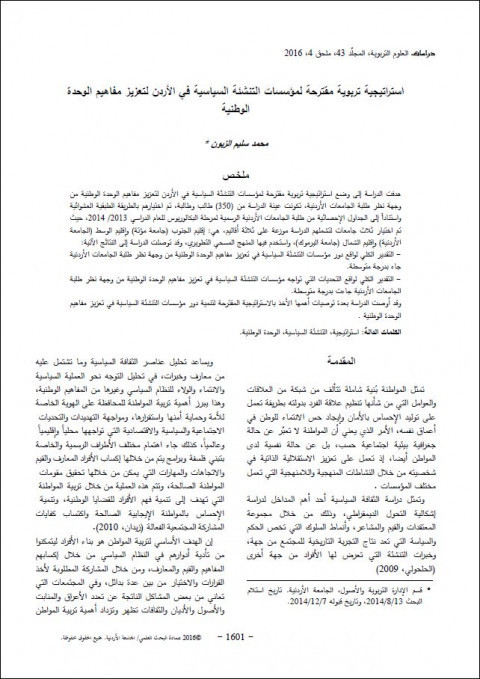 إستراتيجية تربوية مقترحة لمؤسسات التنشئة السياسية في الأردن لتعزيز مفاهيم الوحدة الوطنية سنة النشر: 2016 المؤلف المؤسسي: University of Jordan هدفت الدراسة إلى وضع استراتيجية تربوية مقترحة لمؤسسات التنشئة السياسية في الأردن لتعزيز مفاهيم الوحدة الوطنية من وجهة نظر طلبة الجامعات الأردنية. تكونت عينة الدراسة من (350) طالب وطالبة، تم اختيارهم بالطريقة الطبقية العشوائية من طلبة الجامعات الأردنية الرسمية لمرحلة البكالوريوس للعام الدراسي 2013 /2014 ...تم اختيار ثلاث جامعات لتشملهم الدراسة موزعة على ثلاثة أقاليم، هي: إقليم الجنوب (جامعة مؤتة) والوسط (الجامعة الأردنية) والشمال (جامعة اليرموك)، واستخدم فيها المنهج المسحي التطويري. وقد توصلت الدراسة إلى النتائج الآتية: - التقدير الكلي لواقع دور مؤسسات التنشئة السياسية في تعزيز مفاهيم الوحدة الوطنية من وجهة نظر طلبة الجامعات الأردنية جاء بدرجة متوسطة. - التقدير الكلي لواقع التحديات التي تواجه مؤسسات التنشئة السياسية في تعزيز مفاهيم الوحدة الوطنية من وجهة نظر طلبة الجامعات الأردنية جاءت بدرجة متوسطة. وقد أوصت الدراسة بعدة توصيات أهمها الأخذ بالاستراتيجية المقترحة لتنمية دور مؤسسات التنشئة السياسية في تعزيز مفاهيم الوحدة الوطنية .