
الموارد
استكشف مجموعة واسعة من الموارد القيمة حول تعليم المواطنة العالمية لتعميق فهمك وتعزيز البحث والمناصرة والتعليم والتعلم.
تم العثور على 3,451 نتيجة
 Youth Declarations on Transforming Education سنة النشر: 2022 المؤلف المؤسسي: United Nations (UN) The Youth Declaration on Transforming Education has been launched. It is a document prepared by young people from all over the world and was presented to the UN Secretary-General on Friday.This declaration is the input of the youth to the Transforming Education Summit 2022. It highlights young people’s collective commitment to transforming education. Declaración de la juventud sobre la transformación de la educación سنة النشر: 2022 المؤلف المؤسسي: United Nations (UN) Se ha lanzado la Declaración de la Juventud sobre la Transformación de la Educación. Es un documento elaborado por jóvenes de todo el mundo y fue presentado el viernes al Secretario General de la ONU.Esta declaración es el aporte de los jóvenes a la Cumbre de Transformación de la Educación 2022. Destaca el compromiso colectivo de los jóvenes con la transformación de la educación. Déclarations de la jeunesse sur la transformation de l'éducation سنة النشر: 2022 المؤلف المؤسسي: United Nations (UN) La Déclaration des jeunes sur la transformation de l'éducation a été lancée. Il s'agit d'un document préparé par des jeunes du monde entier et présenté vendredi au Secrétaire général de l'ONU.Cette déclaration est la contribution des jeunes au Sommet Transformer l'éducation 2022. Elle souligne l'engagement collectif des jeunes à transformer l'éducation. Декларация молодежи о трансформации образования سنة النشر: 2022 المؤلف المؤسسي: United Nations (UN) Принята Молодежная декларация о преобразовании образования. Это документ, подготовленный молодыми людьми со всего мира и представленный в пятницу Генеральному секретарю ООН.Эта декларация представляет собой вклад молодежи в Саммит по преобразованию образования 2022 года. В нем подчеркивается коллективная приверженность молодых людей преобразованию образования. 教育变革青年宣言 سنة النشر: 2022 المؤلف المؤسسي: United Nations (UN) 《关于教育转型的青年宣言》已经发布。 这是一份由来自世界各地的年轻人准备的文件,并于周五提交给联合国秘书长。该宣言是青年对 2022 年转型教育峰会的投入。它突出了年轻人对转型教育的集体承诺。
 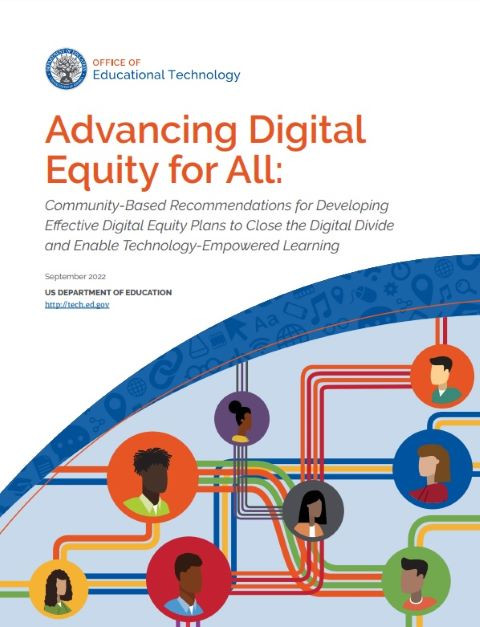 Advancing Digital Equity for All: Community-Based Recommendations for Developing Effective Digital Equity Plans to Close the Digital Divide and Enable Technology-Empowered Learning سنة النشر: 2022 المؤلف المؤسسي: USA. Department of Education. Office of Educational Technology In spring 2022, the U.S. Department of Education’s Office of Educational Technology (OET) committed to advancing digital equity through the Digital Equity Education Roundtables (DEER) Initiative. Through DEER, OET hosted a series of national conversations with leaders from community-based organizations, as well as families and learners furthest from digital opportunities. The “Advancing Digital Equity for All” resource illuminates insights from these conversation to highlight the barriers faced by learner communities and promising solutions for increasing access to technology for learning.The historic federal investments authorized by the Infrastructure Investment and Jobs Act offer critical opportunities for broadband planning that can identify and equitably address the various availability, affordability, and adoption challenges described. Using this guidance resource as a starting point, it is essential that leaders collaborate with those most impacted by the digital divide to develop comprehensive digital equity plans that outline strategies to meet the needs of learners, their families/caregivers, and communities effectively and sustainably.
  Interculturality of Disability Situations: From Designation to Recognition سنة النشر: 2021 المؤلف: Geneviève Piérart | Mélissa Arneton المؤلف المؤسسي: Alterstice Alterstice has been offering, for ten years, a unique space for scientific production responding to socially acute questions related to the consideration of inter-individual, social, and societal diversity. This thematic issue is linked to the creation in 2017 of a thematic axis within the International Association for Intercultural Research (ARIC). This network has enabled researchers to organize symposia questioning disability, intersectionality, and how the work carried out in more mainstream currents take into account or not the intercultural dimension to study the paradigm shift of disability. Fifteen years after the launch of the International Convention on the Rights of Persons with Disabilities (CRPD) marks a societal desire to renew living together at the international level as well as at the national level for the countries that have ratified it, as revealed by the work scientific studies carried out from an intercultural perspective. After an introduction to the notions of disability and interculturality, which also refer to designation processes, which may or may not be crossed and compared in scientific analysis. From a multidisciplinary perspective, different angles relating to the diversity of representations of disability and the issues it raises in situations of contact between cultures are discussed. Interculturalité des situations de handicap: De la désignation à la reconnaissance سنة النشر: 2021 المؤلف: Geneviève Piérart | Mélissa Arneton المؤلف المؤسسي: Alterstice Alterstice propose depuis dix ans un espace unique de production scientifique répondant à des questions socialement aiguës liées à la prise en compte de la diversité interindividuelle, sociale et sociétale. Ce numéro thématique est lié à la création en 2017 d'un axe thématique au sein de l'Association internationale pour la recherche interculturelle (ARIC). Ce réseau a permis aux chercheurs d'organiser des colloques questionnant le handicap, l'intersectionnalité, et comment les travaux menés dans des courants plus mainstream prennent en compte ou non la dimension interculturelle pour étudier le changement de paradigme du handicap. Quinze ans après le lancement de la Convention Internationale des Droits des Personnes Handicapées (CDPH) marque une volonté sociétale de renouveler le vivre ensemble au niveau international comme au niveau national pour les pays qui l'ont ratifiée, comme le révèle la travaux d'études scientifiques menées dans une perspective interculturelle. Après une introduction aux notions de handicap et d'interculturalité, qui renvoient également à des processus de désignation, qui peuvent ou non être croisés et comparés dans l'analyse scientifique. Dans une perspective pluridisciplinaire, différents angles relatifs à la diversité des représentations du handicap et aux enjeux qu'il soulève dans les situations de contact entre cultures sont abordés.
  The Genesis of the Category of “LGBT Refugee” Within the United Nations High Commissioner for Refugees سنة النشر: 2021 المؤلف: Ahmed Hamila المؤلف المؤسسي: Alterstice The international protection system is governed by the Geneva Convention of 1951, supplemented by the New York Protocol of 1967. These international conventions list five grounds for granting refugee status: persecution based on race, religion, nationality, membership of a certain social group, and political opinions. These international instruments do not explicitly recognize persecution based on sexual orientation and gender identity as grounds for granting refugee status. However, over the past three decades, the Office of the United Nations High Commissioner for Refugees (UNHCR) has come to recognize such persecution as grounds for granting international protection. In this article, I focus on the genesis of the "LGBT refugee" category within the UNHCR in the early 2000s. The essay argue that the emergence of this new category of refugees is part of two parallel dynamics, which both led to the development of the UNHCR Guidelines, which explicitly recognize persecution based on sexual orientation as a ground for granting refugee status. On the one hand, it is in the context of greater attention paid to refugee women, and in particular to gender-related persecutions, that persecutions related to sexual orientation are for the first time discussed. On the other hand, the category of “LGBT refugee” also appears in the context of the interpretation of the notion of “belonging to a certain social group”. La genèse de la catégorie de « réfugié LGBT » au sein du Haut-Commissariat des Nations Unies pour les réfugiés سنة النشر: 2021 المؤلف: Ahmed Hamila المؤلف المؤسسي: Alterstice Le système de protection international est régi par la Convention de Genève de 1951, complétée par le Protocole de New York de 1967. Ces conventions internationales énumèrent cinq motifs d’octroi du statut de réfugié : les persécutions du fait de la race, de la religion, de la nationalité, de l’appartenance à un certain groupe social et des opinions politiques. Ces instruments internationaux ne reconnaissent pas explicitement les persécutions du fait de l’orientation sexuelle et de l’identité de genre en tant que motifs d’octroi du statut de réfugié. Cependant, au cours des trois dernières décennies, le Haut-Commissariat des Nations Unies pour les réfugiés (HCR) a été amené à reconnaître ces persécutions en tant que motifs d’octroi de la protection internationale. Dans cet article, je m’intéresse à la genèse de la catégorie de « réfugié LGBT » au sein du HCR au début des années 2000. Je soutiens que l’émergence de cette nouvelle catégorie de réfugiés s’inscrit dans deux dynamiques parallèles, qui ont toutes les deux débouché sur l’élaboration des Principes directeurs du HCR, qui reconnaissent explicitement les persécutions du fait de l’orientation sexuelle en tant que motif d’octroi du statut de réfugié. D’une part, c’est dans le contexte d’une plus grande attention portée aux femmes réfugiées, et notamment aux persécutions liées au genre, qu’il est pour la première fois question des persécutions liées à l’orientation sexuelle. D’autre part, la catégorie de « réfugié LGBT » apparaît aussi dans le contexte de l’interprétation de la notion d’« appartenance à un certain groupe social ».