
الموارد
استكشف مجموعة واسعة من الموارد القيمة حول تعليم المواطنة العالمية لتعميق فهمك وتعزيز البحث والمناصرة والتعليم والتعلم.
تم العثور على 1,445 نتيجة
 Europe and North America Regional Workshop on the Global Action Programme on Education for Sustainable Development and Cities سنة النشر: 2017 المؤلف المؤسسي: UNESCO UNESCO promotes Education for Sustainable Development (ESD) through the Global Action Programme (GAP), the official follow-up to the UN Decade of ESD. The Europe and North America region was the first to officially adopt a regional strategy for the United Nations Decade of Education for Sustainable Development (DESD, 2005-2014), which seeks to promote a better quality of life for populations and human settlements. Learning to live in a sustainable way and securing people’s involvement and participation in community and urban life are key factors in ensuring sustainable economic, social and environmental development. It is in this context that UNESCO, the UNESCO Global Network of Learning Cities, with its secretariat in the UNESCO Institute for Lifelong Learning (UIL) in Hamburg, and the Free and Hanseatic City of Hamburg, organized the regional workshop for Europe and North America on the role of cities in accelerating sustainable solutions at local level through education. More than 50 experts and city representatives from Europe and North America participated in the regional workshop in Hamburg, Germany, from 12 to 14 December 2016. The workshop examined how education and learning beyond the formal system can be used to support the implementation of the five Ps (Planet, People, Peace, Prosperity and Partnership) of the 2030 Agenda to achieve the Sustainable Development Goals (SDGs). Experts shared their views on ESD, with cities providing insight into their good practices and enriching discussions on the challenges of promoting the various SDGs through education and lifelong learning at city level. These discussions helped to promote awareness on integrating ESD in their cities’ development and education agendas. Programme d'action global pour l'Education en vue du développement durable et les villes: atelier régional pour l'Europe et l'Amérique du Nord سنة النشر: 2017 المؤلف المؤسسي: UNESCO L’UNESCO oeuvre pour l’éducation au développement durable (EDD) dans le cadre du Programme d’action global, suivi officiel de la Décennie des Nations Unies pour l'éducation au service du développement durable (DEDD, 2005-2014). La région Europe et Amérique du Nord a été la première à adopter formellement une stratégie régionale pour la Décennie visant à promouvoir une meilleure qualité de vie pour les populations et les établissements humains. L’apprentissage d’un mode de vie durable et la participation des individus à la vie de la communauté et de la ville sont des conditions essentielles d’un développement économique, social et environnemental durable. C’est dans ce contexte que l’UNESCO, son Réseau mondial des villes apprenantes, dont le secrétariat est hébergé par l’Institut de l'UNESCO pour l'apprentissage tout au long de la vie (UIL) à Hambourg, et les autorités de la Ville libre et hanséatique de Hambourg ont organisé l’atelier régional pour l’Europe et l’Amérique du Nord sur le rôle des villes dans la mise en place accélérée de solutions locales durables, par l’éducation. Plus de 50 experts et représentants de villes d’Europe et d’Amérique du Nord ont participé à l’atelier régional, qui s’est tenu à Hambourg (Allemagne) du 12 au 14 décembre 2016. Ils ont réfléchi à la manière de s’appuyer sur l’éducation et l’apprentissage, au-delà du cadre formel, pour faciliter la mise en oeuvre des « cinq P » – planète, population (humanité), paix, prospérité et partenariats – du Programme 2030 et réaliser les Objectifs de développement durable (ODD). Les experts ont partagé leurs vues sur l’EDD, et les municipalités ont présenté leurs bonnes pratiques et enrichi les discussions sur les défis que représentait la promotion des différents ODD par l’éducation et l’apprentissage tout au long de la vie, au niveau des villes. Ces discussions ont aidé les villes à mieux comprendre comment intégrer l’EDD dans leurs programmes de développement et d’éducation.
 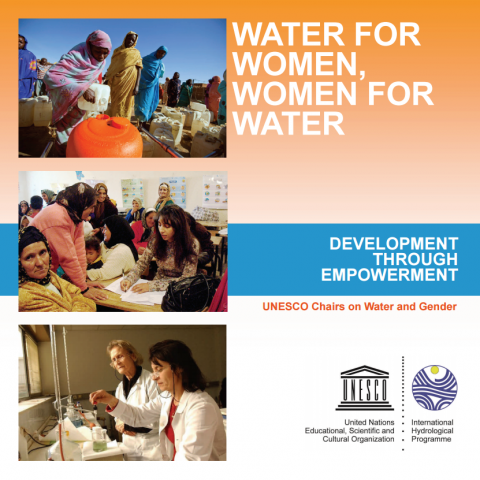 Water for Women, Women for Water: UNESCO's Chairs on Water and Gender سنة النشر: 2014 المؤلف المؤسسي: UNESCO The access to sufficient, safe and affordable water is a basic human right. It calls for governments, institutions, corporations and public and private organizations involved in the water sector to eliminate various forms of discrimination in the access, management and decision‐making processes involving water resources. Within the framework of the UNITWIN/UNESCO Chairs Programme, UNESCO has established five Chairs seeking to promote the engagement of women in sustainable development and water resource management. These Chairs integrate the UNESCO Water Family, consisting of the International Hydrological Programme (IHP), water‐related Centers’, the UNESCO‐IHE Institute for Water Education, the World Water Assessment Programme (WWAP), and a total of 35 UNESCO Chairs and UNITWIN Networks.Located in Brazil, Côte d’Ivoire, Morocco, Togo and the Dominican Republic, the Chairs are based in institutions of research and higher education, working actively to develop human resources, build solutions, and share scientific and practical knowledge. They work in partnership with other academic institutions, as well as public and private organizations. They also pave the way for the research and higher education communities to join forces with UNESCO in an effort to achieve internationally agreed Development Goals and targets. With a high appreciation for the Chairs’ great potential for impact, IHP has strongly encouraged their projects and initiatives, as well their involvement in other focal areas of the Eighth Phase of IHP, in order to strengthen water security, enhance tertiary and technical water education and respond to the needs of communities, with a special focus on women’s needs. With their inception in 2006, the UNESCO Chairs on Water and Gender have built a remarkable combination of knowledge and experience in their area of expertise. Through their actions, the Chairs have successfully fostered cooperation and exchange of information among different institutions of higher education; conducted research and training activities on gender‐related issues, water and natural sciences; established networks between professionals, governmental, non‐governmental and private organizations; created new approaches to deal with the water‐related needs of local communities and succeeded in increasing participation, leadership and the role of women in the water sector.As a general goal, the Chairs strive to enhance women’s capacities through motivation, engagement, development of skills and education. They have been active in organizing learning courses, training sessions, workshops, conferences and a diverse range of research and community projects. The following pages present a detailed overview of the five Chairs and their goals, activities, and initiatives.
  Other lang. title: L'Education pour tous 2000-2015: progrès et enjeux, rapport mondial de suivi sur l'EPT, 2015, résumé; La Educación para Todos, 2000-2015: logros y desafíos, informe de seguimiento de la EPT en el mundo, 2015, resumen سنة النشر: 2015 المؤلف المؤسسي: UNESCO At the World Education Forum in Dakar, Senegal, in 2000, governments from 164 countries, together with representatives of regional groups, international organizations, donor agencies, non-government organizations (NGOs) and civil society, adopted a Framework for Action to deliver Education for All (EFA) commitments. The Dakar Framework comprised 6 goals and their associated targets to be achieved by 2015, and 12 strategies to which all stakeholders would contribute. The EFA Global Monitoring Report (GMR) has monitored progress on an almost annual basis towards the EFA goals and the two education-related Millennium Development Goals (MDGs). The 2015 GMR provides a complete assessment of progress since 2000 towards the target date for reaching the Dakar Framework’s goals. It takes stock of whether the world achieved the EFA goals and stakeholders upheld their commitments. It explains possible determinants of the pace of progress. Finally, it identifies key lessons for shaping the post-2015 global education agenda. Образование для всех 2000-2015 гг.: достижения и вызовы, всемирный доклад по мониторингу ОДВ, 2015 г., резюме سنة النشر: 2015 المؤلف المؤسسي: Организация Объединенных Наций по вопросам образования, науки и культуры (UNESCO) At the World Education Forum in Dakar, Senegal, in 2000, governments from 164 countries, together with representatives of regional groups, international organizations, donor agencies, non-government organizations (NGOs) and civil society, adopted a Framework for Action to deliver Education for All (EFA) commitments. The Dakar Framework comprised 6 goals and their associated targets to be achieved by 2015, and 12 strategies to which all stakeholders would contribute. The EFA Global Monitoring Report (GMR) has monitored progress on an almost annual basis towards the EFA goals and the two education-related Millennium Development Goals (MDGs). The 2015 GMR provides a complete assessment of progress since 2000 towards the target date for reaching the Dakar Framework’s goals. It takes stock of whether the world achieved the EFA goals and stakeholders upheld their commitments. It explains possible determinants of the pace of progress. Finally, it identifies key lessons for shaping the post-2015 global education agenda. 2000-2015年 全民教育: 成就与挑战; 全民教育 全球监测报告, 2015; 摘 要 سنة النشر: 2015 المؤلف المؤسسي: UNESCO At the World Education Forum in Dakar, Senegal, in 2000, governments from 164 countries, together with representatives of regional groups, international organizations, donor agencies, non-government organizations (NGOs) and civil society, adopted a Framework for Action to deliver Education for All (EFA) commitments. The Dakar Framework comprised 6 goals and their associated targets to be achieved by 2015, and 12 strategies to which all stakeholders would contribute. The EFA Global Monitoring Report (GMR) has monitored progress on an almost annual basis towards the EFA goals and the two education-related Millennium Development Goals (MDGs). The 2015 GMR provides a complete assessment of progress since 2000 towards the target date for reaching the Dakar Framework’s goals. It takes stock of whether the world achieved the EFA goals and stakeholders upheld their commitments. It explains possible determinants of the pace of progress. Finally, it identifies key lessons for shaping the post-2015 global education agenda.
  L'Education pour les peuples et la planète: créer des avenirs durables pour tous, résumé du rapport mondial de suivi sur l'éducation, 2016 سنة النشر: 2016 المؤلف المؤسسي: UNESCO The GEM Report provides an authoritative account of how education is the most vital input for every dimension of sustainable development. Better education leads to greater prosperity, improved agriculture, better health outcomes, less violence, more gender equality, higher social capital and an improved natural environment. Education is key to helping people around the world understand why sustainable development is such a vital concept for our common future. Education gives us the key tools – economic, social, technological, even ethical – to take on the SDGs and to achieve them. These facts are spelled out in exquisite and unusual detail throughout the report. Yet the report also emphasizes the remarkable gaps between where the world stands today on education and where it has promised to arrive as of 2030. La Educación al servicio de los pueblos y el planeta: creación de futuros sostenibles para todos, resumen del informe de seguimiento de la educación en el mundo 2016; سنة النشر: 2016 المؤلف المؤسسي: UNESCO The GEM Report provides an authoritative account of how education is the most vital input for every dimension of sustainable development. Better education leads to greater prosperity, improved agriculture, better health outcomes, less violence, more gender equality, higher social capital and an improved natural environment. Education is key to helping people around the world understand why sustainable development is such a vital concept for our common future. Education gives us the key tools – economic, social, technological, even ethical – to take on the SDGs and to achieve them. These facts are spelled out in exquisite and unusual detail throughout the report. Yet the report also emphasizes the remarkable gaps between where the world stands today on education and where it has promised to arrive as of 2030. Образование в интересах людей и планеты: ПОСТОЕНИЕ УСТОЙЧИВОГО БУДУЩЕГО ДЛЯВСЕХ, РЕЗЮМЕ ВСЕМИРНОГО ДОКЛАДА ПО МОНИТОРИНГУ ОБРАЗОВАНИЯ, 2016 سنة النشر: 2016 المؤلف المؤسسي: UNESCO The GEM Report provides an authoritative account of how education is the most vital input for every dimension of sustainable development. Better education leads to greater prosperity, improved agriculture, better health outcomes, less violence, more gender equality, higher social capital and an improved natural environment. Education is key to helping people around the world understand why sustainable development is such a vital concept for our common future. Education gives us the key tools – economic, social, technological, even ethical – to take on the SDGs and to achieve them. These facts are spelled out in exquisite and unusual detail throughout the report. Yet the report also emphasizes the remarkable gaps between where the world stands today on education and where it has promised to arrive as of 2030.
  Developing a Monitoring Instrument to Measure Extracurricular and Non-formal Activities which Promote Global Citizenship Education (GCED) and Education for Sustainable Development (ESD) سنة النشر: 2016 المؤلف: Bassel Akar المؤلف المؤسسي: UNESCO The goal on Education is 1 of 17 Sustainable Development Goals that comprises a target to ensure all learners around the world have an opportunity to develop the competencies to promote sustainable approaches to living, including appreciating of cultural diversity, non-violence, and gender equality. Extracurricular activities and non-formal education (ENA) provides a non-traditional space for learning global citizenship and sustainable development. Around the world, communities have organized education programs and activities for youth outside school to learn the values and practices of being global citizens. Research shows, however, that most efforts to review and improve ENA for global citizenship and sustainable development have focused on summative evaluations with little attention to formative approaches of monitoring. Drawing on basic principles of action research, sustainable professional development, and education quality enhancement, a monitoring framework emerges to support organizations around the world in measuring progress towards education for global citizenship and sustainable development. This framework also suggests (1) inclusive monitoring spaces like internal reviews and online social networking platforms, (2) roles of stakeholders like donor agencies in institutionalizing monitoring practices, (3) instruments and measurable scales to facilitate dialogues that review program objectives and action plans, and (4) challenges in inclusive and sustainable monitoring tools and approaches.