
الموارد
استكشف مجموعة واسعة من الموارد القيمة حول تعليم المواطنة العالمية لتعميق فهمك وتعزيز البحث والمناصرة والتعليم والتعلم.
تم العثور على 2,199 نتيجة
 Values of Kazakhstan Society in the Sociological Dimension سنة النشر: 2020 المؤلف: Gulnara Ismukhanova | Dina Sharipova | Botagoz Turekhanova | Botagoz Rakisheva | Gulnar Nasimova | Saltanat Ermakhanova | Shugla Kylybayeva | Tolganai Umbetalieva | Leonid Gurevich المؤلف المؤسسي: Friedrich-Ebert-Stiftung Kazakhstan Office The book provides a structured analysis of the values of modern Kazakhstani society, based both on well-known classical models and on original author’s approaches. The book is based on a sociological study conducted on a national representative sample and which allowed us to describe the value portrait of Kazakhstanis taking into account the specifics of social groups and regions. The key vectors of transformation of values in Kazakhstan are identified against the backdrop of global trends and in the context of the national strategy of spiritual modernization.The book is addressed to scientists, politicians, government and public figures, representatives of the business community, journalists, teachers and university students and is of interest to anyone who seeks to understand the complex structure of social and cultural processes in modern Kazakhstan. Ценности казахстанского общества в социологическом измерении سنة النشر: 2020 المؤلف: Gulnara Ismukhanova | Dina Sharipova | Botagoz Turekhanova | Botagoz Rakisheva | Gulnar Nasimova | Saltanat Ermakhanova | Shugla Kylybayeva | Tolganai Umbetalieva | Leonid Gurevich المؤلف المؤسسي: Фонд имени Фридриха Эберта в Казахстане В книге предпринят структурированный анализ ценностей современного казахстанского общества, базирующийся как на известных классических моделях, так и на оригинальных авторских подходах. В основе книги – социологическое исследование, проведенное на национальной репрезентативной выборке и позволившее описать ценностный портрет казахстанцев с учетом специфики социальных групп и регионов. Определены ключевые векторы трансформации ценностей в Казахстане на фоне мировых трендов и в контексте национальной стратегии духовной модернизации.Книга адресована ученым, политикам, государственным и общественным деятелям, представителям деловых кругов, журналистам, преподавателям и студентам вузов и представляет интерес для всех, кто стремится понять сложную структуру социальных и культурных процессов в современном Казахстане.
  Connet with respect: preventing-gender based violence in schools; classroom programme for students in early secondary school سنة النشر: 2016 المؤلف المؤسسي: UNESCO Bangkok Students learn best in schools that provide safety and social support. However, some young people experience violence and harassment in, around, and on the way to school. This includes gender-based violence (GBV), which can take many different forms.As a teacher, you can play an important role in preventing the expression of gender-based violence in the school setting. Teachers, school principals and the broader education system can provide positive role models, empower children and youth to have healthy and respectful relationships, and deliver a violence prevention programme within their curriculum.This tool has been created to help schools in Asia and the Pacific to do all of these things.
 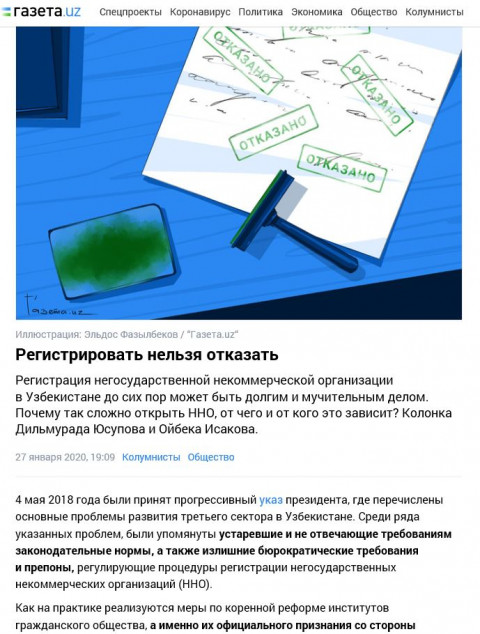 Registration or Block? سنة النشر: 2020 المؤلف: Dilmurod Yusupov | Oybek Isakov Registration of a non-governmental non-profit organization in Uzbekistan can still be a long and painful affair. The article discusses why it is so difficult to open an NGO, what and whom it depends on. Регистрировать нельзя отказать سنة النشر: 2020 المؤلف: Dilmurod Yusupov | Oybek Isakov Регистрация негосударственной некоммерческой организации в Узбекистане до сих пор может быть долгим и мучительным делом. В статье рассматривается, почему так сложно открыть ННО, от чего и от кого это зависит.
  유네스코학교 길라잡이: 밑동부터 차근차근 سنة النشر: 2020 المؤلف: 김다영 | 박현주 | 유성상 | 임재민 | 정다정 المؤلف المؤسسي: 유네스코한국위원회 본 자료는 유네스코학교 담당 신규교사를 위한 길라잡이로, 유네스코학교 담당교사들이 직접 집필에 참여하였다. 유네스코학교 연간운영계획 예시 및 실제 현장사례와 함께 세계시민교육 관련 교육자료가 풍성하게 담겨있다.
  道德教育与“积极公民”的培育—从以赛亚・伯林的两种自由概念谈起 سنة النشر: 2019 المؤلف: Ye Fei المؤلف المؤسسي: Soochow University 以赛亚·伯林在两种自由概念的基础上提出了“消极公民”和“积极公民”两种人格观念。“消极公民”倾向于将个体的自由和权利置于共同体之上,把捍卫个体的自由视为第一要务,这容易导致个体与共同体之 间的分裂与疏离; 而“积极公民”则更强调自由与责任、个体与社会的交融,主张个体在捍卫个人权利的同时也要勇于担当公共责任。在当前的社会转型期,不论是从个体品格完善、学校德育改革还是从社会发展等角度而言,道德教育都有必要引导“积极公民”的培育,推动道德责任感和公共精神的发展。为此,道德教育应致力于建构课堂的公共生活空间,发展学校的民主共治理念,同时实现学校生活与社区生活的有效联结,从而培育学生的平等、合作、尊重、宽容等公共道德品质,使其成长为负责任的积极公民,在实现自我的品格完善的同时促进公共社会的发展。
  Research on Building Ideological Foundation of a Sense of Community for the Chinese Nation سنة النشر: 2020 المؤلف: Wang Jian | Hu Hong-Xing المؤلف المؤسسي: Central Minzu University From a global perspective, the development of citizenship education emphasizing national identity has become the core theme of multicultural society. At present, the research on the sense of community for Chinese nation focuses on two themes: one is the situation of “the pattern of diversity in unity of the Chinese nation”, and the other is the sense of community for Chinese nation. It is an important part of Xi Jinping’s thought on ethnic work of the new era to strengthen the consciousness and foundation of the Chinese nation community. To lay an ideological foundation of the Chinese nation community in the new era, we need to unswervingly carry out the propaganda and education of Marxist views on the motherland, the nation, culture and history. It means that firstly we should study Marxist views on them and their relations to form a Marxist ideological system of national work. Secondly, we need to understand the Xi Jinping’s guiding ideology of ethnic work in the new era and firmly follow the “Chinese road” with Chinese characteristics to solve ethnic problems. Finally, starting from the path of culture, education, and propaganda, we need to strengthen a strategy of the Chinese Nation Community. 打牢中华民族共同体意识的思想基础研究 سنة النشر: 2020 المؤلف: Wang Jian | Hu Hong-Xing المؤلف المؤسسي: 中央民族大学 从世界范围来看,强调国家认同的公民教育已发展成为当前全球多元文化社会治理的核心 主题。我国学术界对中华民族共同体的研究,目前集中在两个主题,一是研究“中华民族多元一体格局”的多 民族国情,二是研究“中华民族共同体意识”。铸牢中华民族共同体意识、打牢中华民族共同体思想基础,既 是马克思主义民族理论中国化的重要产物,也是习近平新时代民族工作指导思想的核心内容。新时代打牢中 华民族共同体意识的思想基础,需要坚持不懈地开展马克思主义祖国观、民族观、文化观、历史观宣传教育。 首先,打牢中华民族共同体意识的思想基础需要深入研究马克思主义的祖国观、民族观、文化观、历史观及其 相互关系,形成马克思主义的民族工作思想体系; 其次,打牢中华民族共同体意识的思想基础需要从政治上深 入理解习近平新时代民族工作的指导思想,坚定走有中国特色的解决民族问题的“中国道路”; 最后,从教育 路径入手,提出打牢中华民族共同体思想基础的治理方略。
  Preschool Children's Citizenship Education in Global Context: The Transformation of Ideas and Development Trends سنة النشر: 2019 المؤلف: Xu Peng المؤلف المؤسسي: International and Comparative Education In recent years, preschool children’s citizenship education has been emphasized globally and gradually becomes a main content in early childhood curriculum. Traditional ideas on early age citizens see some new changes. As the core of early age children’s citizenship education, children’s citizenship is gradually transferred from citizens in waiting to citizens today, including right, active participation, identity and sense of belonging, and collective responsibility. The above transformation highlights global trends such as enriching ideas and contents on citizenship, regarding equity as the logic starting point, paying attention to young children’s participation and experience, and being rooted in indigenous context and culture. In the meantime, potential challenges still exist for the future development of young children's citizenship, such as the difficulty of transferring ideas, ambiguous standing point and the tokenism of curriculum content and practice.