
الموارد
استكشف مجموعة واسعة من الموارد القيمة حول تعليم المواطنة العالمية لتعميق فهمك وتعزيز البحث والمناصرة والتعليم والتعلم.
تم العثور على 2 نتيجة
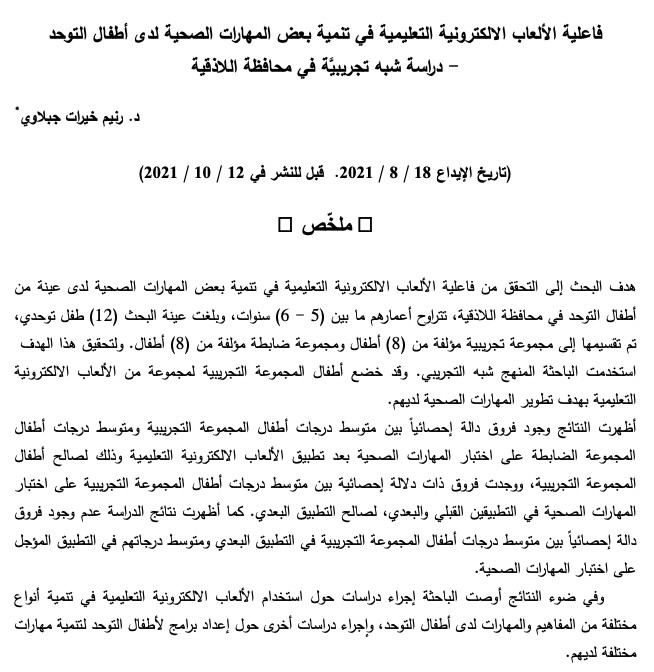 فاعلية الألعاب الالكترونية التعليمية في تنمية بعض المهارات الصحية لدى أطفال التوحد - دراسة شبه تجريبيَّة في محافظة اللاذقية (مجلة جامعة تشرين للبحوث والدراسات العلمية ، الآداب والعلوم الإنسانية ، المجلد 43 ، العدد 5) سنة النشر: 2021 المؤلف: Raneem Jablawi المؤلف المؤسسي: Tishreen University هدف البحث إلى التحقق من فاعلية الألعاب الالكترونية التعليمية في تنمية بعض المهارات الصحية لدى عينة من أطفال التوحد في محافظة اللاذقية، تتراوح أعمارهم ما بين (5 - 6) سنوات، وبلغت عينة البحث (12) طفل توحدي، تم تقسيمها إلى مجموعة تجريبية مؤلفة من (8) أطفال ومجموعة ضابطة مؤلفة من (8) أطفال. ولتحقيق هذا الهدف استخدمت الباحثة المنهج شبه التجريبي. وقد خضع أطفال المجموعة التجريبية لمجموعة من الألعاب الالكترونية التعليمية بهدف تطوير المهارات الصحية لديهم.أظهرت النتائج وجود فروق دالة إحصائياً بين متوسط درجات أطفال المجموعة التجريبية ومتوسط درجات أطفال المجموعة الضابطة على اختبار المهارات الصحية بعد تطبيق الألعاب الالكترونية التعليمية وذلك لصالح أطفال المجموعة التجريبية، ووجدت فروق ذات دلالة إحصائية بين متوسط درجات أطفال المجموعة التجريبية على اختبار المهارات الصحية في التطبيقين القبلي والبعدي، لصالح التطبيق البعدي. كما أظهرت نتائج الدراسة عدم وجود فروق دالة إحصائياً بين متوسط درجات أطفال المجموعة التجريبية في التطبيق البعدي ومتوسط درجاتهم في التطبيق المؤجل على اختبار المهارات الصحية.وفي ضوء النتائج أوصت الباحثة إجراء دراسات حول استخدام الألعاب الالكترونية التعليمية في تنمية أنواع مختلفة من المفاهيم والمهارات لدى أطفال التوحد، وإجراء دراسات أخرى حول إعداد برامج لأطفال التوحد لتنمية مهارات مختلفة لديهم. The Effectiveness of Educational Electronic Games in Developing Some Health Skills of Autistic Children Semi-Experimental Study in Lattakia Governorate (Tishreen University Journal for Research and Scientific Studies, Arts and Humanities; vol. 43, no. 5) سنة النشر: 2021 المؤلف: Raneem Jablawi المؤلف المؤسسي: Tishreen University "The aim of the research is to verify the effectiveness of educational electronic games in developing some health skills among a sample of autistic children in Lattakia Governorate, their ages ranged between (5-6) years, and the research sample amounted to (12) autistic children, which were divided into an experimental group consisting of (8) children and a control group consisting of (8) children. To achieve this goal, the researcher used the quasi-experimental method. The children of the experimental group were subjected to a set of educational electronic games in order to develop their health skills.The results showed that there were statistically significant differences between the average scores of the children of the experimental group and the average scores of the children of the control group on the health skills test after the application of educational electronic games, in favor of the children of the experimental group, and there were statistically significant differences between the average scores of the children of the experimental group on the health skills test in the two tribal applications. and dimensional, in favor of dimensional application. The results of the study also showed that there were no statistically significant differences between the average scores of the experimental group children in the post application and their average scores in the delayed application on the health skills test.In light of the results, the researcher recommended conducting studies on the use of educational electronic games in developing different types of concepts and skills for autistic children, and conducting other studies on preparing programs for autistic children to develop different skills for them."