
الموارد
استكشف مجموعة واسعة من الموارد القيمة حول تعليم المواطنة العالمية لتعميق فهمك وتعزيز البحث والمناصرة والتعليم والتعلم.
تم العثور على 22 نتيجة
 Symposium on climate change education and sustainable cities, 31 August 2009, United Nations Office at Nairobi, Kenya سنة النشر: 2009 المؤلف المؤسسي: United Nations Environment Programme (UNEP) | United Nations Centre for Human Settlement Programme (UN Habitat) Education plays an important role in promoting knowledge, skills and values that are necessary for the realization of a sustainable society. It also assists learners to learn to cope with today's challenges such as climate change and urbanization. The overarching theme of the symposium was the critical role of education in promoting sustainable urbanization with a particular focus on climate change and its challenges. This broad theme was divided into two major sub-themes: 1. Role of education in building sustainable cities 2. Mainstreaming climate change in education for building sustainable cities. The key objective of the symposium was to raise awareness about the decade of education on sustainable development and to promote a constructive dialogue between local authorities, practitioners, academia and civil society organizations on the role of education in addressing the challenges of sustainable urbanization and climate change. A major thrust of the dialogue was “moving from rhetoric to action”. Key concepts of the Symposium Cities Half of humanity now lives in cities, and around one billion urban residents live in slums. The urbanization of poverty is therefore one of the most daunting challenges of the 21st century. Cities offer opportunities, but most urban development is largely toxic, segregated and inefficient. If cities are to come to terms with rapid levels of urbanization, they require leaders, managers and staff capable of adopting innovative and robust approaches to planning, developing, managing and financing growth for all citizens. Climate Change Globally, climate change is now recognized as one of the defining challenges of the 21st century. The future of hundreds of millions of people in urban areas across the world will be affected by the different impacts of climate change. Developing and least developed countries have higher vulnerability to climate change impacts compared to developed countries. Climate change has been identified as one of the main strategic perspectives to inform education and learning for sustainable development and by extension sustainable city development. Climate change issues need to be part of public awareness, learning and education for a sustainable future. The integrated, multifaceted vision provided by ESD is particularly well-suited to addressing climate change and city development in terms of understanding its causes, recognising its impact and effects, and preparing and implementing appropriate mitigation and adaptation responses. Symposium sur le changement climatique et l'éducation des villes durables 31 Août 2009, le Bureau des Nations Unies à Nairobi, au Kenya سنة النشر: 2009 المؤلف المؤسسي: United Nations Environment Programme (UNEP) | United Nations Centre for Human Settlement Programme (UN Habitat) L'éducation joue un rôle important dans la promotion des connaissances, des compétences et des valeurs qui sont nécessaires à la réalisation d'une société durable. Il aide également les élèves à apprendre à faire face aux défis actuels tels que le changement climatique et l'urbanisation. Le thème général du colloque était le rôle crucial de l'éducation dans la promotion de l'urbanisation durable avec un aCECnt particulier sur le changement climatique et ses défis. Ce thème général a été divisé en deux sous-thèmes: 1. Rôle de l'éducation dans la construction de villes durables 2. Intégration du changement climatique dans l'éducation pour la construction de villes durables. L'objectif principal du colloque était de sensibiliser au sujet de la décennie de l'éducation sur le développement durable et de promouvoir un dialogue constructif entre les organisations autorités, les praticiens, les universités et la société civile locale sur le rôle de l'éducation dans la lutte contre les défis de l'urbanisation durable et le changement climatique . Un axe majeur du dialogue était «passer de la rhétorique à l'action». Les concepts clés du Symposium Villes moitié de l'humanité vit aujourd'hui dans les villes, et environ un milliard de citadins vivent dans des bidonvilles. L'urbanisation de la pauvreté est donc l'un des défis les plus redoutables du 21e siècle. Les villes offrent des possibilités, mais la plupart du développement urbain est en grande partie toxique, la ségrégation et inefficace. Si les villes doivent se réconcilier avec les niveaux rapides d'urbanisation, ils exigent des dirigeants, des gestionnaires et du personnel capables d'adopter des approches novatrices et robustes à la planification, le développement, la gestion et la croissance de financement pour tous les citoyens. À l'échelle mondiale sur les changements climatiques, le changement climatique est maintenant reconnu comme l'un des défis du 21ème siècle. L'avenir de centaines de millions de personnes dans les zones urbaines à travers le monde seront touchés par les différents impacts du changement climatique. Le développement et les pays les moins avancés ont une plus grande vulnérabilité aux impacts des changements climatiques par rapport aux pays développés. Le changement climatique a été identifié comme l'une des principales perspectives stratégiques pour informer l'éducation et l'apprentissage pour le développement durable et, par extension, le développement de la ville durable. les questions de changement climatique doivent faire partie de la sensibilisation du public, l'apprentissage et l'éducation pour un avenir durable. La vision à multiples facettes intégré fourni par EDD est particulièrement bien adapté à lutter contre le changement climatique et le développement de la ville en termes de compréhension de ses causes, en reconnaissant son impact et les effets, et la préparation et la mise en œuvre des mesures d'atténuation et d'adaptation appropriées.
  Environmental Education Toolkit Guide for Latin America and the Caribbean سنة النشر: 2023 المؤلف: Eloísa Tréllez Solís المؤلف المؤسسي: United Nations Environment Programme (UNEP) The Environmental Education Toolkit is aimed primarily at teachers, multipliers and facilitators in Latin America and the Caribbean (LAC), and aims to promote interdisciplinary approaches, with a view to the transversality of environmental education. In the new context of a post-COVID-19 health emergency world, this approach becomes more relevant and necessary to achieve a better vision and understanding of the relationships between humans and nature; between societies, cultures and with the ecosystems on which they depend. In the chapters that make up this publication, an approach is proposed through a methodological proposal for reflection and action, the Interdisciplinary Roundtables for Environmental Education towards Sustainability, whose main objective is to strengthen and complement the environmental education processes that are carried out both in educational centers and in community groups, from an interdisciplinary, transversal perspective and with systemic thinking. Guía de herramientas de educación ambiental para América Latina y el Caribe سنة النشر: 2023 المؤلف: Eloísa Tréllez Solís المؤلف المؤسسي: United Nations Environment Programme (UNEP) La Guía de Herramientas de Educación Ambiental está dirigida principalmente a docentes, multiplicadores y facilitadores de América Latina y el Caribe (ALC), tiene el propósito de impulsar enfoques interdisciplinarios, con miras a la transversalidad de la educación ambiental. En el nuevo contexto de un mundo post emergencia sanitaria COVID-19 este enfoque se vuelve más relevante y necesario para lograr una mejor visión y entendimiento de las relaciones entre el ser humano y la naturaleza; entre las sociedades, culturas y con los ecosistemas, de los que depende. Se propone, en los capítulos que integran esta publicación, un abordaje a través de una propuesta metodológica de reflexión y acción, las Mesas Interdisciplinarias de Educación Ambiental hacia la Sostenibilidad, cuyo objetivo principal es fortalecer y complementar los procesos de educación ambiental que se llevan a cabo tanto en centros educativos como en grupos comunitarios, desde una perspectiva interdisciplinaria, transversal y con pensamiento sistémico.
  Education for Sustainable Development Policy for the Education Sector سنة النشر: 2017 المؤلف المؤسسي: Kenya. Ministry of Education | UNESCO Nairobi This ESD Policy provides for the incorporation of key themes of sustainable development such as poverty alleviation, human rights, innovation, health and environmental protection and climate change into the Kenyan education system. It promotes competencies such as critical thinking, crativity and making decisions in a collaborative way.
  Higher Education, Peace & Security in the Eastern Africa Region سنة النشر: 2023 المؤلف: Sabiti Makara المؤلف المؤسسي: UNESCO Nairobi This paper stems from issues that were deliberated on at a regional conference titled, Emerging Issues in the Sciences, Climate Change, Peace and Security and Information and Communication Technologies (ICTs), organized in Djibouti, in May 2017 by UNESCO Regional Office for Eastern Africa. The paper examines the issues and challenges of peace and security in Eastern Africa region. It puts into perspective higher education in the region, in terms of assess, quality, relevance, knowledge and skill products, and capacity to solve social challenges of society. The May 2017 Djibouti Conference on Higher Education, Peace and Security aimed at placing higher education at the center of understanding the complex regional challenges with regard to peace and security in a broad context, including poverty, climate change and environment, intergenerational transfer of knowledge, colonial/neo-colonial heritage, regional integration, cultural resources, and unemployment. The centrality of education as a tool for social transformation in Africa, and elsewhere is a critical element of transforming society, however that very element is up for debate. Specifically, the impact of higher education as a means of accelerating the sciences (natural and social sciences) is due for robust debate, as to whether or not, it is leading to innovations, creativity, and research-led solutions to challenges of society. The critical issue for the Djibouti Conference deliberations was: could Science, technology and in more recent years, information and communications technology, lead to transformation of society in the region? The other issue was: is it only the natural sciences that have the greatest potential for that transformation, or that the social sciences and humanities are relevant in this context? Besides, since issues of peace and security are complex, could multidisciplinary approaches be appropriate? This paper is not a rapporteur's report of the Djibouti conference. It is a set of reflection and reframing of issues for further debate and discussion.
  Digital Technologies for Environmental Peacebuilding: Horizon Scanning of Opportunities and Risks سنة النشر: 2024 المؤلف المؤسسي: United Nations Environment Programme (UNEP) This report specifically delves into how digital technologies can be harnessed to manage environmental and natural resource risks that contribute to insecurity and social conflict, as well as the opportunities they present for peacebuilding, cooperation, and social cohesion. It examines relevant use cases spanning the peace and security continuum and concludes with a set of important policy and governance recommendations. The report is designed to inform and contribute to significant upcoming frameworks addressing digital technologies, including the Summit of the Future and the Global Digital Compact.
  Emissions Gap Report 2024: No More Hot Air … Please! With a Massive Gap Between Rhetoric and Reality, Countries Draft New Climate Commitments سنة النشر: 2024 المؤلف: Anne Olhoft | John Christensen | William F. Lamb | Minal Pathak | Takeshi Kuramochi | Taryn Fransen | Joeri Rogelj | Michel den Elzen | Joana Portugal-Pereira | Neil rant | Jiang Kejun | Stephanie Roe | Chris Bataille | Kornelis Blok | Kelly Levin | Eleonore Soubeyran | Costanza Strinati المؤلف المؤسسي: United Nations Environment Programme (UNEP) As climate impacts intensify globally, the Emissions Gap Report 2024: No more hot air … please! finds that nations must deliver dramatically stronger ambition and action in the next round of Nationally Determined Contributions or the Paris Agreement’s 1.5°C goal will be gone within a few years. The report is the 15th edition in a series that brings together many of the world’s top climate scientists to look at future trends in greenhouse gas emissions and provide potential solutions to the challenge of global warming.
  Global Resources Outlook: 2024 Bend the Trend; Pathways to a Liveable Planet as Resource Use Spikes سنة النشر: 2024 المؤلف: Hans Bruyninckx, Steve Hatfield-Dodds, Stefanie Hellweg, Heinz Schandl المؤلف المؤسسي: United Nations Environment Programme (UNEP) | International Resource Panel (IRP) The world is in the midst of a triple planetary crisis of climate change, biodiversity loss and pollution and waste. The global economy is consuming ever more natural resources, while the world is not on track to meet the Sustainable Development Goals. The scientific community has never before been more aligned or more resolute on the need for urgent global transformation towards the sustainable use of resources. This 2024 edition of the Global Resources Outlook sheds light on how resources are essential to the effective implementation of the Agenda 2030 and multilateral environmental agreements to tackle the triple planetary crisis. The report brings together the best available data, modelling and assessments to analyse trends, impacts and distributional effects of resource use. It builds on more than 15 years of work by the International Resource Panel, including scientific assessments and inputs from countries, a vast network of stakeholders in the field and regional experts. The report illustrates how, since the 2019 edition of this report, rising trends in global resource use have continued or accelerated. The report also shows how demand for resources is expected to continue increasing in the coming decades. This means that, without urgent and concerted action, by 2060 resource extraction could rise by 60% from 2020 levels – driving increasing damage and risks. However, this fate is not sealed. The report also describes the potential to turn negative trends around and put humanity on a trajectory towards sustainability. For that, bold policy action is critical to phase out unsustainable activities, speed up responsible and innovative ways of meeting human needs and create conditions conducive to social acceptance and equity within the necessary transitions. This includes urgent action to embed resources in the delivery of multilateral environmental agreements, define sustainable resource use paths and roll out appropriate financial, trade and economic incentives. The pathway towards sustainability is increasingly steep and narrow, and the window of opportunity is closing. The science is clear: The key question is no longer whether a transformation towards global sustainable resource consumption and production is necessary, but how to make it happen now. Addressing this reality, based on evolving concepts of a just transition, is an essential part of any credible and justifiable way forward.
 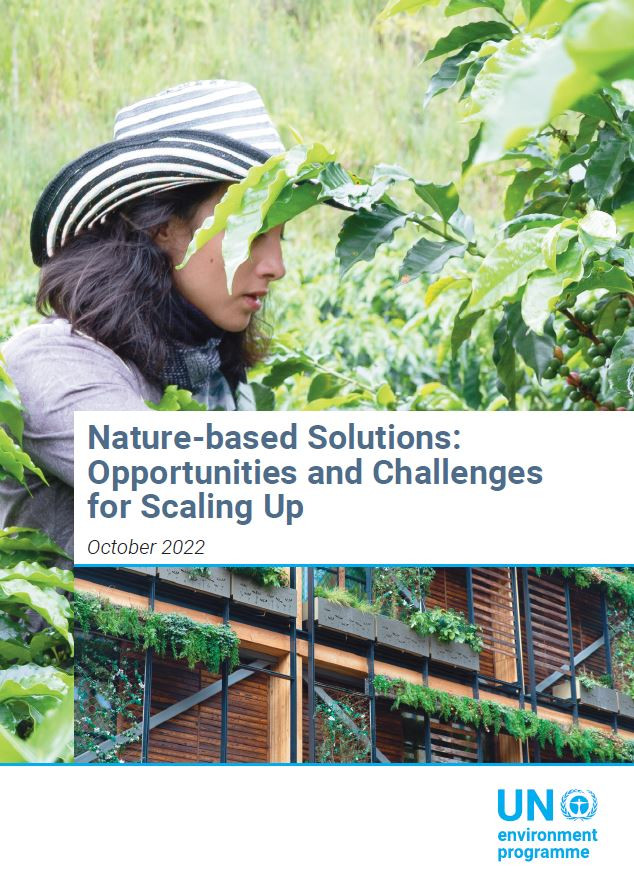 Nature-based Solutions: Opportunities and Challenges for Scaling Up سنة النشر: 2022 المؤلف: Charlotte Hicks | Carolina Chambi | Hemant Tripathi | Katie Dawkins | Tania Salvaterra | Kollie Tokpah | Valerie Kapos | Hashim Zaman المؤلف المؤسسي: United Nations Environment Programme (UNEP) Nature-based Solutions (NbS) are important for the global sustainable development agenda because they offer the potential to address, in an effective way, diverse challenges such as climate change, food and water insecurity, disaster impacts, and threats to human health and wellbeing, while reducing environmental degradation and biodiversity loss. Some of the challenges addressed by NbS, including biodiversity loss and climate action, cannot be fully tackled without this contribution. This does not mean that other actions, such as rapid decarbonization of our economies, are not also essential. This report: Outlines recent developments on NbS, with a focus on global, regional and national commitments, and key issues and concerns Builds on the new multilaterally agreed definition of NbS – agreed by the UN Environment Assembly in March 2022 – to set out key elements in the concept, provides examples of NbS, and discusses related approaches Provides recommendations for actions by governments, civil society and the private sector to substantially scale up the use of NbSThe report aims to inform NbS-related initiatives and discussions on NbS at global, regional, and national levels, with a focus on how NbS can be scaled up to more effectively address social, economic, and environmental challenges.