
الموارد
استكشف مجموعة واسعة من الموارد القيمة حول تعليم المواطنة العالمية لتعميق فهمك وتعزيز البحث والمناصرة والتعليم والتعلم.
تم العثور على 18 نتيجة
 Teaching for Global Competence in a Rapidly Changing World سنة النشر: 2018 المؤلف: Richard Lee Colvin | Virginia Edwards المؤلف المؤسسي: Asia Society | Organisation for Economic Co-operation and Development (OECD) Educators and education systems worldwide are reassessing the knowledge, skills, and dispositions students need for success in today's rapidly changing and complex world. In a remarkable moment of global consensus, the member states of both the United Nations (UN), through its adoption of the Sustainable Development Goals (SDGs) in 2015, and the Organisation for Economic Co-operation and Development (OECD), through its Programme for International Student Assessment (PISA) in 2018, prioritized education for global citizenship and global competence.The OECD and the Center for Global Education at Asia Society have worked with academics, educators, and stakeholders in the global education field over several years to define global competence for primary and secondary education. The Center also has extensive experience supporting educators to integrate global competence into their teaching.A new publication from both organizations, entitled Teaching for Global Competence in a Rapidly Changing World, sets forward a new framework for global competence developed by OECD, which aligns closely with the definition developed by the Center for Global Education, and provides practical guidance and examples of how educators can embed global competence into their existing curriculum, instruction, and assessment.
  مرحلة ما بعد عام 2015: التعليم الذي نصبو إليه سنة النشر: 2014 المؤلف المؤسسي: UNESCO | United Nations Children's Fund (UNICEF) The post-2015 education agenda should be aspirational, transformative and holistic, and an integral part of the broader post-2015 development agenda. It should be of universal relevance and mobilize all stakeholders in all countries. Education must be a stand-alone goal in the broader post-2015 development agenda and should be framed by a comprehensive overarching goal, with measurable global targets and related indicators. In addition, education must be integrated into other development goals. The future education agenda should be rights-based and reflect a perspective based on equity and inclusion, with particular attention to gender equality and to overcoming all forms of discrimination in and through education, ensuring that no-one is left behind. It must support free and compulsory basic education. It should expand the vision of access for all to reflect relevant learning outcomes through the provision of quality education at all levels, from early childhood to higher education, in safe and healthy environments. It should take a holistic and lifelong learning approach, and provide multiple pathways of learning using innovative methods and information and communication technologies. It should reinforce approaches such as global citizenship education and education for sustainable development, which foster attitudes and behaviours that promote peace, conflict resolution and mutual understanding, tolerance, critical thinking, and respect for cultural diversity and for the environment. Más allá de 2015: la educación que queremos سنة النشر: 2014 المؤلف المؤسسي: UNESCO | United Nations Children's Fund (UNICEF) The post-2015 education agenda should be aspirational, transformative and holistic, and an integral part of the broader post-2015 development agenda. It should be of universal relevance and mobilize all stakeholders in all countries. Education must be a stand-alone goal in the broader post-2015 development agenda and should be framed by a comprehensive overarching goal, with measurable global targets and related indicators. In addition, education must be integrated into other development goals. The future education agenda should be rights-based and reflect a perspective based on equity and inclusion, with particular attention to gender equality and to overcoming all forms of discrimination in and through education, ensuring that no-one is left behind. It must support free and compulsory basic education. It should expand the vision of access for all to reflect relevant learning outcomes through the provision of quality education at all levels, from early childhood to higher education, in safe and healthy environments. It should take a holistic and lifelong learning approach, and provide multiple pathways of learning using innovative methods and information and communication technologies. It should reinforce approaches such as global citizenship education and education for sustainable development, which foster attitudes and behaviours that promote peace, conflict resolution and mutual understanding, tolerance, critical thinking, and respect for cultural diversity and for the environment. L'Après-2015: l'éducation que nous voulons سنة النشر: 2014 المؤلف المؤسسي: UNESCO | United Nations Children's Fund (UNICEF) The post-2015 education agenda should be aspirational, transformative and holistic, and an integral part of the broader post-2015 development agenda. It should be of universal relevance and mobilize all stakeholders in all countries. Education must be a stand-alone goal in the broader post-2015 development agenda and should be framed by a comprehensive overarching goal, with measurable global targets and related indicators. In addition, education must be integrated into other development goals. The future education agenda should be rights-based and reflect a perspective based on equity and inclusion, with particular attention to gender equality and to overcoming all forms of discrimination in and through education, ensuring that no-one is left behind. It must support free and compulsory basic education. It should expand the vision of access for all to reflect relevant learning outcomes through the provision of quality education at all levels, from early childhood to higher education, in safe and healthy environments. It should take a holistic and lifelong learning approach, and provide multiple pathways of learning using innovative methods and information and communication technologies. It should reinforce approaches such as global citizenship education and education for sustainable development, which foster attitudes and behaviours that promote peace, conflict resolution and mutual understanding, tolerance, critical thinking, and respect for cultural diversity and for the environment.
  Beyond 2015: the education we want سنة النشر: 2014 المؤلف المؤسسي: UNESCO | United Nations Children's Fund (UNICEF) The post-2015 education agenda should be aspirational, transformative and holistic, and an integral part of the broader post-2015 development agenda. It should be of universal relevance and mobilize all stakeholders in all countries. Education must be a stand-alone goal in the broader post-2015 development agenda and should be framed by a comprehensive overarching goal, with measurable global targets and related indicators. In addition, education must be integrated into other development goals. The future education agenda should be rights-based and reflect a perspective based on equity and inclusion, with particular attention to gender equality and to overcoming all forms of discrimination in and through education, ensuring that no-one is left behind. It must support free and compulsory basic education.It should expand the vision of access for all to reflect relevant learning outcomes through the provision of quality education at all levels, from early childhood to higher education, in safe and healthy environments. It should take a holistic and lifelong learning approach, and provide multiple pathways of learning using innovative methods and information and communication technologies. It should reinforce approaches such as global citizenship education and education for sustainable development, which foster attitudes and behaviours that promote peace, conflict resolution and mutual understanding, tolerance, critical thinking, and respect for cultural diversity and for the environment.
  Global guidance on addressing school related gender based violence سنة النشر: 2016 المؤلف المؤسسي: UNESCO | United Nations Entity for Gender Equality and the Empowerment of Women (UN Women) More than 246 million children are subjected to gender-based violence in or around schools every year. This is a violation of their human rights, and a form of gender-discrimination that has far-reaching physical, psychological and educational consequences. Ending schoolrelated gender-based violence (SRGBV) is a priority for countries wishing to achieve ambitious global goals on inclusive and quality education for all and gender equality.WHAT IS THE AIM OF THIS GUIDANCE? This guidance aims to provide a comprehensive, one-stop resource on school-related gender-based violence (SRGBV), including clear, knowledge-based operational guidance, diverse case studies drawn from examples of promising practice and recommended tools for the education sector and its partners working to eliminate gender-based violence. It distils programme knowledge based on existing global literature, promising practices, expert recommendations and practitioner consensus.WHO IS THIS GUIDANCE FOR? The primary audience for this global guidance is the national education sector, including government policy-makers, education ministries, school administrators, educators and other school staff. The guidance may also have wider interest for other national and international stakeholders that are interested in addressing SRGBV, including NGOs, bilateral and multilateral agencies, teachers’ trade unions and policy-makers in other domestic sectors. The guidance is intended primarily for use in low- and middle-income settings, but is based on norms and principles that are universally applicable.WHAT IS COVERED IN THIS GUIDANCE? Promising practice case studies and recommended tools are embedded throughout the relevant sub-sections of the guidance. These provide readers with illustrative examples of implementation in real-life contexts and can serve as resources that have been successfully used – and can be adapted – for application in different contexts.This guidance complements other existing tools and materials for specific bilateral, multilateral and NGO audiences on violence against women and girls, and violence in schools. An expanded online version, which will be regularly updated, is available at www.endvawnow.org Lutte contre la violence de genre en milieu scolaire: orientations mondiales: سنة النشر: 2016 المؤلف المؤسسي: UNESCO | United Nations Entity for Gender Equality and the Empowerment of Women (UN Women) More than 246 million children are subjected to gender-based violence in or around schools every year. This is a violation of their human rights, and a form of gender-discrimination that has far-reaching physical, psychological and educational consequences. Ending schoolrelated gender-based violence (SRGBV) is a priority for countries wishing to achieve ambitious global goals on inclusive and quality education for all and gender equality.WHAT IS THE AIM OF THIS GUIDANCE? This guidance aims to provide a comprehensive, one-stop resource on school-related gender-based violence (SRGBV), including clear, knowledge-based operational guidance, diverse case studies drawn from examples of promising practice and recommended tools for the education sector and its partners working to eliminate gender-based violence. It distils programme knowledge based on existing global literature, promising practices, expert recommendations and practitioner consensus.WHO IS THIS GUIDANCE FOR? The primary audience for this global guidance is the national education sector, including government policy-makers, education ministries, school administrators, educators and other school staff. The guidance may also have wider interest for other national and international stakeholders that are interested in addressing SRGBV, including NGOs, bilateral and multilateral agencies, teachers’ trade unions and policy-makers in other domestic sectors. The guidance is intended primarily for use in low- and middle-income settings, but is based on norms and principles that are universally applicable.WHAT IS COVERED IN THIS GUIDANCE? Promising practice case studies and recommended tools are embedded throughout the relevant sub-sections of the guidance. These provide readers with illustrative examples of implementation in real-life contexts and can serve as resources that have been successfully used – and can be adapted – for application in different contexts.This guidance complements other existing tools and materials for specific bilateral, multilateral and NGO audiences on violence against women and girls, and violence in schools. An expanded online version, which will be regularly updated, is available at www.endvawnow.org
  Good Practices in South-South and Triangular Cooperation: Transforming Education and Delivering on SDG 4 سنة النشر: 2023 المؤلف المؤسسي: UNESCO | United Nations Children's Fund (UNICEF) | UN. Office for South-South Cooperation (UNOSSC) Quality Education: South-South cooperation as a lever for action. This publication showcases 40 innovative solutions on how South-South and Triangular Cooperation can transform education.South-South and triangular cooperation is at the heart of SDG4 implementation on Quality Education. As demonstrated in the last few years, this kind of cooperation can mobilize action, ambition, solidarity and solutions to transform education in a rapidly changing world. From the inclusive approach to digital learning in Lao People’s Democratic Republic to distance learning and teacher training strategies in Caribbean SIDS, South-South cooperation is a key modality of cooperation for transforming education and supporting internationally agreed development goals, including the 2030 Agenda. This publication showcases 40 innovative solutions on how South-South and Triangular Cooperation can transform education.This publication presents forty innovative solutions from around the world which showcase how South-South and triangular cooperation can support the development of more efficient, equitable and resilient education systems that are adapted to the challenges of the 21st century. Countries of the South, with the support of partners, must enhance South-South and triangular cooperation to exchange resources, technology, skills and knowledge to realize the promise of making inclusive, quality education available to all.
 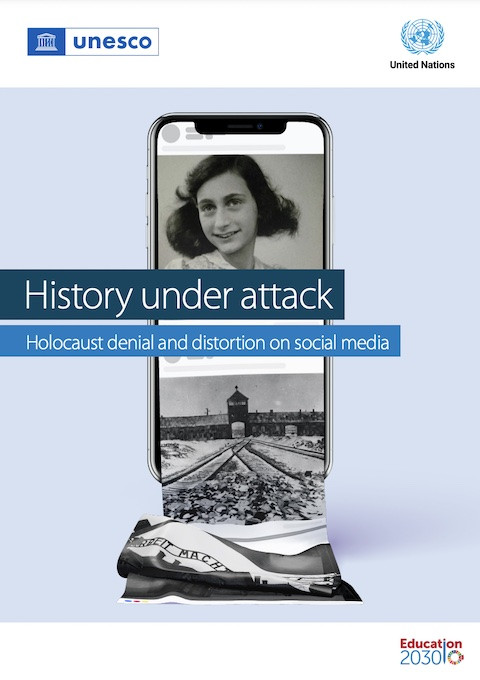 History Under Attack: Holocaust Denial and Distortion on Social Media سنة النشر: 2022 المؤلف المؤسسي: Организация Объединенных Наций по вопросам образования, науки и культуры (UNESCO) | United Nations (UN) Holocaust denial and distortion are dangerous. It is an attack on truth and knowledge. It feeds on and spreads antisemitic tropes and prejudices, and threatens our understanding of one of the most tragic and violent histories: The genocide of six million Jews by Nazi Germany, its allies and collaborators. In countries across Europe, people became complicit in the persecution and murder of their neighbours. Holocaust denial and distortion can prevent society from reckoning with this past. It impedes our comprehension of the causes and warning signs of genocide, and that might strengthen efforts for genocide prevention. It is insulting to the victims and survivors of the Holocaust, and risks the rehabilitation of violent, antisemitic ideologies. At its most extreme, it celebrates and glorifies this history, inciting violence against Jews and calling for another genocide. The United Nations and UNESCO condemn the rise of Holocaust denial and distortion online as a dangerous form of hatred, and commissioned this report in partnership with the World Jewish Congress to raise awareness of the forms and functions of Holocaust denial and distortion on social media, and determine a series of policy and educational responses. This report is a data-driven investigation into the extent and nature of Holocaust denial and distortion on online platforms. It is based on a manual review of almost 4,000 pieces of content collected in June and July 2021 that related to Jews, the Holocaust, antisemitism and Holocaust denial and distortion from five major online platforms and messenger apps. It looks at content posted on Facebook, Instagram, Telegram, TikTok and Twitter: some of the world’s largest online platforms and collectively home to billions of users. It addresses content in four different languages: English, French, Spanish and German, with the aim of providing a wide-ranging review that addresses multiple countries and contexts. This report aims to answer four questions:How much Holocaust-related content on social media either denies the Holocaust or distorts key elements of history?What are the key narratives in contemporary Holocaust denial and distortion?How are Holocaust denial and distortion communicated, and how are they situated within wider discourses and frames?What can online platform companies, policy-makers, educators and organizations promoting Holocaust remembrance, education and research do to tackle the problem? Based on the findings of this report, it provides a series of recommended actions that online platforms, policy-makers, civil society, researchers and educators can implement to prevent and counter Holocaust denial and distortion online.
 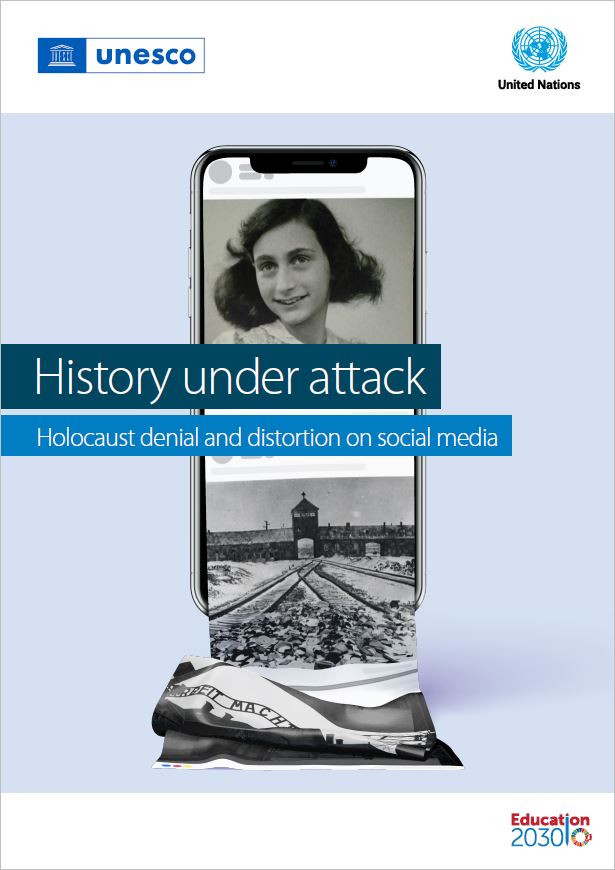 History Under Attack: Holocaust Denial and Distortion on Social Media سنة النشر: 2022 المؤلف المؤسسي: 联合国教科文组织 (UNESCO) | United Nations (UN) A new United Nations and UNESCO study together with the support of the World Jewish Congress investigates Holocaust denial and distortion on social media, measuring their extent and nature on Facebook, Instagram, Telegram, Twitter and TikTok, at a time when the memory and fundamental facts of the Holocaust are under threat from lies, smears and the spread of violent ideologies. It provides recommendations that governments, online platforms, educators and researchers can implement to counter denial and distortion, prevent antisemitism and uphold human rights.This report aims to provide a wide-ranging assessment of the extent to which Holocaust-related content on social media and online platforms denies its factual basis or distorts the Holocaust by minimizing or misrepresenting its history. The report seeks to identify content that has evaded content moderation (on platforms that seek to remove content which denies and distorts the Holocaust). Perhaps more importantly, it also aims to provide an understanding of how denial and distortion about the Holocaust are communicated by people on online platforms.