
Resources
Explore a wide range of valuable resources on GCED to deepen your understanding and enhance your research, advocacy, teaching, and learning.
4 Results found
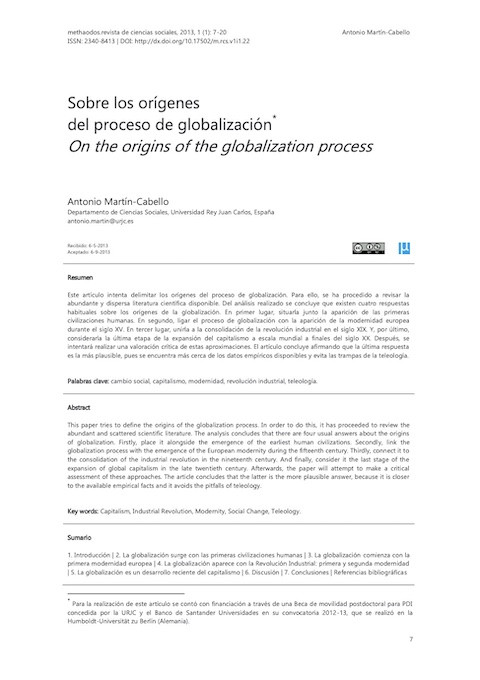 On the Origins of the Globalization Process (Methaodos.revista de ciencias sociales; vol. 1, no. 1) Year of publication: 2013 Author: Antonio Martín-Cabello Corporate author: Rey Juan Carlos University This paper tries to define the origins of the globalization process. In order to do this, it has proceeded to review the abundant and scattered scientific literature. The analysis concludes that there are four usual answers about the origins of globalization. Firstly, place it alongside the emergence of the earliest human civilizations. Secondly, link the globalization process with the emergence of the European modernity during the fifteenth century. Thirdly, connect it to the consolidation of the industrial revolution in the nineteenth century. And finally, consider it the last stage of the expansion of global capitalism in the late twentieth century. Afterwards, the paper will attempt to make a critical assessment of these approaches. The article concludes that the latter is the more plausible answer, because it is closer to the available empirical facts and it avoids the pitfalls of teleology. Sobre los orígenes del proceso de globalización (Methaodos.revista de ciencias sociales; vol. 1, no. 1) Year of publication: 2013 Author: Antonio Martín-Cabello Corporate author: Rey Juan Carlos University Este artículo intenta delimitar los orígenes del proceso de globalización. Para ello, se ha procedido a revisar la abundante y dispersa literatura científica disponible. Del análisis realizado se concluye que existen cuatro respuestas habituales sobre los orígenes de la globalización. En primer lugar, situarla junto la aparición de las primeras civilizaciones humanas. En segundo, ligar el proceso de globalización con la aparición de la modernidad europea durante el siglo XV. En tercer lugar, unirla a la consolidación de la revolución industrial en el siglo XIX. Y, por último, considerarla la última etapa de la expansión del capitalismo a escala mundial a finales del siglo XX. Después, se intentará realizar una valoración crítica de estas aproximaciones. El artículo concluye afirmando que la última respuesta es la más plausible, pues se encuentra más cerca de los datos empíricos disponibles y evita las trampas de la teleología.
 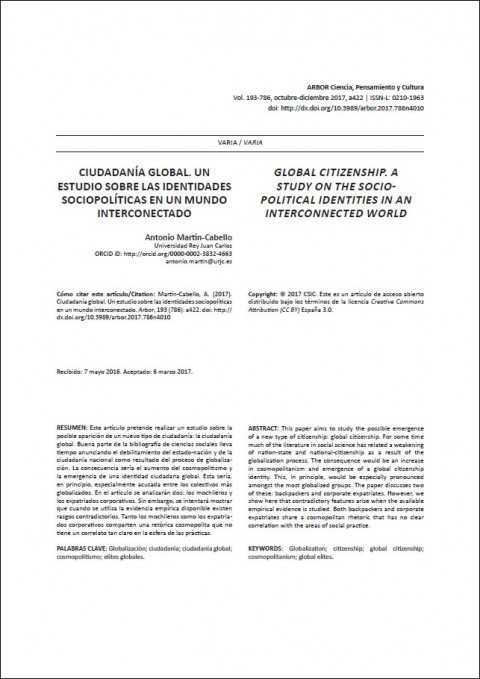 Global Citizenship: A Study on the Socio-political Identities in an Interconnected World Year of publication: 2017 Author: Antonio Martín-Cabello This paper aims to study the possible emergence of a new type of citizenship: global citizenship. For some time much of the literature in social science has related a weakening of nation-state and national-citizenship as a result of the globalization process. The consequence would be an increase in cosmopolitanism and emergence of a global citizenship identity. This, in principle, would be especially pronounced amongst the most globalized groups. The paper discusses two of these: backpackers and corporate expatriates. However, we show here that contradictory features arise when the available empirical evidence is studied. Both backpackers and corporate expatriates share a cosmopolitan rhetoric that has no clear correlation with the areas of social practice. Ciudadanía global. Un estudio sobre las identidades sociopolíticas en un mundo interconectado Year of publication: 2017 Author: Antonio Martín-Cabello Este artículo pretende realizar un estudio sobre la posible aparición de un nuevo tipo de ciudadanía: la ciudadanía global. Buena parte de la bibliografía de ciencias sociales lleva tiempo anunciando el debilitamiento del estado-nación y de la ciudadanía nacional como resultado del proceso de globalización. La consecuencia sería el aumento del cosmopolitismo y la emergencia de una identidad ciudadana global. Esta sería, en principio, especialmente acusada entre los colectivos más globalizados. En el artículo se analizarán dos: los mochileros y los expatriados corporativos. Sin embargo, se intentará mostrar que cuando se utiliza la evidencia empírica disponible existen rasgos contradictorios. Tanto los mochileros como los expatria- dos corporativos comparten una retórica cosmopolita que no tiene un correlato tan claro en la esfera de las prácticas.