
Resources
Explore a wide range of valuable resources on GCED to deepen your understanding and enhance your research, advocacy, teaching, and learning.
4 Results found
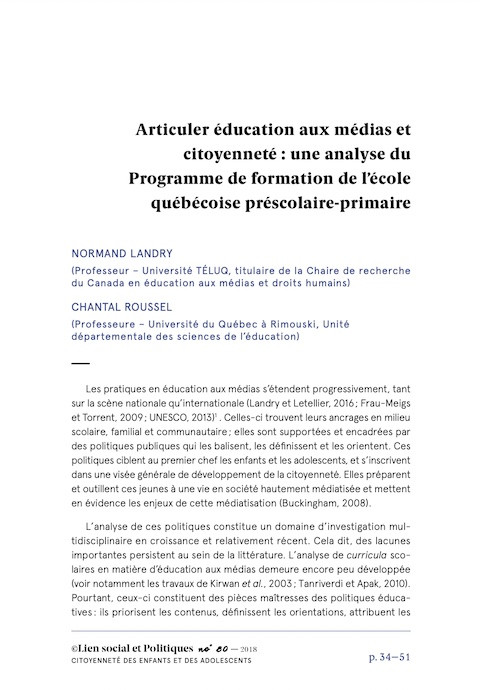 Media Education and Citizenship: An Analysis of the Quebec Preschool and Elementary Education Program (No. 80) Year of publication: 2018 Author: Normand Landry | Chantal Roussel Corporate author: Lien social et Politiques In Canada, the limited level of knowledge on media education content that is conveyed by academic curricula hinders its critical evaluation. This article presents the ways in which media education is introduced in the Quebec Education Program (QEP) at the preschool and elementary level. More specifically, it highlights the connections at work between media education, childhood and citizenship in the program. Our method tracks and extracts a set of statements related to information and communications technologies (ICTs) and the media, then conducts their automated classification into four principal categories: speech, verbs used that reflect the actions undertaken by categories of actors (school, pupils, teachers), learning objectives and suggestions. A subsequent classification allows for the emergence of verbs and learning objectives associated to the notion of citizenship. The latter are then subject to speech analysis. Our analysis intends to demonstrate the message conveyed by the QEP on media and ICTs. It highlights the roles, tasks and responsibilities of its various actors in relation to the acquisition of knowledge and skill development. In addition, it features the actions taken by these actors to operationalize the academic goals of the program. Our conclusion indicates a low subject implementation of the statements associated to media education and citizenship, relevant content, although thematically limited, along with the conception of students as capable of a reflection and critical thinking process. Articuler éducation aux médias et citoyenneté : Une analyse du Programme de formation de l’école québécoise préscolaire-primaire (nº 80) Year of publication: 2018 Author: Normand Landry | Chantal Roussel Corporate author: Lien social et Politiques Au Canada, le faible niveau de connaissance des contenus en éducation aux médias véhiculés par les curricula scolaires proscrit leur évaluation critique. Cet article présente les façons selon lesquelles l’éducation aux médias est introduite dans le Programme de formation de l’école québécoise (PFEQ) des niveaux préscolaire et primaire. Plus spécifiquement, il témoigne des articulations entre éducation aux médias, enfance et citoyenneté. La méthode utilisée procède au repérage et à l’extraction d’énoncés associés aux technologies de l’information et de la communication (TIC) et aux médias, puis à leur classement en quatre catégories principales : discours, verbes témoignant des actions de chaque catégorie d’acteurs (école, élève, enseignant), objets d’apprentissage et suggestions d’utilisation des TIC. Une classification permet de faire émerger les verbes et les objets d’apprentissage référant à la notion de citoyenneté en utilisant la définition et les composantes associées. Ces derniers sont ensuite soumis à une analyse de discours. Notre analyse fait émerger les discours véhiculés par le PFEQ sur les médias et les TIC. Elle met en exergue les rôles, les tâches et les responsabilités des différents acteurs en lien avec l’acquisition de connaissances et le développement de compétences. En outre, elle présente les actions menées par ces acteurs afin d’opérationnaliser les intentions pédagogiques du programme. La conclusion montre un faible ancrage disciplinaire des énoncés traitant de l’éducation aux médias et à la citoyenneté, des contenus pertinents, mais limités thématiquement, ainsi qu’une représentation de l’élève en tant qu’individu capable de réflexion et de pensée critique.
  Media Education and Citizenship: An analysis of the Quebec Preschool and Elementary Education Program Year of publication: 2018 Author: Normand Landry | Chantal Roussel Corporate author: Revue Lien social et Politiques In Canada, the limited level of knowledge on media education content that is conveyed by academic curricula hinders its critical evaluation. This article presents the ways in which media education is introduced in the Quebec Education Program (QEP) at the preschool and elementary level. More specifically, it highlights the connections at work between media education, childhood and citizenship in the program. Our method tracks and extracts a set of statements related to information and communications technologies (ICTs) and the media, then conducts their automated classification into four principal categories: speech, verbs used that reflect the actions undertaken by categories of actors (school, pupils, teachers), learning objectives and suggestions. A subsequent classification allows for the emergence of verbs and learning objectives associated to the notion of citizenship. The latter are then subject to speech analysis. Our analysis intends to demonstrate the message conveyed by the QEP on media and ICTs. It highlights the roles, tasks and responsibilities of its various actors in relation to the acquisition of knowledge and skill development. In addition, it features the actions taken by these actors to operationalize the academic goals of the program. Our conclusion indicates a low subject implementation of the statements associated to media education and citizenship, relevant content, although thematically limited, along with the conception of students as capable of a reflection and critical thinking process. Articuler éducation aux médias et citoyenneté : une analyse du Programme de formation de l’école québécoise préscolaire-primaire Year of publication: 2018 Author: Normand Landry | Chantal Roussel Corporate author: Revue Lien social et Politiques Au Canada, le faible niveau de connaissance des contenus en éducation aux médias véhiculés par les curricula scolaires proscrit leur évaluation critique. Cet article présente les façons selon lesquelles l’éducation aux médias est introduite dans le Programme de formation de l’école québécoise (PFEQ) des niveaux préscolaire et primaire. Plus spécifiquement, il témoigne des articulations entre éducation aux médias, enfance et citoyenneté. La méthode utilisée procède au repérage et à l’extraction d’énoncés associés aux technologies de l’information et de la communication (TIC) et aux médias, puis à leur classement en quatre catégories principales : discours, verbes témoignant des actions de chaque catégorie d’acteurs (école, élève, enseignant), objets d’apprentissage et suggestions d’utilisation des TIC. Une classification permet de faire émerger les verbes et les objets d’apprentissage référant à la notion de citoyenneté en utilisant la définition et les composantes associées. Ces derniers sont ensuite soumis à une analyse de discours. Notre analyse fait émerger les discours véhiculés par le PFEQ sur les médias et les TIC. Elle met en exergue les rôles, les tâches et les responsabilités des différents acteurs en lien avec l’acquisition de connaissances et le développement de compétences. En outre, elle présente les actions menées par ces acteurs afin d’opérationnaliser les intentions pédagogiques du programme. La conclusion montre un faible ancrage disciplinaire des énoncés traitant de l’éducation aux médias et à la citoyenneté, des contenus pertinents, mais limités thématiquement, ainsi qu’une représentation de l’élève en tant qu’individu capable de réflexion et de pensée critique.