
Resources
Explore a wide range of valuable resources on GCED to deepen your understanding and enhance your research, advocacy, teaching, and learning.
4 Results found
 Manual for Developing Intercultural Competencies: Story Circles Year of publication: 2020 Author: Darla K. Deardorff Corporate author: UNESCO This book presents a structured yet flexible methodology for developing intercultural competence in a variety of contexts, both formal and informal. Piloted around the world by UNESCO, this methodology has proven to be effective in a range of different contexts and focused on a variety of different issues. It, therefore, can be considered an important resource for anyone concerned with effectively managing the growing cultural diversity within our societies to ensure inclusive and sustainable development.The book serves as a tool to develop those competences, presenting an innovative adaptation of what could be considered an ancient tradition of storytelling found in many cultures. Through engaging in the methodology, participants develop key elements of intercultural competence, including greater self-awareness, openness, respect, reflexivity, empathy, increased awareness of others, and in the end, greater cultural humility.This book will be of great interest to intercultural trainers, policy makers, development practitioners, educators, community organizers, civil society leaders, university lecturers, and students – all who are interested in developing intercultural competence as a means to understand and appreciate difference, develop relationships with those across difference, engage in intercultural dialogue, and bridge societal divides. Manuel de développement des compétences interculturelles: les cercles d’histoires Year of publication: 2020 Author: Darla K. Deardorff Corporate author: UNESCO Le présent ouvrage propose une méthode structurée mais flexible de développement des compétences interculturelles qui pourra être utilisée dans les contextes les plus divers, formels ou informels. Mise en oeuvre à titre expérimental par l’UNESCO dans plusieurs pays du monde, cette méthode, qui aborde une grande diversité de thèmes, a apporté la preuve de son efficacité dans des situations très variées. Elle constitue donc un outil capital pour tous ceux qui ont à coeur d’appréhender efficacement la diversité culturelle grandissante qui est devenue la marque de nos sociétés, et ce afin de parvenir à un développement inclusif et durable.Ce manuel consacre l’adaptation innovante d’une tradition très ancienne, celle du récit, que l’on retrouve dans un très grand nombre de cultures. À l’aide de cette méthode, les participants apprennent à renforcer certains aspects clés des compétences interculturelles comme la conscience de soi, l’ouverture d’esprit, le respect, la réflexivité, l’empathie, la conscience d’autrui, en manifestant, en fin de compte, une plus grande humilité culturelle.Cette publication présente un grand intérêt pour les formateurs interculturels, les dirigeants politiques, les praticiens du développement, les éducateurs, les responsables des communautés et de la société civile, les universitaires et les étudiants – pour tous ceux qui s’intéressent au développement des compétences interculturelles comme moyen de comprendre et d’apprécier la différence, d’approfondir les relations indépendamment des différences, de participer au dialogue interculturel et de surmonter tout ce qui divise les sociétés. 培养跨文化能力手册 : 故事圈 Year of publication: 2020 Author: Darla K. Deardorff Corporate author: UNESCO 该文件详细介绍了用以培养跨文化能力的“故事圈”的方法,包括其使用的工具,操作方法等,同时包括了大量培训资源、案例素材与辅助材料。
 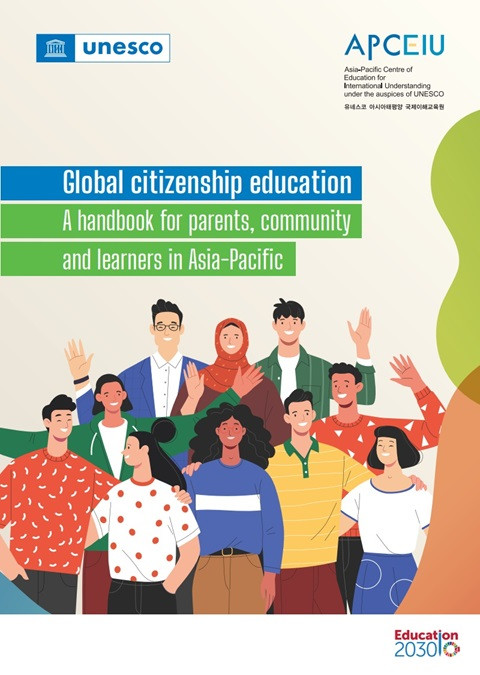 Global Citizenship Education: A Handbook for Parents, Community and Learners in Asia-Pacific Year of publication: 2023 Author: Darla K. Deardorff | Seek Ling Tan Corporate author: UNESCO Bangkok | APCEIU This handbook aspires to engage and involve parents, caregivers and the community to join the mission of developing every learner into a global citizen. To achieve this, parents, caregivers and the community will need to be empowered with the necessary GCED knowledge and skills too. In this handbook, GCED related concepts are introduced, alongside adaptable step-by-step action plans and best practices collected across the Asia-Pacific region to support parents and the community to take action in developing GCED competences in learners.