
Resources
Explore a wide range of valuable resources on GCED to deepen your understanding and enhance your research, advocacy, teaching, and learning.
4 Results found
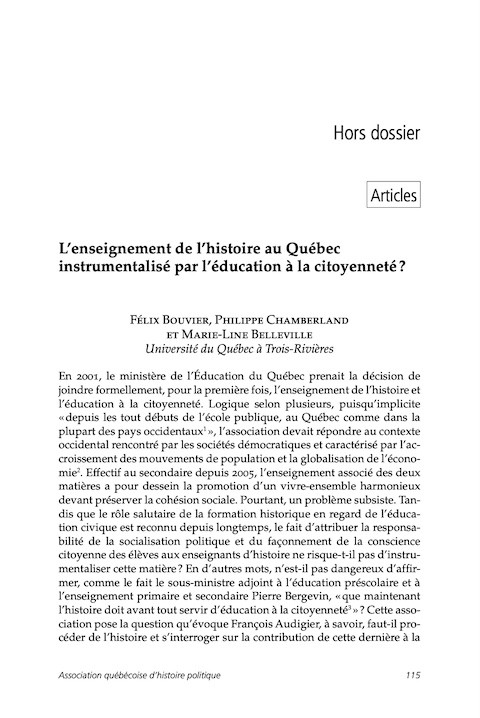 Is History Teaching in Quebec Instrumentalized by Citizenship Education? (Bulletin d'histoire politique; vol. 21, no. 3) Year of publication: 2013 Author: Félix Bouvier | Philippe Chamberland | Marie-Line Belleville Corporate author: Association québécoise d'histoire politique | VLB Éditeur In 2001, the Quebec Ministry of Education made the decision to formally join, for the first time, the teaching of history and education to citizenship. Logical according to many, since implicit" since the very beginning. beginnings of public schools, in Quebec as in most Western countries”, the association had to respond to the Western context encountered by democratic societies and characterized by the increase in population movements and the globalization of the economy. In secondary school since 2005, the associated teaching of the two subjects aims to promote a harmonious living together to preserve social cohesion. However, a problem remains. history with regard to civic education has long been recognized, the attribution of responsibility for political socialization and the shaping of consciousness citizen of students to history teachers risk instrumentalizing this subject? In other words, is it not dangerous to assert, as the Assistant Deputy Minister for Preschool, Elementary and Secondary Education Pierre Bergevin does, “that now history must above all serve as education for citizenship”? This association poses the question that François Audigier evokes, namely, should we proceed from history and question the latter's contribution to citizen consciousness, or proceed from the aspects of citizen consciousness that one wishes to construct and then determine the historical objects which should be studied? The experience of comparable nations on a planetary scale makes us doubt the relevance of the association of the two disciplines. In fact, some Western democracies are worried about the quality of the civic education of their young people since the waves of industrialization and the great wars of the XIXth and XXth centuries which changed manners forever: intensification of migrations, upheavals social roles, loss of influence of religions, etc. Thus, although Great Britain has for some time taken the path taken by Quebec, France clearly dissociates the teaching of history from that of civic education. In order to understand all the ins and outs of the issue, we first provide a portrait of the context at the origin of the association of history and education for citizenship. Then, we will discuss the arguments in favor of combining the two subjects, especially in Great Britain, France and Australia. Finally, our gaze will focus on the case of Quebec and the type of privileged citizenship, in order to determine whether the teaching of history is not instrumentalised for the benefit of a citizenship education valuing the concealment of conflicts and divergences and if, to use the writings of Robert Martineau, the Ministry of Education has sacrificed the history class on the altar of citizenship education. L’enseignement de l’histoire au Québec instrumentalisé par l’éducation à la citoyenneté? (Bulletin d'histoire politique; vol. 21, no. 3) Year of publication: 2013 Author: Félix Bouvier | Philippe Chamberland | Marie-Line Belleville Corporate author: Association québécoise d'histoire politique | VLB Éditeur En 2001, le ministère de l’Éducation du Québec prenait la décision de joindre formellement, pour la première fois, l’enseignement de l’histoire et l’éducation à la citoyenneté. Logique selon plusieurs, puisqu’implicite « depuis les tout débuts de l’école publique, au Québec comme dans la plupart des pays occidentaux », l’association devait répondre au contexte occidental rencontré par les sociétés démocratiques et caractérisé par l’ac-croissement des mouvements de population et la globalisation de l’économie. Effectif au secondaire depuis 2005, l’enseignement associé des deux matières a pour dessein la promotion d’un vivre-ensemble harmonieux devant préserver la cohésion sociale. Pourtant, un problème subsiste. Tan-dis que le rôle salutaire de la formation historique en regard de l’éducation civique est reconnu depuis longtemps, le fait d’attribuer la responsabilité de la socialisation politique et du façonnement de la conscience citoyenne des élèves aux enseignants d’histoire ne risque-t-il pas d’instrumentaliser cette matière ? En d’autres mots, n’est-il pas dangereux d’affirmer, comme le fait le sous-ministre adjoint à l’éducation préscolaire et à l’enseignement primaire et secondaire Pierre Bergevin, « que maintenant l’histoire doit avant tout servir d’éducation à la citoyenneté » ? Cette association pose la question qu’évoque François Audigier, à savoir, faut-il pro-céder de l’histoire et s’interroger sur la contribution de cette dernière à la conscience citoyenne, ou procéder des aspects de la conscience citoyenne que l’on souhaite construire et déterminer alors les objets historiques dont il faut privilégier l’étude ? L’expérience de nations comparables à l’échelle planétaire nous fait douter de la pertinence de l’association des deux dis-ciplines. En fait, certaines démocraties occidentales s’inquiètent de la qualité de la formation citoyenne de leurs jeunes depuis les vagues d’industriali-sation et les grandes guerres des XIXe et XXe siècles qui ont bouleversé à jamais les mœurs : intensifi cation des migrations, bouleversements des rôles sociaux, perte d’infl uence des religions, etc. Ainsi, bien que la Grande-Bretagne prenne depuis un moment le chemin pris par le Québec, la France dissocie clairement l’enseignement de l’histoire et celui de l’édu-cation civique. Afi n de saisir l’ensemble des tenants et aboutissants de la question, nous dressons d’abord le portrait du contexte à l’origine de l’as-sociation de l’histoire et de l’éducation à la citoyenneté. Ensuite, nous aborderons les arguments en faveur de l’association des deux matières, notamment en la Grande-Bretagne, en France et en Australie. Finalement, notre regard se portera sur le cas québécois et le type de citoyenneté privi-légié, afi n de déterminer si l’enseignement de l’histoire n’est pas instru-mentalisé au profi t d’une éducation à la citoyenneté valorisant l’occulta-tion des confl its et des divergences et si, pour reprendre des écrits de Robert Martineau, le ministère de l’Éducation a sacrifi é la classe d’histoire sur l’autel de l’éducation à la citoyenneté.
 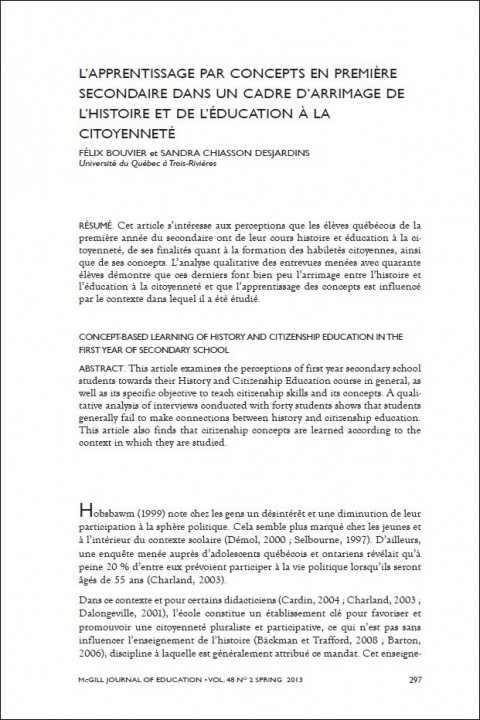 Concept-Based Learning of History and Citizenship Education in the First Year of Secondary School Year of publication: 2013 Author: Félix Bouvier | Sandra Chiasson Desjardins Corporate author: McGill University. Faculty of Education This article examines the perceptions of first year secondary school students towards their History and Citizenship Education course in general, as well as its specific objective to teach citizenship skills and its concepts. A qualitative analysis of interviews conducted with forty students shows that students generally fail to make connections between history and citizenship education. This article also finds that citizenship concepts are learned according to the context in which they are studied. L’apprentissage par concepts en première secondaire dans un cadre d’arrimage de l’histoire et de l’éducation à la citoyenneté Year of publication: 2013 Author: Félix Bouvier | Sandra Chiasson Desjardins Corporate author: McGill University. Faculty of Education Cet article s’intéresse aux perceptions que les élèves québécois de la première année du secondaire ont de leur cours histoire et éducation à la citoyenneté, de ses finalités quant à la formation des habiletés citoyennes, ainsi que de ses concepts. L’analyse qualitative des entrevues menées avec quarante élèves démontre que ces derniers font bien peu l’arrimage entre l’histoire et l’éducation à la citoyenneté et que l’apprentissage des concepts est influencé par le contexte dans lequel il a été étudié.