
Resources
Explore a wide range of valuable resources on GCED to deepen your understanding and enhance your research, advocacy, teaching, and learning.
2 Results found
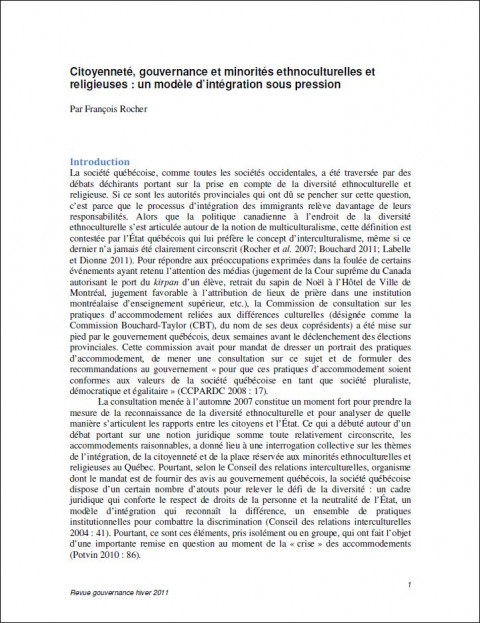 Citoyenneté, gouvernance et minorités ethnoculturelles et religieuses : un modèle d’intégration sous pression Year of publication: 2011 Author: François Rocher Corporate author: Revue Gouvernance S’appuyant sur la notion de citoyenneté substantive, cet article vise à mieux cerner les conditions d’inclusion et d’exclusion des minorités ethnoculturelles et religieuses au sein de l’État québécois. Il s’intéresse aussi aux modèles de gouvernance privilégiés par ceux‐ci et examine le rapport entre la participation civique et la gestion des affaires publiques afin de mieux comprendre le type de gouvernance privilégiée par l’État et l’incidence de ce choix sur le rapport qu’entretiennent les minorités face à l’État. Son originalité repose sur un angle d’approche qui demeure peu étudié, notamment le discours des minorités ethnoculturelles et religieuses face à l’État. Au Québec plusieurs moments critiques autour de la question des accommodements raisonnables se sont enchaînés, culminant en la création de la Commission Bouchard‐Taylor en 2007. Ce qui a débuté autour d’un débat portant sur une notion juridique somme toute relativement circonscrite a donné lieu à une interrogation collective sur les thèmes de l’intégration, de la citoyenneté et de la place réservée aux minorités ethnoculturelles et religieuses au Québec. Cette recherche analyse les positions exprimées par les leaders des minorités ethnoculturelles ou religieuses quant aux principes et modalités de participation à la vie publique et aux rapports qu’elles veulent entretenir avec l’État. Elle cherchera à montrer l’hétérogénéité des approches privilégiées et les défis que cela pose sur les différents modèles de gouvernance pouvant être adoptés. Citizenry, Governance and Ethno‐cultural and Religious Minorities: A Model of Integration Under Stress Year of publication: 2011 Author: François Rocher Corporate author: Revue Gouvernance Using citizenship as a lens, this article aims to determine the conditions that result in the inclusion or exclusion of ethno-cultural and religious minorities in Quebec. It is also interested in models of governance that examine how the type of governance practiced by the state is reflected in the policies put forward and the consequences on the participation of ethno-cultural and religious minorities in the public realm. This research is innovative since it proposes to examine the positions put forward by ethno-cultural and religious minorities, a perspective that has been, for the most part, overlooked in the literature. In Quebec, numerous events concerning the accommodation of ethnocultural and religious differences have marked the social and political climate. The creation, by the Quebec government in February 2007, of the Bouchard-Taylor Commission, culminated in a society-wide re-evaluation of the models of integration, of citizenship and of the role of ethno-cultural and religious minorities in Quebec society. This article seeks to illustrate the variety of positions put forward by ethno-cultural and religious minorities, and the challenges vis-à-vis various models of governance.