
Resources
Explore a wide range of valuable resources on GCED to deepen your understanding and enhance your research, advocacy, teaching, and learning.
3 Results found
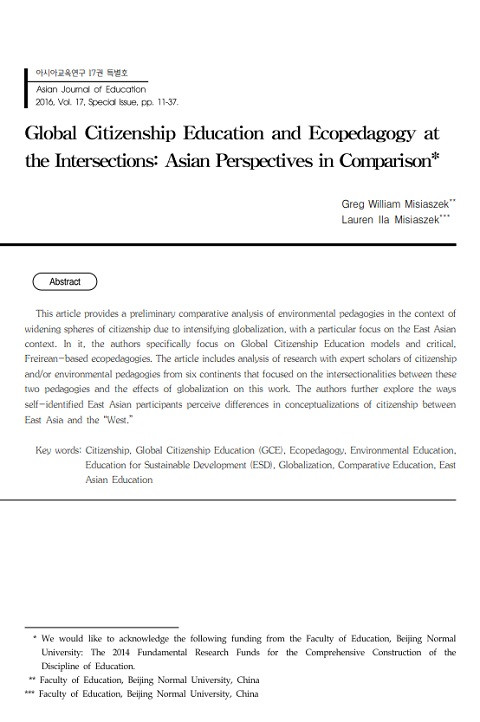 Global Citizenship Education and Ecopedagogy at the Intersections: Asian Perspectives in Comparison (Asian Journal of Education; Vol. 17, Special Issue) Year of publication: 2016 Author: Greg William Misiaszek | Lauren Ila Misiaszek Corporate author: Seoul National University. Education Research Institute This article provides a preliminary comparative analysis of environmental pedagogies in the context of widening spheres of citizenship due to intensifying globalization, with a particular focus on the East Asian context. In it, the authors specifically focus on Global Citizenship Education models and critical, Freirean-based ecopedagogies. The article includes analysis of research with expert scholars of citizenship and/or environmental pedagogies from six continents that focused on the intersectionalities between these two pedagogies and the effects of globalization on this work. The authors further explore the ways self-identified East Asian participants perceive differences in conceptualizations of citizenship between East Asia and the “West.”
  Ecopedagogy and citizenship in the age of globalisation: connections between environmental and global citizenship education to save the planet Year of publication: 2015 Author: Greg William Misiaszek Corporate author: Wiley‑Blackwell Teaching the connections between environmentally-harmful acts and social conflict is essential but is often ignored in education. This article presents two ways in which these are not taught because of the policies of those who benefit from the ignorance of these connections: first, the avoidance of teaching global-local connectivity and second, the devaluing of non-dominant cultures. Ecopedagogy is a democratic, transformative pedagogy centred on increasing justice by critically teaching the politics of environmental issues. I argue that global citizenship education (GCE) must be an element of ecopedagogy to contextually learn globalisation's effects upon local communities. In addition, GCE's goal is to increase students' understanding of diverse cultures to respect them. Ecopedagogy is also essential to GCE to fully teach social conflicts resulting from environmentally harmful acts. I offer policy and pedagogical changes to disrupt reproductive environmental pedagogies that help to sustain environmental ills for ecopedagogy-GCE models to emerge. Ecopedagogy et Citoyenneté à l'ère de la Mondialisation: des liens entre l'environnement et l'éducation à la citoyenneté Mondiale (ECM) pour sauver la planète Year of publication: 2015 Author: Greg William Misiaszek Corporate author: Wiley‑Blackwell Enseigner les liens entre les actes nuisibles à l'environnement et les conflits sociaux est essentielle, mais est souvent ignorée dans l'éducation. Cet article présente deux façons dont ceux-ci ne sont pas enseignées à cause des politiques de ceux qui profitent de l'ignorance de ces connexions: d'abord, l'évitement de l'enseignement connectivité mondiale-locale et, deuxièmement, la dévalorisation des cultures non dominantes. Ecopedagogy est une société démocratique, la pédagogie transformative centrée sur l'augmentation de la justice par l'enseignement critique la politique des questions environnementales. Je soutiens que L'éducation à la citoyenneté Mondiale (ECM) doit être un élément de ecopedagogy apprendre contextuellement les effets de la mondialisation sur les communautés locales. En outre, l'objectif de l'ECM est d'accroître la compréhension des élèves de diverses cultures à les respecter. Ecopedagogy est également essentiel d'ECM pour enseigner pleinement les conflits sociaux résultant d'actes préjudiciables à l'environnement. Je propose des changements politiques et pédagogiques pour perturber les pédagogies environnementaux de reproduction qui aident à maintenir les maux environnementaux pour les modèles ecopedagogy-ECM à émerger.