
Resources
Explore a wide range of valuable resources on GCED to deepen your understanding and enhance your research, advocacy, teaching, and learning.
6 Results found
 SDG 4 Midterm Review: Monitoring Implementation of SDG 4 Target 4.1. ~ 4.c. in Rep. of Korea Year of publication: 2023 Author: Hunwoo Joo | Mikyung Kim | Mugyeong Moon | Jeongwon Hwang | Kirak Ryu | Hyeseung Cho | Yunjeong Choi | Hyosook Shin | Kyungsook Kang | Minseon Park | Eunju Lee | Nayoung Kim | Hwanbo Park | Hannah Kim | Jonghun Kim Corporate author: National Consultative Group on Education 2030 | Korean National Commission for UNESCO This report presents the compiled work from the National Consultative Group and Working Groups on Education 2030 of the Republic of Korea regarding the midterm review on the implementation of SDG 4.
  A Study on the Monitoring Framework of GCED in South Korea Year of publication: 2020 Author: Hwanbo Park | Daehoon Jho | Kyunghee Park | Jeongmin Eom Corporate author: APCEIU The purpose of this study is to establish a feasible monitoring system for the implementation of Global Citizenship Education (GCED) in South Korea that can both align itself with the global indicator (SDG 4.7.1) and reflect the domestic context and feasibility. The study further builds upon previous studies carried out by the Asia-Pacific Centre of Education for International Understanding (APCEIU). Particularly, it aims to refine and validate the GCED indicator system for domestic monitoring as proposed in the previous studies, which are also in line with SDG 4.7.1, the global indicator to monitor the mainstreaming of GCED/ESD.To this end, the study involved a Delphi survey and expert consultation to build the refined list and classification of GCED related thematic areas and keywords contextualized in Korea, and aligned these with global indicators so that it could establish a set of sub-indicators for the South Korean context. Then, it pilot-tested the sub-indicators by codifying and statistically analyzing key policy documents and the curricula of Teacher Education Institutes (TEIs) to validate the sub-indicators and to examine the extent to which GCED is mainstreamed in the given domains of the Korean context. Case analyses with focused interviews for some TEI curricula were also added to enrich the study. Lastly, the study draws key implications and proposes some recommendations for the establishment of a feasible and sustainable GCED monitoring system in South Korea. Considering the importance of national input in initiating the SDG agenda, the research concluded with a proposal on how to manage the global citizenship indicators in South Korea.
  2021 Study on the Monitoring Framework of GCED in South Korea Year of publication: 2021 Author: Hwanbo Park | Daehoon Jho | Kyunghee Park | Sungho Park | Jeongmin Eom Corporate author: APCEIU The purpose of this study is to establish a feasible monitoring system for the implementation of Global Citizenship Education (GCED) in South Korea that can both align itself with the global indicator (SDG 4.7.1) and reflect the domestic context and feasibility. To this end, the study continues to examine the extent to which GCED is mainstreamed in education policies in Korea by utilizing the monitoring tool developed by the aforementioned 2020 study. In so doing, it aims to build sustaining and robust data in the area of GCED policies with the consistent monitoring tool developed. Second, the study explores enabling aspects as well as gaps between policies or programmes and how GCED is implemented on the ground by schools and teachers. Through this analysis, the study draws implications for further refining of the developed monitoring system. Third, the study surveys and analyzes existing monitoring tools developed by other fields and the data accumulated through those existing tools to assess learners' knowledge acquisition, values, skills and attitudes relevant to global citizenship competences, In so doing, it explores possibilities and makes recommendations for effectively monitoring learners’ competences by utilizing and modifying existing tools as well as developing new ones.
  An Analysis of the Global Citizenship of Youth Participated in Global Citizenship Education (Journal of Education for International Understanding; Vol. 13, No. 1) Year of publication: 2018 Author: Kyunghee Park | Hwanbo Park | Namsoon Kim Corporate author: Korean Society of Education for International Understanding (KOSEIU) The purpose of this study is to analysis characteristics of the global citizenship for youth participated in global citizenship education and the factors influencing for global citizenship. To achieve this, the study surveyed around 300 youth participated in global citizenship education. The results of the analysis are as follows. First, global citizenship of youth participated in global citizenship education are generally higher than those of ordinary youth. Second, it was analyzed that the global citizenship was significantly higher for girls than boys; for the lower school level than higher; and for the ones having the greater experience with the mass media, overseas visits, and family communication. Factors influencing the global citizenship of youth participated in global citizenship education were influenced by school class, experience in mass media, gender, communication with family, and experience of visiting abroad. The results suggest that there is a need to think about ways to educate the global citizenship through everyday life, such as using various media and communicating with family as well as participating in education programs to improve the level of global citizenship.
 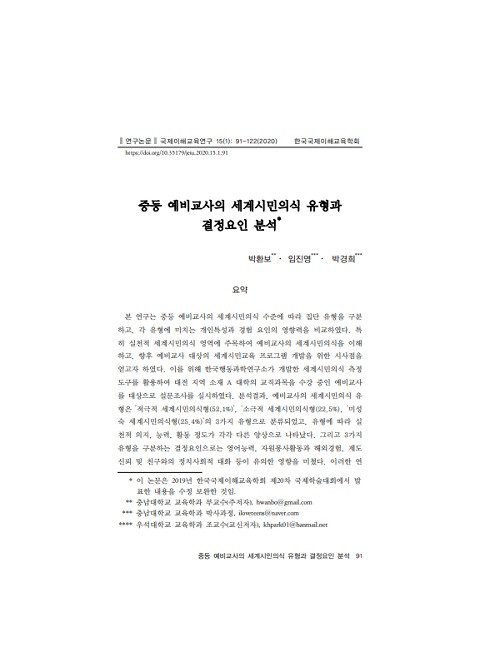 An Analysis on the Types of Global Citizenship Among the Pre-Service Secondary Teachers and the Determinant Factors (Journal of Education for International Understanding; Vol. 15, No. 1) Year of publication: 2020 Author: Hwanbo Park | Jinyoung Im | Kyunghee Park Corporate author: Korean Society of Education for International Understanding (KOSEIU) This study aims to investigate the types of global citizenship among pre-service teachers based on the level of global citizenship and to explore the factors effect on each types. Especially, this study focus on the action area among the three dimension of global citizenship. For this purpose, 180 students were surveyed A university in Daejeon metro city with measurement tool developed by Korea Institute for Research in the Behavioral Sciences (KIRBS). The results show that the types of pre-service teachers divided into 3 group, ‘active global citizenship (52.1%)’, ‘passive global citizenship (22.5%)’, and ‘immature global citizenship (25.4%)’. fluency of English language, experience of volunteer and overseas, institutional trust, and communication with friends about political issues were significant factor effect on the practical type of global citizenship. The findings suggest that it is necessary to provide global citizenship education based on the characteristics of the pre-service teachers.
 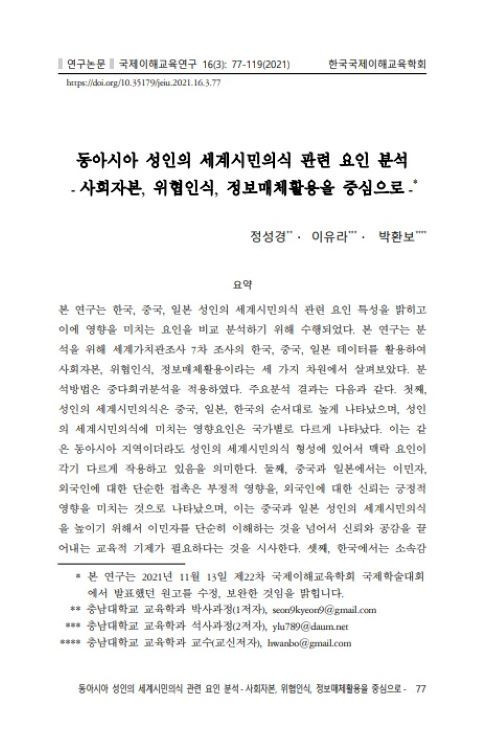 An Analysis of the Factors Affecting East-Asian Adults’ Global Citizenship: Social capital, Threat Recognition, Information Media Utilization (Journal of Education for International Understanding; vol.16, no.3) Year of publication: 2021 Author: Seongkyeong Jeong | Yura Lee | Hwanbo Park Corporate author: Korean Society of Education for International Understanding (KOSEIU) This paper puts an in-depth study on identifying the characteristics of factors related to global citizenship in adults from South Korea, China, and Japan and analyzing the elements affecting them. For this purpose, data from the 7th World Value Survey which was undertaken in South Korea, China, and Japan were used, and they were examined with three different perspectives of social capital, threat recognition, and information media utilization to get to know the influence of variables from various aspects. Multiple regression was applied for this and the results are as follows. Firstly, the global citizenship of adults was high in the order of China, Japan, and South Korea, and the factors influencing global citizenship depend on the country. This implies that contextual factors are acting differently in the formation of the global citizenship of adults even they are from the same East Asian region. Secondly, simple contact with immigrants and foreigners in China and Japan has negative effects while having a positive effect on trust in foreigners. This suggests that an educational mechanism is required to raise trust and empathy beyond understanding immigrants simply to foster global citizenship among Chinese and Japanese adults. Thirdly, depending on the hierarchy of the sense of belonging, the impact on global citizenship was different in South Korea. Educational activities and programs should be implemented to establish the sense of global citizenship of adults in South Korea. Fourthly, the treat perception of social safety and employment insecurity in South Korea and China did not have statistical significance to global citizenship. While the higher the social safety perception the heavier the employment insecurity, adults in Japan had higher global citizenship awareness. This implies that Japanese adults perceive the problems of immigration as a matter of national or social situation and structure. Finally, the utilization of information media in all countries revealed statistical significance, which means that attitude for immigrants would vary depending on which information medica is used from those three countries.