
Resources
Explore a wide range of valuable resources on GCED to deepen your understanding and enhance your research, advocacy, teaching, and learning.
3 Results found
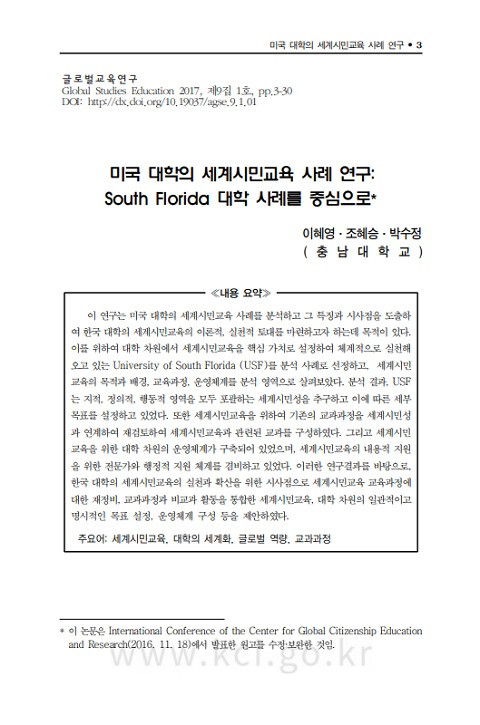 A Case Study on Global Citizenship Education of University of South Florida (Global Studies Education; Vol. 9, No. 1) Year of publication: 2017 Author: Hyeyoung Lee | Hyeseung Cho | Soojung Park Corporate author: Global Studeis Education Association This study investigates the issues for the practice of global citizenship education in universities and analyses a case study of the university in US. The University of South Florida (USF), which defines global citizen education as one of the core strategic plans of the university, is selected. Global citizenship education at USF is aimed at strengthening students' global competencies; global awareness, responsibility and participation. The goals of the practice are globalization of the undergraduate general education curriculum, extra-curricular activities in connection with the curriculum, globalized curriculum leading to graduate courses, and enhancing global competencies of all university members. It is reported that USF dedicated special organizations and systematic operation to support these goals. Based on our investigation and analysis, a reform of the global citizen education curriculum, a global citizenship education that integrates the curriculum and the extra-curricular activities, a coherent and explicit goal setting at the university level, and an operating system structure are required for universities in Korea to promote global citizenship education.
  SDG 4 Midterm Review: Monitoring Implementation of SDG 4 Target 4.1. ~ 4.c. in Rep. of Korea Year of publication: 2023 Author: Hunwoo Joo | Mikyung Kim | Mugyeong Moon | Jeongwon Hwang | Kirak Ryu | Hyeseung Cho | Yunjeong Choi | Hyosook Shin | Kyungsook Kang | Minseon Park | Eunju Lee | Nayoung Kim | Hwanbo Park | Hannah Kim | Jonghun Kim Corporate author: National Consultative Group on Education 2030 | Korean National Commission for UNESCO This report presents the compiled work from the National Consultative Group and Working Groups on Education 2030 of the Republic of Korea regarding the midterm review on the implementation of SDG 4.
 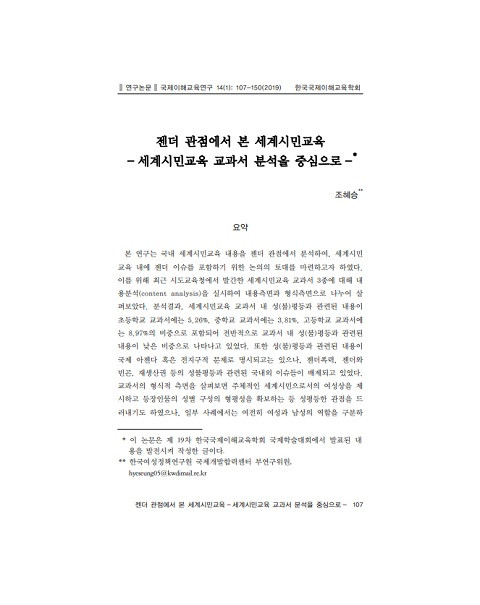 Integrating Gender into Global Citizenship Education (Journal of Education for International Understanding; Vol. 14, No. 1) Year of publication: 2019 Author: Hyeseung Cho Corporate author: Korean Society of Education for International Understanding (KOSEIU) The purpose of this study is to explore the contents of global citizenship education(GCE) from a gender perspective, and to lay the theoretical foundation to integrate gender issues into GCE. To this end, this research analyzes GCE textbooks published by four Metropolitan City Offices of Education employing content analysis. As results, GCE textbooks rarely include contents related to gender (in)equality by representing 5.26%, 3.81%, and 8.97% of the textbooks of elementary, middle and high school respectively. In terms of topics, although a word of gender (in)equality is mentioned as an international agenda or a global problems in textbooks, the specific concept of it or various worldwide gender inequalities issues such as gender-based violence, women in poverty, reproductive rights were excluded. In terms of format aspects of the textbooks, the textbooks present gender perspective by describing woman as an independent global citizen, and by ensuring the equality of gender composition of characters. In some cases, however, the roles of women and men in textbooks are still divided, and gender stereotype was recognized through sex=segregated activities. Based on these results, this research argues that it is required to expand the contents of GCE by including the importance of gender equality and global structural gender inequality problems, and that it is necessary to review the discourse and practice of GCE in Korea from a gender perspective.