
Resources
Explore a wide range of valuable resources on GCED to deepen your understanding and enhance your research, advocacy, teaching, and learning.
5 Results found
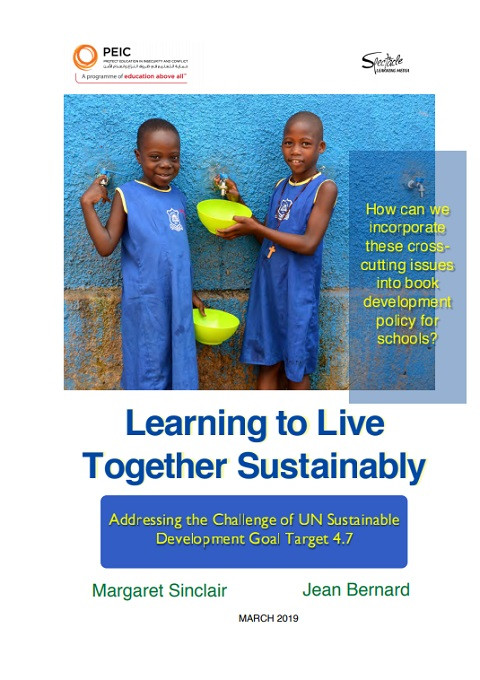 Learning to Live Together Sustainably: Addressing the Challenge of UN Sustainable Development Goal Target 4.7 Year of publication: 2019 Author: Margaret Sinclair | Jean Bernard Corporate author: Protect Education in Conflict and Insecurity (PEIC) | Spectacle Learning Media The practical advice and guidelines in this book help support learning to live together, conflict transformation and peace at the individual, group and community levels. The framework for developing widely accessible, high quality learning materials supports the UN Sustainable Development Goals and is relevant to formal and non-formal education activities and projects. This document also raises important issues about the professional responsibilities of policy-makers at global and national level, who determine what content is addressed in the classroom. In particular, it addresses the need for education materials that support cross-cutting issues such as learning to live together, global citizenship education, and education for sustainable development.
  Learning to live together: education for conflict resolution, responsible citizenship, human rights and humanitarian norms Year of publication: 2013 Author: Margaret Sinclair Corporate author: Education Above All (Qatar) Education cannot offer immediate remedies to the local and global problems that we see on the news screens every day, but it can contribute to solving them over the longer term. This book examines specifically the contribution that education for learning to live together can make, even in countries where teacher training and classroom resources are limited. Many countries have diverse populations (ethnic, linguistic, religious, etc) and seek to maintain harmony among the different groups. In some countries, however, especially where economic stress or climate change have intensified arguments over resources, tensions have led to armed conflict. This brings with it all the misery of death, injury, displacement and poverty, along with disruption of education systems. In some instances education itself has been a contributory factor to the outbreak of conflict, notably through unequal education opportunities for different groups, and through biased school curricula.Civil conflict has brought untold suffering in recent years, and in a globalised world it has negative spill-over effects to neighbouring and other countries. It is vital to develop education policies and curricular reforms that can help convey values and skills for learning to live together to young people, to help lessen tensions, within and between countries.Education policy-makers can help lay the foundations for a better future by adjusting the content and process of education to reflect skills and values for human rights, humanitarian norms, peaceful resolution of conflicts, sustainable development and other issues as elements of local, national and global citizenship.Education reform is not enough, of course, to resolve the numerous problems of our times. The focus of this volume is on the contribution that can be made through aligning the content of education to the goal of learning to live together. This work will have greater impact when it takes place within education systems and policies that are consistent with human rights values and of course when other sectors besides education make their respective contributions.This book shows that transformative education for conflict resolution and peace, for local, national and global citizenship, for human rights and humanitarian values can be implemented even under difficult conditions if there is a policy commitment to do so. Authors have provided examples and lessons learned from their own experiences as eminent practitioners in the field. Learning to live together: education for conflict resolution, responsible citizenship, human rights and humanitarian norms Year of publication: 2013 Author: Margaret Sinclair Corporate author: Education Above All (Qatar) L'éducation ne peut offrir des remèdes immédiats aux problèmes locaux et mondiaux que nous voyons sur les écrans d'information tous les jours, mais elle peut contribuer à les résoudre sur le long terme. Ce livre examine spécifiquement la contribution que l'éducation peut apporter pour vivre ensemble même dans les pays où la formation des enseignants et les ressources en classe sont limitées.De nombreux pays ont des populations diverses (ethniques, linguistiques, religieuses, etc.) cherchent à maintenir l'harmonie entre les différents groupes. Dans certains pays, cependant, en particulier lorsque le stress économique ou les changements climatiques ont intensifié les arguments sur les ressources, les tensions ont conduit à des conflits armés. Cela apporte avec elle toute la misère de la mort, les blessures, le déplacement et la pauvreté, ainsi que la perturbation des systèmes éducatifs. Dans certains cas, l'éducation elle-même a été un facteur contributif à l'éclatement du conflit, notamment grâce à des possibilités d'éducation inégales pour les différents groupes, et à travers les programmes scolaires biaisés.La guerre civile a causé des souffrances indicibles au cours des dernières années, et dans un monde globalisé, il a des effets négatifs de débordement vers les pays voisins et d'autres pays. Il est essentiel d'élaborer des politiques de l'éducation et la réforme des programmes qui peuvent aider à transmettre les valeurs et les compétences pour apprendre à vivre ensemble pour les jeunes, pour aider à réduire les tensions, à l'intérieur et entre les pays.Education décideurs politiques peuvent aider à jeter les bases d'un avenir meilleur en ajustant le contenu et le processus de l'éducation afin de refléter les compétences et les valeurs des droits de l'homme, des normes humanitaires, la résolution pacifique des conflits, le développement durable et d'autres questions comme éléments de local, national et citoyenneté mondiale.Réforme de l'éducation ne suffit pas, bien sûr, de résoudre les nombreux problèmes de notre temps. L'objectif de ce volume est sur la contribution qui peut être faite par le biais d'aligner le contenu de l'éducation à l'objectif d'apprendre à vivre ensemble. Ce travail aura un plus grand impact quand il a lieu au sein des systèmes et politiques d'éducation qui sont conformes aux valeurs des droits de l'homme et bien sûr, quand d'autres secteurs en dehors de l'éducation font leurs contributions respectives.Ce livre montre que l'éducation transformatrice pour la résolution des conflits et la paix, à la citoyenneté locale, nationale et mondiale, des droits de l'homme et des valeurs humanitaires peut être appliqué même dans des conditions difficiles, s'il y a un engagement politique de le faire. Les auteurs ont fourni des exemples et les enseignements tirés de leurs propres expériences en tant que praticiens éminents dans le domaine.
  NISSEM Global Briefs: Educating for the Social, the Emotional and the Sustainable Year of publication: 2019 Author: Andy Smart | Margaret Sinclair | Aaron Benavot | Jean Bernard | Colette Chabbott | S. Garnett Russell | James Williams Corporate author: Networking to Integrate SDG Target 4.7 and SEL skills into Educational Materials (NISSEM) The NISSEM global briefs are a collection of peer-reviewed essays from over 60 contributors with standing within the field of education. At the junction of SDG Target 4.7, SEL, and education in post conflict and low-resource settings, the NISSEM global briefs are a key resource for current research and practice.NISSEM is a Networking to Integrate SDG Target 4.7 and SEL(Social and emotional learning) into Educational Materials launched in March, 2018.
  NISSEM Global Briefs (Volume II): Educating for the Social, the Emotional and the Sustainable; Pedagogy, Practice and Materials Year of publication: 2020 Author: Andy Smart | Margaret Sinclair Corporate author: Networking to Integrate SDG Target 4.7 and SEL skills into Educational Materials (NISSEM) The timeframe for achieving the Sustainable Development Goals (SDGs) is tight, and the world also faces the consequences of Covid-19. NISSEM Global Briefs aim to show how SDG Target 4.7 themes and social and emotional learning (SEL) can be embedded in education policies, programs, curricula, materials, and practice, to help make progress towards sustainable development.