
Resources
Explore a wide range of valuable resources on GCED to deepen your understanding and enhance your research, advocacy, teaching, and learning.
2 Results found
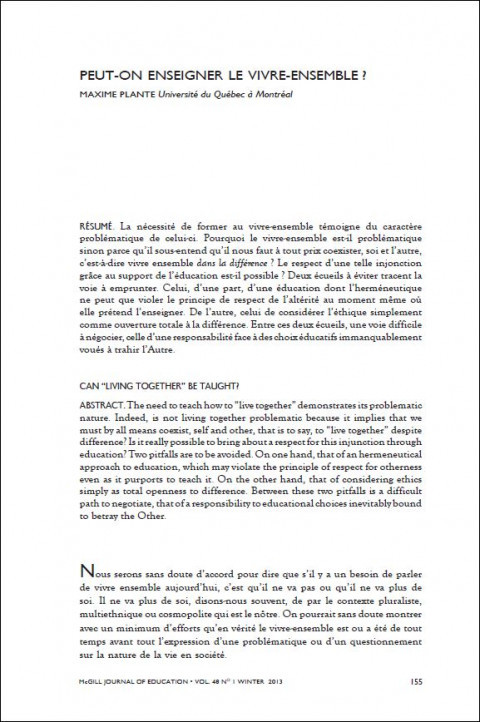 Can “Living Together” Be Taught? Year of publication: 2013 Author: Maxime Plante Corporate author: McGill University. Faculty of Education The need to teach how to “live together” demonstrates its problematic nature. Indeed, is not living together problematic because it implies that we must by all means coexist, self and other, that is to say, to “live together” despite difference? Is it really possible to bring about a respect for this injunction through education? Two pitfalls are to be avoided. On one hand, that of an hermeneutical approach to education, which may violate the principle of respect for otherness even as it purports to teach it. On the other hand, that of considering ethics simply as total openness to difference. Between these two pitfalls is a difficult path to negotiate, that of a responsibility to educational choices inevitably bound to betray the Other. Peut-on enseigner le vivre-ensemble ? Year of publication: 2013 Author: Maxime Plante Corporate author: McGill University. Faculty of Education La nécessité de former au vivre-ensemble témoigne du caractère problématique de celui-ci. Pourquoi le vivre-ensemble est-il problématique sinon parce qu’il sous-entend qu’il nous faut à tout prix coexister, soi et l’autre, c’est-à-dire vivre ensemble dans la différence ? Le respect d’une telle injonction grâce au support de l’éducation est-il possible ? Deux écueils à éviter tracent la voie à emprunter. Celui, d’une part, d’une éducation dont l’herméneutique ne peut que violer le principe de respect de l’altérité au moment même où elle prétend l’enseigner. De l’autre, celui de considérer l’éthique simplement comme ouverture totale à la différence. Entre ces deux écueils, une voie difficile à négocier, celle d’une responsabilité face à des choix éducatifs immanquablement voués à trahir l’Autre.