
Resources
Explore a wide range of valuable resources on GCED to deepen your understanding and enhance your research, advocacy, teaching, and learning.
6 Results found
 Being and Becoming Global Citizens: Measuring Progress toward SDG 4.7 (Phase I: Monitoring teacher and school readiness to enact global citizenship in the Asia-Pacific region) Year of publication: 2023 Author: Rachel Parker | Jennie Chainey | Payal Goundar | Sarah Richardson | Anna Dabrowski | Amy Berry | Claire Scoular Corporate author: Australian Council for Educational Research (ACER) | APCEIU Since 2022, APCEIU and the Australian Council for Educational Research (ACER) have conducted a study to identify enhanced tools and resources for schools and systems in the Asia-Pacific region to monitor and evaluate GCED in line with SDG 4.7.The Report of the Research for Phase 1 is available in three forms: Full report; Summary; and Policy Brief.
 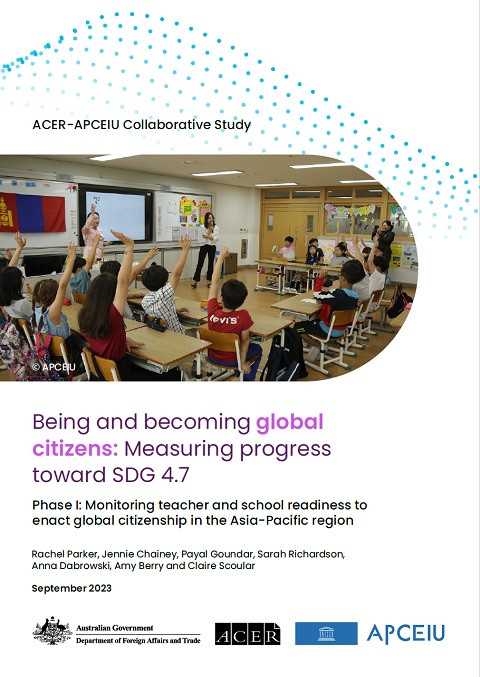 [Summary] Being and Becoming Global Citizens: Measuring Progress toward SDG 4.7 (Phase I: Monitoring teacher and school readiness to enact global citizenship in the Asia-Pacific region) Year of publication: 2023 Author: Rachel Parker | Jennie Chainey | Payal Goundar | Sarah Richardson | Anna Dabrowski | Amy Berry | Claire Scoular Corporate author: Australian Council for Educational Research (ACER) | APCEIU This is a summary report of the Being and Becoming Global Citizens: Measuring Progress toward SDG 4.7 (Phase I: Monitoring teacher and school readiness to enact global citizenship in the Asia-Pacific region), conducted by APCEIU and ACER in since 2022.
 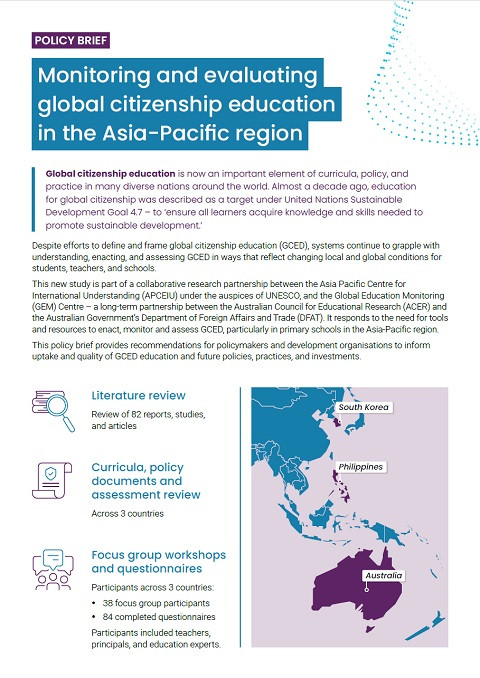 [Policy Brief] Monitoring and Evaluating Global Citizenship Education in the Asia-Pacific Region Year of publication: 2023 Author: Payal Goundar | Rachel Parker Corporate author: Australian Council for Educational Research (ACER) | APCEIU This is a policy brief version of the reserach report, Being and Becoming Global Citizens: Measuring Progress toward SDG 4.7 (Phase I: Monitoring teacher and school readiness to enact global citizenship in the Asia-Pacific region), conducted by APCEIU and ACER in since 2022.
  ACER-APCEIU 세계시민교육 모니터링 가이드: 교사, 학교 관리자, 교육행정가를 위한 안내서 Year of publication: 2025 Author: Rachel Parker | Amy Berry | Payal Goundar | Karena Menzie-Ballantyne Corporate author: 호주교육연구위원회 | 유네스코 아시아태평양 국제이해교육원 『ACER-APCEIU 세계시민교육 모니터링 가이드: 교사, 학교 관리자, 교육행정가를 위한 안내서』는 APCEIU와 ACER가 2022년부터 2024년까지 3년에 걸쳐 호주, 라오스, 필리핀, 한국의 파트너들과 함께 수행한 공동연구의 결과물인 『ACER-APCEIU Global Citizenship Education Monitoring Toolkit for Teachers, Schools and System Leaders』를 한국의 맥락에 맞게 번역한 국문판이다.이 가이드는 다양한 수준의 교육 이해관계자가 세계시민교육에서 자신의 위치를 진단하고 목표와 계획을 수립하며, 실행과 평가를 지속적으로 이어가도록 설계된 탐구 순환 모형을 제시하며, 이를 각자의 맥락에 맞게 실천할 수 있도록 구체적인 지침과 방법을 안내한다.이 가이드의 주요 활용자는 정책 입안자, 교육부 및 교육청 등 유관 기관의 교육행정가, 학교장과 학교감 등 교육 리더십을 가진 이들뿐 아니라 정규·비정규 교육 전반에서 세계시민교육을 실천하는 모든 교사를 포함한다.
  Supporting Change in Practice: Case Studies on the Use of the ACER-APCEIU Global Citizenship Education Monitoring Toolkit; Country Case-Australia Year of publication: 2025 Author: Rachel Parker | Karena Menzie-Ballantyne Corporate author: APCEIU APCEIU published Supporting Change in Practice: Case Studies on the Use of the ACER-APCEIU Global Citizenship Education Monitoring Toolkit, which shares key findings from the research conducted in Australia and the Republic of Korea. The two reports, based on case studies from two countries, build upon the three-phase Asia-Pacific GCED Monitoring Project (2022–2024) jointly undertaken by ACER and APCEIU to strengthen monitoring and evaluation of GCED and support progress toward SDG 4.7 across the region. The three phases of the initiative identified enabling conditions for GCED, validated the regional GCED Monitoring Framework, and developed the ACER-APCEIU GCED Monitoring Toolkit. The reports for each phase can be found here: Phase I, Phase II, and Phase III.The reports move the project forward by examining how the Toolkit can be practically applied in real educational settings. The study aimed to examine how the Toolkit could be used to support collaboration among key education stakeholders—teachers, school leaders, and education supervisors—in 1) goal setting, 2) planning, 3) implementing, and 4) reflecting on GCED practices. Through this process, the research sought to understand how the Toolkit could help strengthen the connection between policy commitments and everyday educational practice, supporting teachers, school leaders, and system leaders to embed GCED more systematically and sustainably within their existing framework. Both studies conducted in Australia and the Republic of Korea have been guided by the following research questions: How does the GCED Monitoring Toolkit support key stakeholder groups to collaboratively embed GCED in policy and practice? a. What aspects of the Toolkit enable or challenge stakeholders to achieve their GCED goals and objectives? b. How do key stakeholders perceive its usefulness?Are there any aspects of the Toolkit that stakeholders would change to improve its usefulness in supporting the implementation and contextualisation of GCED in policy and practice?The reports demonstrate how a GCED Monitoring Toolkit can be translated into actionable processes within real educational settings. It offers valuable insights for policymakers, school leaders, teachers, and researchers aiming to monitor and strengthen GCED implementation and systematically embed GCED within their educational ecosystems.
  ACER-APCEIU Global Citizenship Education Monitoring Toolkit: For Teachers, Schools and System Leaders Year of publication: 2024 Author: Rachel Parker | Amy Berry | Payal Goundar | Karena Menzie-Ballantyne Corporate author: Australian Council for Educational Research (ACER) | APCEIU The APCEIU-ACER GCED Monitoring Toolkit was developed and informed by research conducted from 2022-2024 in collaboration with partners in Australia, Lao PDR, Philippines, and South Korea. The toolkit aims to assist education stakeholders to embed GCED within policy and practice in alignment with local, regional, and international frameworks. Target users of this toolkit include policy makers, education department and ministry personnel, leaders, and educators at all levels in both formal and non-formal education sectors.The toolkit explores effective GCED including how to conceptualise and define, plan, enact and monitor implementation, and how to measure success. By guiding educators and leaders to align their enactment and monitoring efforts to international guidance, research, theory and practice, this toolkit supports a robust and evidence-informed process for enacting GCED in ways that nurture learners as proactive and empowered global citizens.Phase I Report (Link): https://www.unescoapceiu.org/post/4995Phase II Report (Link): https://www.unescoapceiu.org/post/5184