
Resources
Explore a wide range of valuable resources on GCED to deepen your understanding and enhance your research, advocacy, teaching, and learning.
4 Results found
 Climate change starter's guidebook: an issues guide for education planners and practitioners Year of publication: 2011 Author: Alejandro Deeb | Amber French | Julia Heiss | Jason Jabbour | Dominique LaRochelle | Arkadiy Levintanus | Anna Kontorov | Rummukainen Markku | Gerardo Sanchez Martinez | Rosalyn McKeown | Nicolay Paus | Antoine Pecoud | Guillaume Pénisson | Daniel Puig | Vanessa Retana | Serban Scrieciu | Morgan Strecker | Vimonmas Vachatimanont | Benjamin Witte | Noriko Yamada. Corporate author: United Nations Environment Programme (UNEP) The Climate Change Starter’s Guide provides an introduction and overview for education planners and practitioners on the wide range of issues relating to climate change and climate change education, including causes, impacts, mitigation and adaptation strategies, as well as some broad political and economic principles. The aim of this guide is to serve as a starting point for mainstreaming climate change education into school curricula. It has been created to enable education planners and practitioners to understand the issues at hand, to review and analyse their relevance to particular national and local contexts, and to facilitate the development of education policies, curricula, programmes and lesson plans. The guide covers four major thematic areas: 1. the science of climate change, which explains the causes and observed changes; 2. the social and human aspects of climate change including gender, health, migration, poverty and ethics; 3. policy responses to climate change including measures for mitigation and adaptation; and 4. education approaches including education for sustainable development, disaster reduction and sustainable lifestyles. A selection of key resources in the form of publication titles or websites for further reading is provided after each of the thematic sections. The United Nations Educational, Scientific and Cultural Organization (UNESCO) provides its expertise and know-how in areas such as education, culture, and the social sciences. In particular, UNESCO emphasises the role of education in support of climate change adaptation and mitigation in providing skills and capacities but also through shaping the values, attitudes and behaviours needed to put the world on a more sustainable path. The United Nations Environment Programme (UNEP) works with countries to strengthen their ability to adapt to climate change, move towards low-carbon growth, reduce emissions from deforestation and forest degradation, improve understanding of climate science, and raise public awareness of the changing climate. UNEP is supporting countries to seize the opportunities of moving towards low-carbon growth, while improving human health and well-being, generating green jobs and moving towards a green economy. With this publication, the two organizations have embarked on a collaboration on climate change education that we are committed to building upon and expanding in the period ahead. Le guide du changement climatique démarreur: un guide de questions pour les planificateurs de l'éducation et des praticiens Year of publication: 2011 Author: Alejandro Deeb | Amber French | Julia Heiss | Jason Jabbour | Dominique LaRochelle | Arkadiy Levintanus | Anna Kontorov | Rummukainen Markku | Gerardo Sanchez Martinez | Rosalyn McKeown | Nicolay Paus | Antoine Pecoud | Guillaume Pénisson | Daniel Puig | Vanessa Retana | Serban Scrieciu | Morgan Strecker | Vimonmas Vachatimanont | Benjamin Witte | Noriko Yamada. Corporate author: United Nations Environment Programme (UNEP) Le guide du changement de démarrage climatique fournit une introduction et un aperçu des planificateurs de l'éducation et de praticiens sur le large éventail de questions relatives au changement climatique et éducation au changement climatique, y compris les causes, les impacts, l'atténuation et les stratégies d'adaptation, ainsi que certains grands principes politiques et économiques. Le but de ce guide est de servir de point de départ pour l'intégration de l'éducation au changement climatique dans les programmes scolaires. Il a été créé pour permettre aux planificateurs de l'éducation et les praticiens à comprendre les questions à portée de main, pour examiner et analyser leur pertinence pour des contextes nationaux et locaux, et de faciliter le développement des politiques d'éducation, des programmes, des programmes et des plans de leçon.Le guide couvre quatre grands domaines thématiques: 1. La science du changement climatique, ce qui explique les causes et les changements observés; 2. les aspects sociaux et humains du changement climatique, y compris le sexe, la santé, la migration, la pauvreté et l'éthique; 3. les réponses politiques aux changements climatiques, y compris les mesures d'atténuation et d'adaptation; et 4. approches éducatives, y compris l'éducation pour le développement durable, la prévention des catastrophes et de modes de vie durables. Une sélection de ressources clés sous forme de titres de publications ou sites web pour davantage de lecture est fourni après chacune des sections thématiques. L'Organisation des Nations Unies pour l'éducation, la science et (UNESCO) fournit son expertise et son savoir-faire dans des domaines tels que l'éducation, la culture et les sciences sociales. En particulier, l'UNESCO met l'aCECnt sur le rôle de l'éducation à l'appui de l'adaptation au changement climatique et l'atténuation dans la fourniture de compétences et de capacités mais aussi à travers l'élaboration des valeurs, des attitudes et des comportements nécessaires pour mettre le monde sur une voie plus durable. Le Programme des Nations Unies pour l'Environnement (PNUE) travaille avec les pays pour renforcer leur capacité d'adaptation au changement climatique, se déplacer vers une croissance faible en carbone, la réduction des émissions dues à la déforestation et à la dégradation des forêts, d'améliorer la compréhension de la science du climat, et de sensibiliser le public au changement climatique . Le PNUE aide les pays à saisir les opportunités de progresser vers une croissance à faible émission de carbone, tout en améliorant la santé humaine et le bien-être, la création d'emplois verts et avancer vers une économie verte. Avec cette publication, les deux organisations se sont engagées dans une collaboration sur le changement climatique éducation que nous sommes déterminés à bâtir sur et en expansion dans la période à venir.
 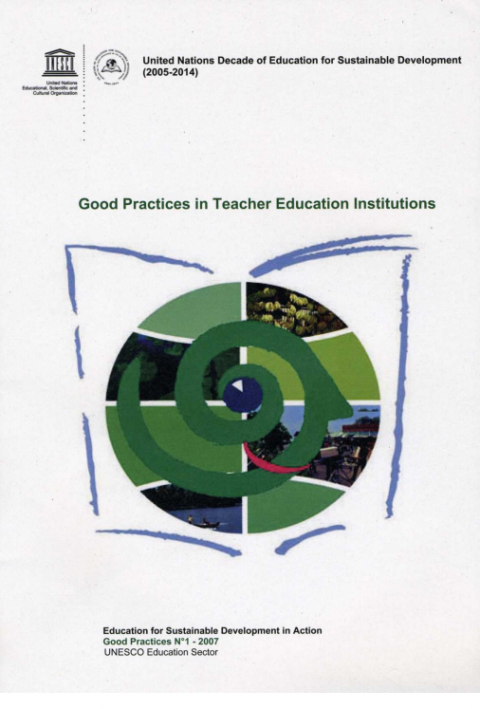 Good practices in education for sustainable development: teacher education institutions Year of publication: 2007 Author: Rosalyn McKeown Corporate author: UNESCO Chair in Reorienting Teacher Education towards Sustainability | International Network of Teacher Education Institutions The case studies in this document reflect individual and institutional efforts to reorient curriculum, programs, practices, and policies to address sustainability at institutions of teacher education. The studies come from Africa, Asia, the Caribbean, Europe, and North America. The case studies deal with professional development for in-service teachers, curriculum revision at the pre-service level, research with students in a local school, greening of a building and its garden, creating a network of universities, starting a journal, and creating new undergraduate and graduate programs. The diversity of efforts is broad; the impact is deep. The dedication of teacher educators around the world is evident on every page of this document. Les bonnes pratiques en matière d'éducation pour le développement durable: institutions de formation des enseignants Year of publication: 2007 Author: Rosalyn McKeown Corporate author: UNESCO Chair in Reorienting Teacher Education towards Sustainability | International Network of Teacher Education Institutions Les études de cas présentées dans ce document reflètent les efforts individuels et institutionnels pour réorienter le curriculum, les programmes, les pratiques et les politiques de lutte contre le développement durable dans les établissements de formation des enseignants. Les études viennent d'Afrique, d'Asie, des Caraïbes, en Europe et en Amérique du Nord. Les études de cas portent sur le développement professionnel des enseignants en service, la révision des programmes au niveau pré-services, la recherche avec les étudiants dans une école locale, l'écologisation d'un bâtiment et son jardin, la création d'un réseau d'universités, à partir d'un journal, et la création de nouveaux programmes de premier cycle et des cycles supérieurs. La diversité des efforts est large; l'impact est profond. Le dévouement des formateurs d'enseignants à travers le monde est évident sur chaque page de ce document.