
Resources
Explore a wide range of valuable resources on GCED to deepen your understanding and enhance your research, advocacy, teaching, and learning.
2 Results found
 Peace Education in Northeast Asia: A Situational Analysis Year of publication: 2021 Author: Soonwon Kang | Cheng Liu | Ketei Matsui | Batbaatar Monkhooroi | Boyoung Park | Muyu Huang | Oyuntsetseg Dugarsuren Corporate author: APCEIU Being central to education for international understanding and global citizenship, peace education has always been an important theme in UNESCO. For effective delivery of peace education, it is critical to examine and understand the relevance of peace education and its key issues and approaches at a given juncture. With this in mind, in 2020, APCEIU conducted a study on peace education in South Korea to review its current state and suggest some policy recommendations. Following up on this study, APCEIU initiated in 2021 a research project on peace education in Northeast Asia in order to identify how peace education is interpreted and practised in the countries of the region and explore possibilities of cooperation among peace educators, researchers, and practitioners in the region. Building on this research, APCEIU hopes to develop and carry out joint projects for peace education in the region.
 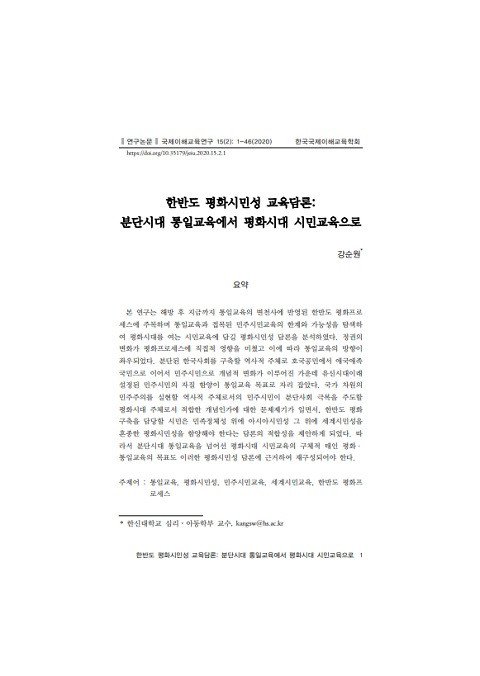 Discourse on Peace-Oriented Citizenship in the Korean Peninsula: Form Unification Education in the Divided Society Into the Citizenship Education in the Peaceful Coexistence Era (Journal of Education for International Understanding; Vol. 15, No. 2) Year of publication: 2020 Author: Soonwon Kang Corporate author: Korean Society of Education for International Understanding (KOSEIU) This paper puts emphasis on designing the peace-oriented citizenship education towards the peaceful coexistent era beyond unification education in the divided society, analyzing the limits and possibility of democratic citizenship education connected with unification education which has been reflected by the peace process of present governments since liberation from the colonial period in 1945. According to the changes of unification education connected the peace process of each government, the name of historical subjects to take the initiative to overcome the division has been changed from civics saving the country to patriotic nation and onto the democratic citizen. Since Yushin reformation period, raising the democratic citizenship has been set up as the goal of unification education. But some critics of democratic citizenship were given to the limitation of the democratic citizen on overcoming the division and realizing peaceful coexistence and to the birth of hybrid citizenship with national commonality, Asian citizenship and global citizenship to challenge Korean peninsula agenda. Thus peace·unification education beyond division should be reconceptualized on the ground of the discourse of peace-oriented citizenship, which is applied to North Korea and South Korea as a global peace education framework.