
Resources
Explore a wide range of valuable resources on GCED to deepen your understanding and enhance your research, advocacy, teaching, and learning.
2 Results found
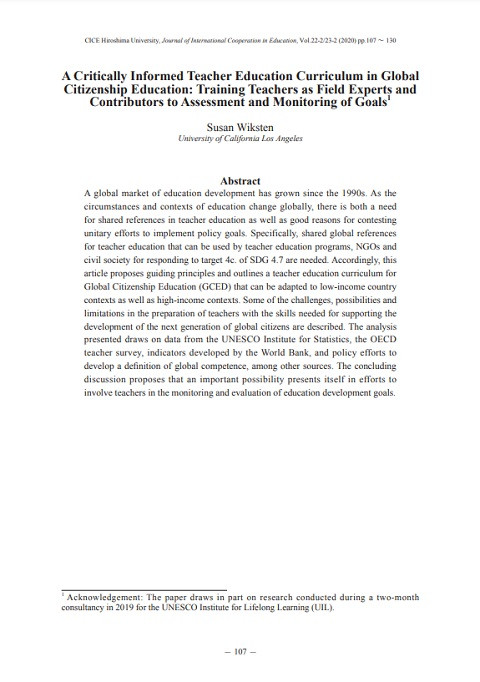 A Critically Informed Teacher Education Curriculum in Global Citizenship Education: Training Teachers as Field Experts and Contributors to Assessment and Monitoring of Goals (Journal of International Cooperation in Education; Vol.22-2/23-2) Year of publication: 2020 Author: Susan Wiksten Corporate author: CICE Hiroshima University A global market of education development has grown since the 1990s. As the circumstances and contexts of education change globally, there is both a need for shared references in teacher education as well as good reasons for contesting unitary efforts to implement policy goals. Specifically, shared global references for teacher education that can be used by teacher education programs, NGOs and civil society for responding to target 4c. of SDG 4.7 are needed. Accordingly, this article proposes guiding principles and outlines a teacher education curriculum for Global Citizenship Education (GCED) that can be adapted to low-income country contexts as well as high-income contexts. Some of the challenges, possibilities and limitations in the preparation of teachers with the skills needed for supporting the development of the next generation of global citizens are described. The analysis presented draws on data from the UNESCO Institute for Statistics, the OECD teacher survey, indicators developed by the World Bank, and policy efforts to develop a definition of global competence, among other sources. The concluding discussion proposes that an important possibility presents itself in efforts to involve teachers in the monitoring and evaluation of education development goals.
  Social Contract Pedagogy: A Dialogical and Deliberative Model for Global Citizenship Education (Background paper for the Futures of Education initiative) Year of publication: 2020 Author: Richard Desjardins | Carlos Alberto Torres | Susan Wiksten Corporate author: UNESCO We propose that together Social Contract Pedagogy (SCP) and Global Citizenship Education (GCE) offer a comprehensive vision including key principles and core elements that are important for rethinking education and shaping the future of the world. We introduce the novel concept of Social Contract Pedagogy (SCP) as a means to adapt the social contract in liberal democracies which has been (conceptually) located at the level of the state, to the level of the classroom and other pedagogically relevant contexts. A key feature of this pedagogy is the negotiation of values and norms in ways that maintain cohesion and inclusion and avoids too much power in the hands of sectarian extremes (of any kind) which tend to impose their views on others, oppress and exclude. This includes using fake news, denying scientific debates and/or any extremely politicized interpretations of evidence and facts to obfuscate or deny consequences of individual and group choices and behavior, but also ‘othering’ of any kind whether from the political right or the political left. In our view, this is an essential premise for the education of democratic citizens. Citizenship education of this kind is seen as essential for the survival and growth of liberal democracies in the future.