
Resources
Explore a wide range of valuable resources on GCED to deepen your understanding and enhance your research, advocacy, teaching, and learning.
9 Results found
 Integrating education for sustainable development & education for international understanding: conceptual issues and pedagogical principles for teacher education to address sustainability Year of publication: 2006 Author: Swee-Hin Toh Corporate author: UNESCO Bangkok It is in this spirit that this essay seeks to “integrate” two active and expanding fields of 2 educational innovation and transformation worldwide, namely ESD (education for sustainable development or sustainability) and EIU (education for international understanding). The key conceptual issues and themes of both of these movements will be clarified and shared values and understandings highlighted. It will also be argued that both ESD and EIU , in order to effectively fulfill their goals of building a peaceful, just and sustainable world order, rests on some key common pedagogical principles and processes. Another introductory caveat is also essential here, namely the question of paradigm. Among policy-makers, theorists and practitioners, there may well be and often are distinct differences in conceptualization according to their paradigmatic interpretations, with consequently alternative implications for policies and practices. Integrating education for sustainable development & education for international understanding: conceptual issues and pedagogical principles for teacher education to address sustainability Year of publication: 2006 Author: Swee-Hin Toh Corporate author: UNESCO Bangkok Il est dans cet esprit que cet essai vise à «intégrer» deux champs actifs et en expansion de 2 innovations pédagogiques et de transformation dans le monde entier, à savoir l'EDD (éducation pour le développement durable ou la durabilité) et ECI (éducation pour la compréhension internationale). Les principaux problèmes conceptuels et les thèmes de ces deux mouvements seront clarifiés et des valeurs et une compréhension partagées mis en évidence. Il sera fait également valoir que les deux EDD et ECI, en vue de remplir efficacement leurs objectifs de construction, un ordre pacifique juste et durable monde, repose sur quelques principes pédagogiques communs clés et des processus. Une autre mise en garde d'introduction est également essentiel ici, à savoir la question de paradigme. Parmi les décideurs, les théoriciens et les praticiens, il pourrait bien être souvent des différences distinctes dans la conceptualisation en fonction de leurs interprétations paradigmatiques, ayant des implications en conséquence alternatives pour les politiques et les pratiques. 지속가능발전교육과 국제이해교육의 통합: 지속가능성 문제 해결에 대한 교사 교육의 개념적 문제와 교육학적 원칙 Year of publication: 2006 Author: Swee-Hin Toh Corporate author: UNESCO Bangkok 이것은 ESD(지속가능한발전 혹은 지속가능성을 위한 교육)와 EIU(국제이해교육)이라는 교육 혁신과 전 세계의 변화, 이 두 가지 확장 개념과 활동을 ‘통합’하고자 한다. 아울러 이 두 운동의 주요 개념적 문제와 주제는 명확히 되고, 공유된 가치와 이해가 강조될 것이다. 또한 평화롭고 지속가능한 세계 질서 구축이라는 목표를 효과적으로 수행하기 위해서, ESD와 EIU는 몇 가지 주요 공통 교수법과 과정에 그 성패가 달려있다고 보인다. 여기에 또 다른 입문주의 사항(introductory caveat), 즉 패러다임의 문제가 필수적이다. 정책 입안자, 이론가 및 실무자 사이에선 결과적으로 정책과 관행에 대한 대안적 함의와 함께 그들의 패러다임 해석에 따른 개념화의 뚜렷한 차이점이 종종 나타날 수 있다.
 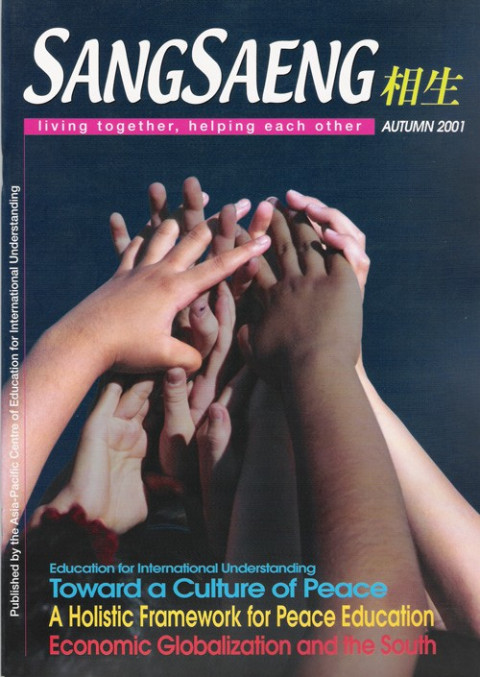 Education for international understanding: toward a culture of peace (SangSaeng vol1. autumn 2001) Year of publication: 2001 Author: Swee-Hin Toh Corporate author: APCEIU Over the past several decades of political, economic, social and cultural changes and developments throughout the world, the idea of education for international understanding (EIU) has evolved through the work of innumerable educators, researchers, institutions and organizations. Initially, the focus in school and tertiary programs tended to emphasize the need to increase the level of knowledge about other nations, societies and cultures as a key means to promote better, more “peaceful” international (economic and political) and intercultural relations. Especially in universities of the “North,” area studies of different regions and countries expanded and found their way into school-based curricula. In part, EIU was deemed important and helpful in the development of human resources needed to implement foreign aid programs. It was also a response to the increased internationalization of campuses due to the growing numbers of foreign/overseas students. By the 60s, however, a variety of social and political forces and movements were beginning to impact on this earlier focus of EIU. First, it was no longer viewed only in terms of understanding the relations between “nations” or “societies” across political and economic boundaries. EIU would need also to look closely at local and internal issues, and at problems of one’s own society that might significantly influence the direction and nature of international relations. Furthermore, conceptual perspectives on EIU began to reflect a spectrum of frameworks of understanding and analysis, from “conservative” and “liberal” to more “critical” paradigms. Underpinning the critical approaches was a questioning of the power inequities characterizing the international order of nation-states, and the need to overcome such gaps if the original vision of “world peace” was to be fulfilled. Third, the evolving theory and practice of EIU took on a host of societal, international and increasingly global issues deemed urgent at all levels of life. Education for international understanding: toward a culture of peace (SangSaeng vol1. autumn 2001) Year of publication: 2001 Author: Swee-Hin Toh Corporate author: Centre Asie-Pacifique d'éducation pour la compréhension internationale (APCEIU) Au cours des dernières décennies, des changements et des évolutions politiques, économiques, sociaux et culturels à travers le monde, l'idée de l'éducation pour la compréhension internationale (ECI) a évolué grâce au travail des éducateurs innombrables, chercheurs, institutions et organisations. Dans un premier temps, l'aCECnt dans les programmes scolaires et tertiaires ont tendance à mettre l'aCECnt sur la nécessité d'accroître le niveau des connaissances sur les autres nations, les sociétés et les cultures comme un moyen essentiel de promouvoir une meilleure, les relations internationales (économiques et politiques) et interculturelles plus «pacifiques». Surtout dans les universités du "Nord", les études régionales des différentes régions et pays développés et ont trouvé leur chemin dans les programmes scolaires. En partie, ECI a été jugé important et utile dans le développement des ressources humaines nécessaires à la mise en œuvre de programmes d'aide extérieure. Il a également été une réponse à l'internationalisation accrue du campus en raison du nombre croissant d'étudiants étrangers / outre-mer. Par les années 60, cependant, une variété de forces et de mouvements sociaux et politiques commençaient à avoir un impact sur cette orientation antérieure de ECI. Tout d'abord, il a été plus considéré seulement en termes de compréhension des relations entre les «nations» ou «sociétés» à travers les frontières politiques et économiques. ECI aurait également besoin d'examiner de près les enjeux locaux et internes, et les problèmes de sa propre société qui pourraient influencer de manière significative la direction et la nature des relations internationales. En outre, les perspectives conceptuelles sur ECI ont commencé à refléter un éventail de cadres de compréhension et d'analyse, des paradigmes «conservateurs» et «libérales» à plus «critiques». À la base des approches critiques était une remise en cause des inégalités de pouvoir qui caractérisent l'ordre international des États-nations, et la nécessité de surmonter ces lacunes si la vision originale de la «paix mondiale» devait être rempli. Troisièmement, la théorie et la pratique de ECI évolution ont pris sur une foule de questions sociétales, internationales et de plus en plus globales jugées urgentes à tous les niveaux de la vie.
  Education for international understanding: a river flowing from the mountains (SangSaeng vol5. autumn 2002) Year of publication: 2002 Author: Swee-Hin Toh Corporate author: APCEIU EIU (Education for International Understanding) is a concept that has diverse sources and tributaries, much like a river that begins in the mountains and flows to the sea or ocean, enriched by innumerable ideas, perspectives and practices along its journey. However, unlike a river in one community or nation, this is a river that flows across the world encompassing the breadth and depth of civilizations, peoples and mother Earth. Although by designation EIU appears to have a “modern genealogy,” it is vital to recognize and to search for its roots in the ancient wisdoms of all civilizations, especially through the values and principles of well-being, dignity and good or virtuous relationships between and among all peoples, communities and societies. EIU has been catalyzed and developed by multiple individuals, organizations, agencies and movements, including educators, researchers, national/multilateral organizations (e.g. UN agencies), NGOs, people’s organizations (POs) and other civil society movements and advocates. EIU is simultaneously practiced in all modes of education (formal, non-formal and informal), but a challenge is to attain synergy across all the modes for optimal outcomes and sustainability. Education pour la compréhension internationale: une rivière qui coule des montagnes (SangSaeng vol 5. automne 2002) Year of publication: 2002 Author: Swee-Hin Toh Corporate author: Centre Asie-Pacifique d'éducation pour la compréhension internationale (APCEIU) ECI (éducation pour la compréhension internationale) est un concept qui a diverses sources et affluents, un peu comme une rivière qui commence dans les montagnes et se jette à la mer ou de l'océan, enrichi par des idées innombrables, les perspectives et les pratiques le long de son voyage. Cependant, contrairement à une rivière dans une communauté ou d'une nation, cela est une rivière qui coule à travers le monde englobant la largeur et la profondeur des civilisations, les peuples et la Terre mère. Bien que par la désignation ECI semble avoir une «généalogie moderne», il est essentiel de reconnaître et de rechercher ses racines dans les anciennes sagesses de toutes les civilisations, en particulier à travers les valeurs et les principes du bien-être, la dignité et de bons ou vertueux relations entre et parmi tous les peuples, les communautés et les sociétés. ECI a été catalysée et développé par des individus multiples, les organisations, les organismes et les mouvements, y compris les éducateurs, les chercheurs, les organisations nationales / multilatérales (par exemple les agences de l'ONU), les ONG, les Organisations Populaires (OPs) et les autres mouvements de la société civile et les défenseurs. ECI est simultanément pratiqué dans tous les modes de l'éducation (formelle, non formelle et informelle), mais un défi est d'atteindre une synergie entre tous les modes pour des résultats optimaux et la durabilité.
  Global Citizenship Education: A Guide for Policymakers Year of publication: 2017 Author: Swee-Hin Toh | Gary Shaw | Danilo Padilla Corporate author: APCEIU In order to assist UNESCO Member States to integrate and strengthen Global Citizenship Education (GCED) in national education policies, strategies and plans to achieve SDG Target 4.7 effectively, the Asia-Pacific Centre of Education for International Understanding (APCEIU) has developed and published Global Citizenship Education: A Guide for Policymakers (hereafter referred to as the Guide).The Guide is mainly divided into two parts. Part 1 provides an overview of GCED, including the following three sections: the background to GCED; the rationale for GCED; and the concept of GCED. In Part 2, various selection strategies which allow each country to incorporate GCED into its current education system aligned with its own priorities and context, were divided and suggested into five major policy areas as follow: policy review and development; curriculum review and development; capacity building; knowledge creation; sharing and dissemination; and monitoring and assessment.The Guide was first published in English and Korean and additional translations will be available in the future in other languages, including French and Arabic to provide access to more readers worldwide. We hope that the Guide will provide an opportunity for policymakers and practitioners to share their experiences and insights. 세계시민교육 정책 개발을 위한 가이드 Year of publication: 2017 Author: Swee-Hin Toh | Gary Shaw | Danilo Padilla Corporate author: 유네스코 아시아태평양 국제이해교육원 유네스코 아시아태평양 국제이해교육원은 유네스코 회원국이 국가 교육정책에 세계시민교육을 반영하고 이를 통해 지속가능발전목표 4.7을 효과적으로 달성하는 것을 돕기 위해 『세계시민교육 정책 개발을 위한 가이드(Global Citizenship Education: A Guide for Policymakers)』를 개발ㆍ출간하였다.본 가이드는 크게 두 부분으로 나뉜다. 첫 번째 장에서는 세계시민교육의 배경과 논리, 그리고 개념을 차례로 살펴봄으로써 세계시민교육을 개괄하고자 하였다. 그리고 두 번째 장에서는 각국이 자신의 우선적 목표와 맥락에 맞게 세계시민교육을 현행 교육 시스템에 반영할 수 있도록 하는 다양한 선별적 전략들을 정책 검토ㆍ개발, 교육과정 검토ㆍ개발, 역량 강화, 지식의 창출ㆍ공유ㆍ확산, 모니터링 및 평가 등의 5가지 주요 정책 영역으로 나누어 제시하고자 하였다.본 가이드는 영어와 한국어로 우선 출간되었으며, 향후 전 세계의 더 많은 독자들에게 접근성을 제공하기 위하여 프랑스어와 아랍어를 포함한 다른 언어로도 추가 번역될 예정이다. 모쪼록 본 가이드가 정책입안자들과 실천가들에게 서로의 경험과 통찰을 나누는 계기를 제공할 수 있기를 바란다.