
Resources
Explore a wide range of valuable resources on GCED to deepen your understanding and enhance your research, advocacy, teaching, and learning.
2 Results found
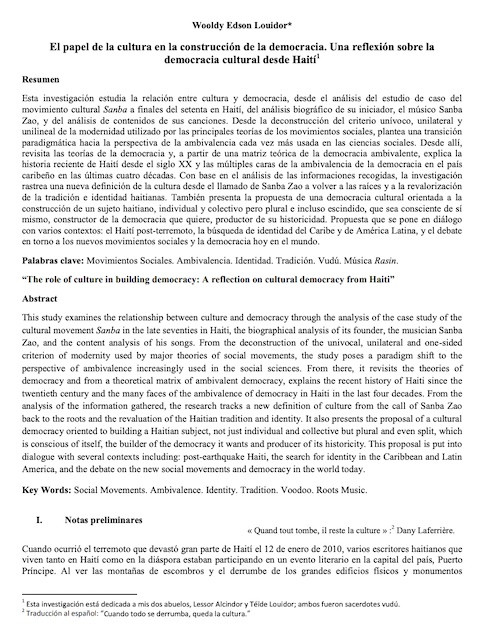 The Role of Culture in the Construction of Democracy: A Reflection on Cultural Democracy From Haiti Year of publication: 2015 Author: Wooldy Edson Louidor Corporate author: Latin American Council of Social Sciences (CLACSO) This research studies the relationship between culture and democracy, from the analysis of the case study of the Sanba cultural movement in the late seventies in Haiti, from the biographical analysis of its initiator, the musician Sanba Zao, and from the analysis of the content of its songs. From the deconstruction of the univocal, unilateral and unilinear criterion of modernity used by the main theories of social movements, it proposes a paradigmatic transition towards the perspective of ambivalence increasingly used in the social sciences. From there, he revisits the theories of democracy and, based on a theoretical matrix of ambivalent democracy, explains the recent history of Haiti since the 20th century and the multiple faces of the ambivalence of democracy in the Caribbean country in the last four years. decades. Based on the analysis of the information collected, the research traces a new definition of culture from Sanba Zao's call to return to the roots and to the revaluation of Haitian tradition and identity. El papel de la cultura en la construcción de la democracia: Una reflexión sobre la democracia cultural desde Haití Year of publication: 2015 Author: Wooldy Edson Louidor Corporate author: Latin American Council of Social Sciences (CLACSO) Esta investigación estudia la relación entre cultura y democracia, desde el análisis del estudio de caso del movimiento cultural Sanba a finales del setenta en Haití, del análisis biográfico de su iniciador, el músico Sanba Zao, y del análisis de contenidos de sus canciones. Desde la deconstrucción del criterio unívoco, unilateral y unilineal de la modernidad utilizado por las principales teorías de los movimientos sociales, plantea una transición paradigmática hacia la perspectiva de la ambivalencia cada vez más usada en las ciencias sociales. Desde allí, revisita las teorías de la democracia y, a partir de una matriz teórica de la democracia ambivalente, explica la historia reciente de Haití desde el siglo XX y las múltiples caras de la ambivalencia de la democracia en el país caribeño en las últimas cuatro décadas. Con base en el análisis de las informaciones recogidas, la investigación rastrea una nueva definición de la cultura desde el llamado de Sanba Zao a volver a las raíces y a la revalorización de la tradición e identidad haitianas.