
Resources
Explore a wide range of valuable resources on GCED to deepen your understanding and enhance your research, advocacy, teaching, and learning.
9 Results found
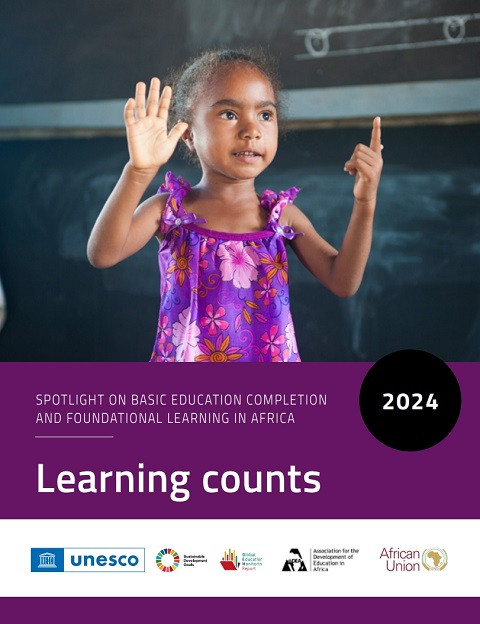 Learning Counts: Spotlight on Basic Education Completion and Foundational Learning in Africa, 2024 Year of publication: 2024 Corporate author: Global Education Monitoring Report Team | Association for the Development of Education in Africa (ADEA) | African Union The African Union’s designation of 2024 as the Year of Education highlights the critical importance of education for equipping young Africans with the skills essential for their own and for the continent’s development. It is also a recognition of the multiple challenges ahead before every child can complete primary school having acquire the foundational skills that open the door for lifelong learning. Currently the out-of-school population is rising, one in five children do not complete primary school and, of those who do, only about one in five achieve minimum proficiency in reading and mathematics. African countries have set targets on primary completion and foundational learning but to effectively translate their ambitions into results, the 2024 Spotlight continental report emphasizes the importance of coherence between their curricula, textbooks, teacher guides and assessments. It evaluates the alignment of these policy documents with each other but also with a global standard of what students are expected to know and by when. It also assesses how these key documents are used in classrooms and what the implications are for children’s opportunities to learn. This report is the second in a series of three envisaged between 2022 and 2025, each covering some 12 countries of which a selection is examined in depth, in dialogue with education ministries and national stakeholders. The focus countries for this second Spotlight report cycle were Mauritania, Niger, South Africa, Uganda, and Zambia. The statistics and analysis presented in this publication aim to feed into the policy dialogue mechanism under the auspices of the African Union and its Continental Education Strategy for Africa. In particular, the Spotlight series aims to spark debate on foundational learning among African countries and encourage them to identify areas for joined action, given that they share a lot of policy challenges.
 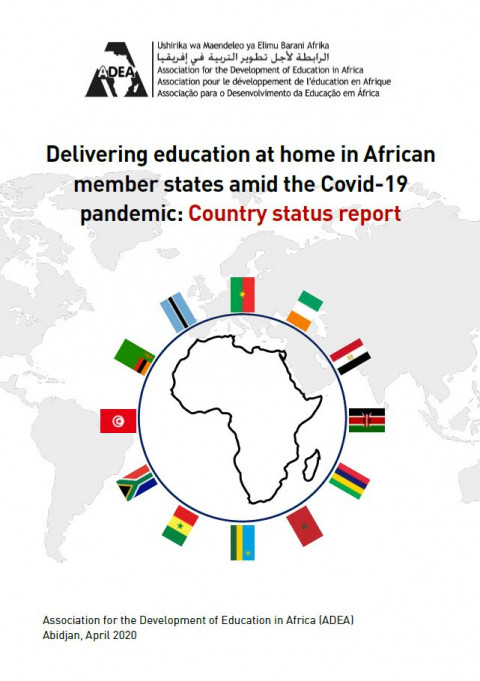 Assurer l’éducation à domicile dans les États membres africains dans le contexte de la pandémie de COVID-19 : rapport sur la situation dans les pays Year of publication: 2020 Corporate author: Association for the Development of Education in Africa (ADEA) Depuis son émergence à la fin de 2019, la maladie à coronavirus 2019 (COVID-19) est devenue une pandémie, affectant fortement la vie de milliards de personnes à travers le monde, avec un impact énorme prévu sur l'économie mondiale et l'Afrique en particulier. L'éducation est l'un des secteurs les plus touchés, la fermeture des établissements d'enseignement dans de nombreux pays africains risquant d'affecter négativement la qualité de l'éducation.Afin d'obtenir une vision plus claire de l'état de l'apprentissage au cours de cette période et de mieux soutenir les pays dans l'immédiat, à court et à long terme, l'ADEA a engagé en mars 2020 certains des pays africains les plus touchés pour schématiser la situation nationale du secteur de l'éducation. Ce qui précède est un résumé des commentaires reçus par l'Afrique du Sud, le Burkina Faso, la Côte d'Ivoire, l'Égypte, le Ghana, le Kenya, l’île Maurice, le Maroc, le Rwanda, le Sénégal, la Tunisie et la Zambie en termes de stratégies nationales, de plateformes, d'outils ou d'applications d’apprentissage, de lacunes et défis, d’engagement des partenaires, de bonnes pratiques et d’enseignements tirés avec quelques recommandations. Delivering Education at Home in African Member States Amid the Covid-19 Pandemic: Country Status Report Year of publication: 2020 Corporate author: Association for the Development of Education in Africa (ADEA) Since its emergence in late 2019, the coronavirus disease 2019 (COVID-19) has evolved into a pandemic, heavily affecting the lives of billions of people across the world with an anticipated huge impact on the global economy and Africa in particular. Education is one of the sectors heavily affected, with the closure of learning institutions in many African countries likely to negatively affect the education quality.In order to obtain a clearer view of the status of learning during this period, and to better support countries in the immediate, short and long term, ADEA engaged some of the most affected African countries in March 2020 to map the national situation in the education sector. The foregoing is a synopsis of the feedback from Burkina Faso, Côte d’Ivoire, Egypt, Ghana, Kenya, Mauritius, Morocco, Rwanda, Senegal, South Africa, Tunisia, and Zambia in terms of national strategies, platforms and tools or applications, gaps and challenges, partner engagement, good practices and lessons learnt with some recommendations.
  Why and how Africa should invest in African languages and multilingual education: an evidence- and practice-based policy advocacy brief Year of publication: 2010 Author: Adama Ouane | Christine Glanz Corporate author: UNESCO Institute for Lifelong Learning (UIL) | Association for the Development of Education in Africa (ADEA) This advocacy brief seeks to show the pivotal role of languages in achieving such learning. It aims in particular to dispel prejudice and confusion about African languages, and exposes the often hidden attempt to discredit them as being an obstacle to learning. It draws on research and practice to argue what kind of language policy in education would be most appropriate for Africa. Pourquoi et comment l'Afrique doit investir dans les langues africaines et l'enseignement multilingue: note de sensibilisation et d'orientation étayée par les faits et fondée sur la pratique Year of publication: 2010 Author: Adama Ouane | Christine Glanz Corporate author: UNESCO Institute for Lifelong Learning (UIL) | Association for the Development of Education in Africa (ADEA) This advocacy brief seeks to show the pivotal role of languages in achieving such learning. It aims in particular to dispel prejudice and confusion about African languages, and exposes the often hidden attempt to discredit them as being an obstacle to learning. It draws on research and practice to argue what kind of language policy in education would be most appropriate for Africa. ¿Por qué y cómo Africa debería invertir en las lenguas africanas y la educación plurilingüe? Opúsculo de apoyo activo a una política basada en la práctica y en pruebas Year of publication: 2010 Author: Adama Ouane | Christine Glanz Corporate author: UNESCO Institute for Lifelong Learning (UIL) | Association for the Development of Education in Africa (ADEA) This advocacy brief seeks to show the pivotal role of languages in achieving such learning. It aims in particular to dispel prejudice and confusion about African languages, and exposes the often hidden attempt to discredit them as being an obstacle to learning. It draws on research and practice to argue what kind of language policy in education would be most appropriate for Africa.
  Optimising learning, education and publishing in Africa: the language factor; a review and analysis of theory and practice in mother-tongue and bilingual education in sub-Saharan Africa Year of publication: 2011 Author: Adama Ouane | Christine Glanz Corporate author: UNESCO Institute for Lifelong Learning (UIL) | Association for the Development of Education in Africa (ADEA) This analytical review consists of three sections. The first section lays the theoretical foundations and is covered by Ekkehard Wolff and Kathleen Heugh: 1) language politics and planning in the light of development and 2) theories of bi- and multilingual education models and their implementation in the African context. A second section analyses teaching practices and classroom interaction in schools in two chapters by Birgit Brock-Utne and Hassana Alidou. This is followed by a review of the use of African languages in literacy and non-formal education by Hassana Alidou1 . Next, a review study by Kathleen Heugh addresses the critical issue of costs by assessing the costs related to implementing mother tongue and strong bilingual education programmes. Finally, the third section explores the role of locally-based multilingual publishing in supporting and promoting African languages and developing the language industries and the creative sector. Here, Yaya Satina Diallo from Guinea and Peter Reiner2 from Namibia shed light on the promise and pitfalls of publishing in African languages.Each of these sections focuses on theoretical frameworks and specific strategies designed to optimise learning and education in multilingual Africa. The language issue is dealt with at the levels of: policy and development; costing and financing; educational reform and governance; education models; classroom interaction; formal and non-formal education settings; literacy and publishing. Optimiser l'apprentissage, l'éducation et l'édition en Afrique: le facteur langue; étude bilan sur la théorie et la pratique de l'enseignement en langue maternelle et l'éducation bilingue en Afrique subsaharienne Year of publication: 2011 Author: Adama Ouane | Christine Glanz Corporate author: UNESCO Institute for Lifelong Learning (UIL) | Association for the Development of Education in Africa (ADEA) This analytical review consists of three sections. The first section lays the theoretical foundations and is covered by Ekkehard Wolff and Kathleen Heugh: 1) language politics and planning in the light of development and 2) theories of bi- and multilingual education models and their implementation in the African context. A second section analyses teaching practices and classroom interaction in schools in two chapters by Birgit Brock-Utne and Hassana Alidou. This is followed by a review of the use of African languages in literacy and non-formal education by Hassana Alidou1 . Next, a review study by Kathleen Heugh addresses the critical issue of costs by assessing the costs related to implementing mother tongue and strong bilingual education programmes. Finally, the third section explores the role of locally-based multilingual publishing in supporting and promoting African languages and developing the language industries and the creative sector. Here, Yaya Satina Diallo from Guinea and Peter Reiner2 from Namibia shed light on the promise and pitfalls of publishing in African languages.Each of these sections focuses on theoretical frameworks and specific strategies designed to optimise learning and education in multilingual Africa. The language issue is dealt with at the levels of: policy and development; costing and financing; educational reform and governance; education models; classroom interaction; formal and non-formal education settings; literacy and publishing.
 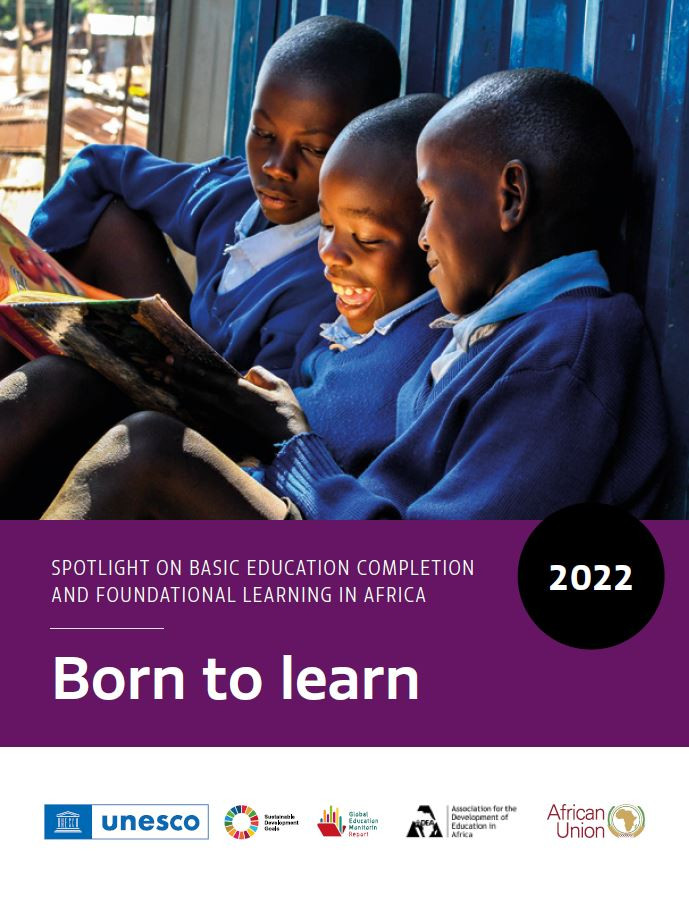 Spotlight on Basic Education Completion and Foundational Learning in Africa, 2022: Born to Learn Year of publication: 2022 Corporate author: UNESCO | Association for the Development of Education in Africa (ADEA) | African Union This publication is the first in a three-part Spotlight series. It is produced by a partnership between the Global Education Monitoring Report, the Association for the Development of Education in Africa and the African Union.The report focuses on why learning levels in the region are low. All children are born to learn yet only one in five children in Africa who reach the end of primary school achieve the minimum proficiency level required to continue their education and fulfil their potential. Combining completion and learning statistics, the report shows that children in Africa are at least five times less likely than children in the rest of the world to be prepared for the future.Given the historically low levels of learning on the continent, fresh thinking is needed to translate the CESA and SDG 4 commitments into focused, coordinated, well-informed and appropriately funded actions. The report contains eight policy-oriented recommendations for driving change.