
Resources
Explore a wide range of valuable resources on GCED to deepen your understanding and enhance your research, advocacy, teaching, and learning.
3 Results found
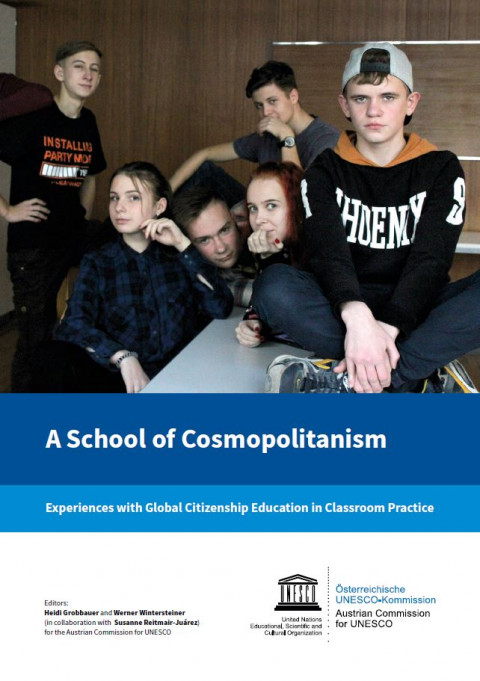 A School of Cosmopolitanism: Experiences with Global Citizenship Education in Classroom Practice Year of publication: 2019 Author: Heidi Grobbauer | Werner Wintersteiner Corporate author: Austrian Commission for UNESCO This publication focuses on examples from academic practice: this best practice collection demonstrates how young people can successfully be inspired to “think globally, act locally”. What is crucial is maintaining a view of the wider world; in particular, cooperation efforts with educational institutes outside of Europe (e.g. “élèves pour élèves” in Burkina Faso) provide a critical awareness of global connections. Learning to know/Learning to do/Learning to be/Learning to live together – these four pillars form the pedagogical foundation of the work carried out at more than 90 UNESCO schools throughout the whole of Austria. Since their founding in 1957, UNESCO schools have been considered model schools at which lessons are structured in a project-oriented, participative and even topic-specifc way. The unique ‘spirit’ of UNESCO schools often makes special projects possible. In the programme for the annual meetings of recent years, for example, Global Citizenship Education has been an ongoing topic of focus, accompanied by experts from various specialised institutions and NGOs. The pedagogical preparation of contents in a manner that ensures they are actually absorbed in the classroom presents a major challenge. Different types of schools have different educational goals, and the themes have to be made accessible for different age groups. The pedagogical finesse of each class team or individual teacher lies in finding the most motivating approaches.
  Global citizenship education: citizenship education for globalizing societies Year of publication: 2015 Author: Werner Wintersteiner | Heidi Grobbauer | Gertraud Diendorfer | Susanne Reitmair-Juárez Corporate author: Austrian Commission for UNESCO This text reflects the work we have been doing for many years in the area of Global Citizenship Education (GCED) in Austria. Two endeavors particularly stand out: first, the continuing Masters programme GCED at the Alps-Adriatic University (Alpen-Adria Universität) in Klagenfurt, which is a specialized course of study for educationalists, teacher trainers, NGO associates and teachers (participants may either graduate with a certificate after two years or an MA degree after three years respectively), and second, our cooperation with the Austrian UNESCO Associated Schools Project Network. This was the originally intended audience for the German version of this brochure, which constitutes the programmatic basis for our training programs. We understand GCED as a concept that is located at the interface between civic education, global education and peace education, as well as education for sustainable development and intercultural learning. Our approach is characterized by these four features:* theoretical grounding and a particular focus on terminology in order to foster competence of judgment regarding political concepts* investigating the historical dimension of GCED in depth in order to account for colonialism and neocolonialism* socio-critical orientation in order to set us apart from strands of GCED that ultimately perpetuate concepts of Western hegemony* didactic implementation that is systematic and based on appropriate theoretical work in order to avoid pragmatismWith this English edition (the section specific to the Austrian context was omitted) we wish to initiate a dialog with colleagues in the whole world and hope to engage in lively exchange. Education à la citoyenneté mondiale: éducation à la citoyenneté pour les sociétés de mondialisation Year of publication: 2015 Author: Werner Wintersteiner | Heidi Grobbauer | Gertraud Diendorfer | Susanne Reitmair-Juárez Corporate author: Austrian Commission for UNESCO Ce texte reflète le travail que nous faisons depuis de nombreuses années dans le domaine de l'éducation à la citoyenneté mondiale (ECM) en Autriche. Deux projets se démarquent particulièrement: d'abord, le programme de maîtrise ECM à l'Université alpine-adriatique de Klagenfurt, qui est un cours spécialisé pour les pédagogues, les formateurs d'enseignants, les associés des ONG et les enseignants (les participants peuvent soit être diplômés Avec un certificat après deux ans ou un MA après trois ans respectivement), et deuxièmement, notre coopération avec le Réseau autrichien du projet des écoles associées de l'UNESCO. Il s'agissait du public initialement destiné à la version allemande de cette brochure, qui constitue la base programmatique de nos programmes de formation. Nous considérons l'ECM comme un concept situé à l'interface entre éducation civique, éducation globale et éducation à la paix, ainsi que l'éducation pour le développement durable et l'apprentissage interculturel. Notre approche se caractérise par ces quatre caractéristiques: fondement théorique et un accent particulier sur la terminologie afin de favoriser la compétence de jugement sur les concepts politiques étudier la dimension historique de l'ECM en profondeur afin de rendre compte du colonialisme et néocolonialisme orientation socio-critique afin Nous distinguent des filières de l'ECM qui, en fin de compte, perpétuent les concepts d'une mise en œuvre didactique de l'hégémonie occidentale systématique et basée sur un travail théorique approprié pour éviter le pragmatisme. Avec cette édition en anglais (la section spécifique au contexte autrichien a été omis), nous souhaitons initier un dialogue avec des collègues dans le monde entier et espérer engager des échanges animés.