
Resources
Explore a wide range of valuable resources on GCED to deepen your understanding and enhance your research, advocacy, teaching, and learning.
2 Results found
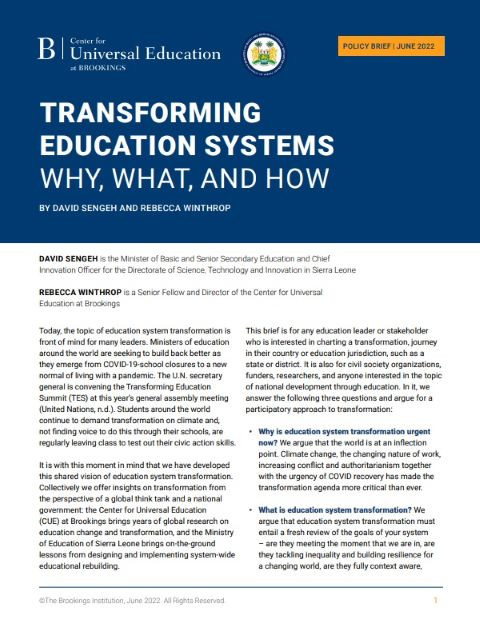 Transforming Education Systems: Why, What, and How Year of publication: 2022 Author: Rebecca Winthrop | David Sengeh Corporate author: Brookings Institution This brief is for any education leader or stakeholder who is interested in charting a transformation journey in their country or education jurisdiction such as a state or district. It is also for civil society organisations, funders, researchers, and anyone interested in the topic of national development through education. In it, the authors answer the following three questions and argue for a participatory approach to transformation: Why is education system transformation urgent now? The world is at an inflection point. Climate change, the changing nature of work, increasing conflict and authoritarianism together with the urgency of COVID recovery has made the transformation agenda more critical than ever. What is education system transformation? Education system transformation must entail a fresh review of the goals of your system – are they meeting the moment that we are in, are they tackling inequality and building resilience for a changing world, are they fully context aware, are they owned broadly across society – and then fundamentally positioning all components of your education system to coherently contribute to this shared purpose. How can education system transformation advance in your country or jurisdiction? Three steps are crucial: Purpose (developing a broadly shared vision and purpose), Pedagogy (redesigning the pedagogical core), and Position (positioning and aligning all components of the system to support the pedagogical core and purpose). Deep engagement of educators, families, communities, students, ministry staff, and partners is essential across each of these 3P steps.
 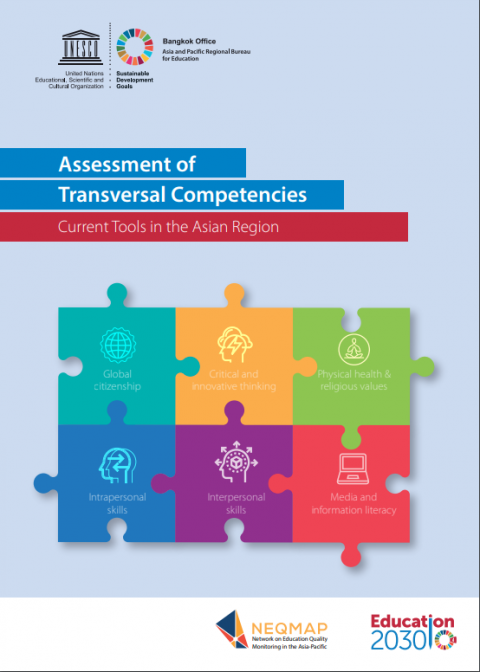 Assessment of Transversal Competencies: Current Tools in the Asian Region Year of publication: 2019 Author: Esther Care | Alvin Vista | Helyn Kim Corporate author: UNESCO Bangkok | Brookings Institution UNESCO’s Asia-Pacific Regional Bureau for Education has been working on education quality under the name of ‘transversal competencies’ (TVC) since 2013. Many of these competencies have been included in national education policy and curricula of countries in the region, but now the importance accorded them is increasingly gaining attention. As policy makers increasingly require their systems to provide evidence of 21st century skills acquired by their learners, implementation challenges highlight the need for a stronger alignment between curricula, pedagogy and learning assessments. UNESCO Bangkok’s Network on Education Quality Monitoring in the Asia Pacific (NEQMAP) undertook this regional study to examine components within countries’ learning assessments that show how these apply to and can measure transversal competencies. This report provides valuable information on how learning assessments are already capturing TVC and is useful for a broad range of education stakeholders, not only test developers, but also curriculum developers, teacher trainers and teachers. Particularly important is the need to align these skills and competencies across the entire education system.