
Resources
Explore a wide range of valuable resources on GCED to deepen your understanding and enhance your research, advocacy, teaching, and learning.
5 Results found
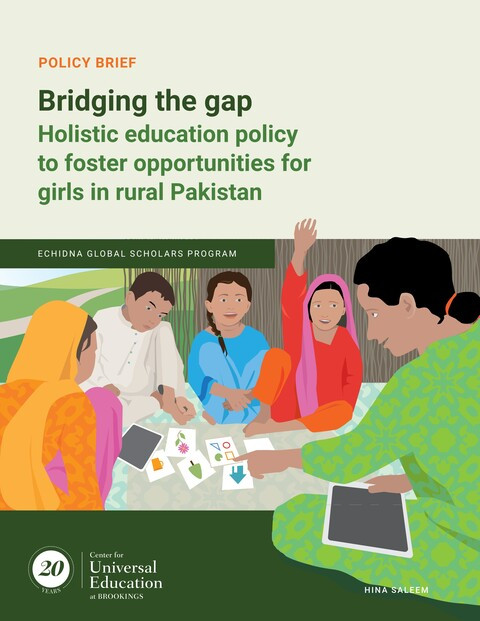 Bridging the Gap: Holistic Education Policy to Foster Opportunities for Girls in Rural Pakistan Year of publication: 2023 Author: Hina Saleem Corporate author: Center for Universal Education at Brookings Seven out of ten girls in rural Sindh are excluded from schooling. This happens for a myriad of reasons and occurs both in the presence and absence of operational school buildings. When schools are present, the challenges that children—especially girls—face due to their economic and social context often go unaddressed; children who are able to enroll in school often find their learning affected by classroom design and practices and experiences that mirror the exclusion they experience outside of school. At the broader level, this exclusion is reflected in limited representation of the needs and aspirations of sizable rural populations in Pakistan’s formal education system and the pathways beyond it. This policy brief presents findings from on-the-ground research in rural settlements in Sindh province that explores the disparities between boys and girls in enrollment and continuation of schooling in addition to overall inadequate education outcomes. It also provides policy recommendations to support all children and particularly girls in meeting their education needs and aspirations. Education policy must respond to these challenges of unmet education needs and aspirations by taking a holistic, welfare-based approach that supports children to overcome the effects of exclusionary conditions to meet their education needs. However, the benefits of such an approach can only be realized if teaching practices and learning experiences are contextualized, build a connection with local knowledge, question root causes of exclusion and support and prepare all children in negotiating pathways beyond education.
  Singapore’s educational reforms toward holistic outcomes: (Un)intended consequences of policy layering Year of publication: 2023 Author: Dennis Kwek | Jeanne Ho | Hwei Ming Wong Corporate author: Center for Universal Education at Brookings In the transition from economic imperatives to holistic drivers, there has been a gradual move over five policy phases (from 1965 to 2022 and beyond) toward curriculum and school diversification to cater to different students, with more autonomy given to schools to innovate their pedagogy and improve instructional quality to meet their students’ unique needs. Importantly, there has been a shift in policy rhetoric from focusing on educational structures to focusing on pedagogy and instructional quality. To shift pedagogy from being mainly didactic in nature—with emphasis on preparing students for national examination—the Singapore government recognized the need to focus on school leaders’ and teachers’ capacity building to enable new curricula and teaching practices. The school cluster structure was initiated in 1997 to enable collaboration and learning among school leaders, key personnel, and teachers. Opportunities for collaborative teacher learning are provided at different ecological levels: professional learning communities (PLCs) within schools and networked learning communities (NLCs) across schools. Beyond the education system, the Singapore government works with other ministries and community organizations, such as ethnic self-help organizations, to tackle educational equity issues. Ultimately, even though the official policy narrative post-1997 has been a de-emphasis on examination results and educational infrastructure to help improve the instructional quality in schools toward holistic outcomes and improved student well-being have been developed, education systems building co-exists with an alternative underlying shadow education system valued by parents who continue to chase narrow academic outcomes. Tuition and enrichment centers in Singapore constitute the shadow education system.
  The Comprehensive Learning Diagnosis: Chile’s approach to assess socio-emotional learning in schools Year of publication: 2023 Author: José Weinstein | Juan Bravo Corporate author: Center for Universal Education at Brookings Education in Chile has important challenges of quality, equity, and social integration. For decades, policies tried to respond to these concerns with a high-stakes accountability institutional framework, which has not had success. The underlying vision of educational quality was limited. The assessment system in place privileged cognitive and academic dimensions of educational results. Socio-emotional learning had been neglected or considered secondary, without an infrastructure of assessment tools that allowed teachers and principals to diagnosis students’ situations and monitor their progress. The COVID-19 crisis was an opportunity for change: Students’ socioemotional needs were a main concern for schools and society, and the regular accountability system based on standardized tests was interrupted. Subsequently, the Comprehensive Learning Diagnosis (DIA) was launched by the Education Quality Agency. The DIA is a voluntary assessment tool made available to all Chilean schools. The DIA promotes the comprehensive development of students, providing timely information and guidance to internally monitor students’ learning in the academic and socio-emotional domains at several points during the school year. Specifically, with respect to socio-emotional learning, three areas were considered: personal, community, and citizenship. In each of these areas, a set of socioemotional skills were defined, operationalized, and became possible to monitor by school communities. The DIA also collects students’ opinions of school management practices regarding socio-emotional skills. The DIA has received a wide acceptance in school communities. Despite being voluntary, an ample majority of schools decided to participate. The information collected from the DIA allows for practical use by principals and teachers. Moreover, the DIA provides the opportunity for students to inform school management. The new Chilean government has decided to strengthen DIA as an important component in a four-year national plan for reactivating academic and socio-emotional learning in schools. The previous high-stakes accountability system, which involved external assessments, has been suspended and is under discussion. The DIA experience has shown that critical social and educational situations can provide fertile ground to motivate deep and rapid transformation, if an educational actor (in this case the Education Quality Agency) is capable of enacting a pertinent, timely, and practical response to school needs. The DIA is not only an example of productive uses of students´ assessment by schools, but also a demonstration that it is possible to build an institutional arrangement among local, intermediate, and national levels of school systems, where a vertical hierarchy is changed by a collaborative relationship based on local agency, mutual trust, and differentiated technical contributions.
  Learning to Leapfrog: Innovative Pedagogies to Transform Education Year of publication: 2019 Author: David Istance | Alejandro Paniagua | Rebecca Winthrop | Lauren Ziegler Corporate author: Center for Universal Education at Brookings This report follows up on the book “Leapfrogging Inequality: Remaking Education to Help Young People Thrive,” published in 2018 by the Center for Universal Education (CUE) at the Brookings Institution. The book argued the importance of education leapfrogging–creating transformative shifts rather than incremental evolution by harnessing the power of innovation to advance a breadth of skills. The book put forth a framework for leapfrogging that outlined two core elements (teaching and learning, and recognition of learning) and two support elements (people and places, and technology and data).This report focuses on the teaching and learning element of the leapfrog framework, especially on pedagogical approaches and the role of teachers, but draws on the others as relevant. It does not attempt to be exhaustive and does not pretend to address neither all education policy variables, nor critical system factors such as political will and adequate funding, nor demand-side factors such as student and parent support for innovative approaches.
  Measuring Global Citizenship Education: A Collection of Practice and Tools Year of publication: 2017 Corporate author: Center for Universal Education at Brookings | UNESCO | UN Global Education First Initiative - Youth Advocacy Group (YAG) The idea of global citizenship has existed for several millennia. In ancient Greece, Diogenes declared himself a citizen of the world,1 while the Mahaupanishads of ancient India spoke of the world as one family.2 Today, education for global citizenship is recognized in many countries as a strategy for helping children and youth prosper in their personal and professional lives and contribute to building a better world.This toolkit is intended to shed light on one aspect of operationalizing global citizenship education (GCED): how it can be measured. This toolkit is the result of the collective efforts of the Global Citizenship Education Working Group (GCED-WG), a collegium of 90 organizations and experts co-convened by the United Nations Educational, Scientific, and Cultural Organization (UNESCO), the Center for Universal Education (CUE) at the Brookings Institution, and the United Nations Secretary General’s Global Education First Initiative’s Youth Advocacy Group (GEFI-YAG). To gather the measurement tools in this collection, the working group surveyed GCED programs and initiatives that target youth (ages 15–24).3 For the purposes of this project, GCED was defined as any educational effort that aims to provide the skills, knowledge, and experiences and to encourage the behaviors, attitudes, and values that allow young persons to be agents of long-term, positive changes in their own lives and in the lives of people in their immediate and larger communities (with the community including the environment).This toolkit begins with a brief review of opinions on why GCED is important and the variety of definitions of GCED. We follow the report with a catalog of 50 profiles of assessment efforts, each describing practices and tools to measure GCED at the classroom, local, and national levels. Note that the survey does not represent an exhaustive list but may be regarded as a living document that will grow as the field of GCED itself grows around the world.Broadly speaking, the assessment efforts in this survey may be categorized across achieving three goals: (1) fostering the values/attitudes of being an agent of positive change; (2) building knowledge of where, why, and how to take action toward positive change; and (3) developing self-efficacy for taking effective actions toward positive change.Today, global challenges such as climate change, migration, and conflict will require people to do more than just think about solutions. They will require effective action, by both individuals and communities. Education for global citizenship is one means to help young people develop the knowledge, skills, behaviors, attitudes, and values to engage in effective individual and collective action at their local levels, with an eye toward a long-term, better future at the global level. We offer this toolkit to provide guidance for educators, policymakers, non-governmental organizations, civil society, and researchers, and to inform this conversation.