
Resources
Explore a wide range of valuable resources on GCED to deepen your understanding and enhance your research, advocacy, teaching, and learning.
62 Results found
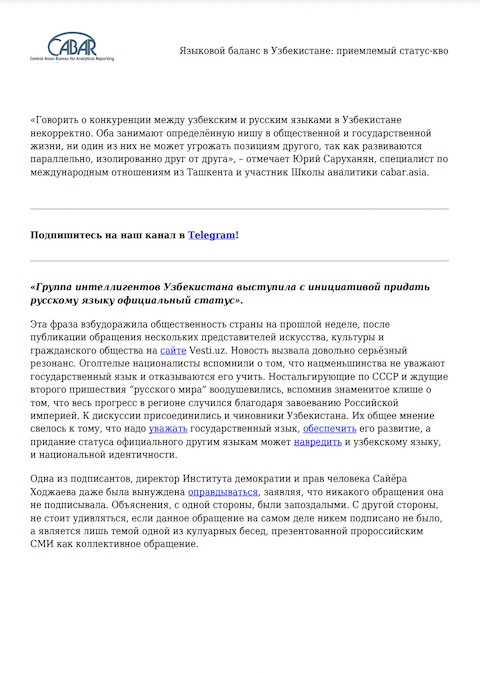 Языковой баланс в Узбекистане: Приемлемый статус-кво Year of publication: 2019 Author: Yuriy Sarukhanyan Corporate author: Central Asian Bureau for Analytical Reporting (CABAR) | Institute for War and Peace Reporting (IWPR) «Говорить о конкуренции между узбекским и русским языками в Узбекистане некорректно. Оба занимают определённую нишу в общественной и государственной жизни, ни один из них не может угрожать позициям другого, так как развиваются параллельно, изолированно друг от друга», – отмечает Юрий Саруханян, специалист по международным отношениям из Ташкента и участник Школы аналитики cabar.asia.
 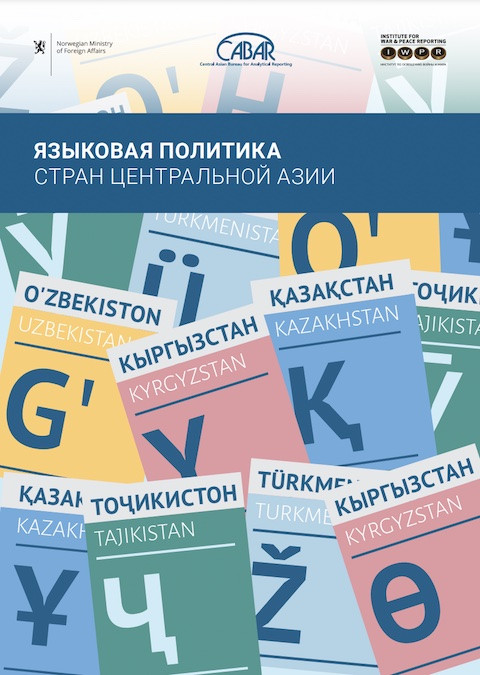 Language Policies of the Central Asian States Year of publication: 2020 Author: Nurbek Bekmurzayev Corporate author: Central Asian Bureau for Analytical Reporting (CABAR) | Institute for War and Peace Reporting (IWPR) The policy brief “Language Policy of the Central Asian States” is presented jointly by IWPR and CABAR.asia. The publication outlines the ways of the formation of state languages in the countries of Central Asia, analyzes their functioning along with the Russian language, draws conclusions and forecasts for the future, and provides recommendations for improving language policy.The publication is intended for young experts and consultants, researchers, management decision makers, and a wide range of readers. Языковая политика стран Центральной Азии Year of publication: 2020 Author: Nurbek Bekmurzayev Corporate author: Central Asian Bureau for Analytical Reporting (CABAR) | Institute for War and Peace Reporting (IWPR) Аналитическая записка “Языковая политика стран Центральной Азии” представлена совместно IWPR и CABAR.asia. В публикации изложены пути становления государственных языков в странах Центральной Азии, проанализировано их функционирование наряду с русским языком, сделаны выводы и прогнозы на будущее и предоставлены рекомендации для улучшения языковой политики.Публикация предназначена для молодых экспертов и консультантов, исследователей, лиц, принимающих управленческие решения, а также широкого круга читателей.
 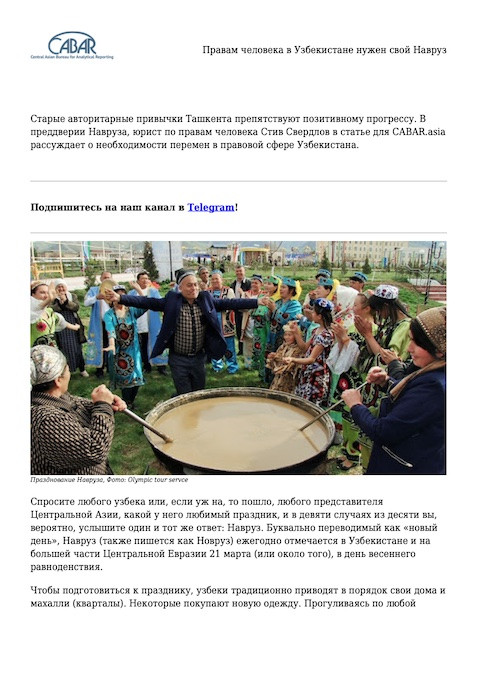 Human Rights in Uzbekistan Need Their Own Navruz Year of publication: 2021 Author: Steve Swerdlow Corporate author: Central Asian Bureau for Analytical Reporting (CABAR) Tashkent's old authoritarian habits hinder positive progress. On the eve of Navruz, human rights lawyer Steve Swerdlov, in an article for CABAR.asia, discusses the need for changes in the legal sphere of Uzbekistan. Правам человека в Узбекистане нужен свой Навруз Year of publication: 2021 Author: Steve Swerdlow Corporate author: Central Asian Bureau for Analytical Reporting (CABAR) Старые авторитарные привычки Ташкента препятствуют позитивному прогрессу. В преддверии Навруза, юрист по правам человека Стив Свердлов в статье для CABAR.asia рассуждает о необходимости перемен в правовой сфере Узбекистана.
 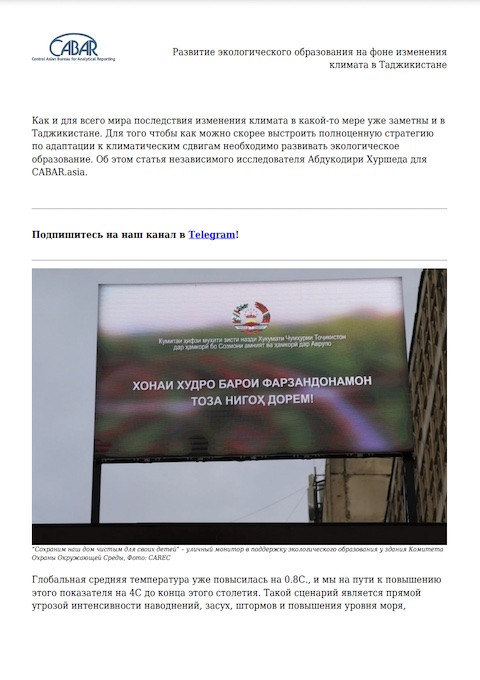 Development of Environmental Education Against the Background of Climate Change in Tajikistan Year of publication: 2021 Author: Khurshed Abdukodiri Corporate author: Central Asian Bureau for Analytical Reporting (CABAR) As well as for the whole world, the consequences of climate change are to some extent already noticeable in Tajikistan. In order to build a full-fledged strategy for adaptation to climate change as soon as possible, it is necessary to develop environmental education. Развитие экологического образования на фоне изменения климата в Таджикистане Year of publication: 2021 Author: Khurshed Abdukodiri Corporate author: Central Asian Bureau for Analytical Reporting (CABAR) Как и для всего мира последствия изменения климата в какой-то мере уже заметны и в Таджикистане. Для того чтобы как можно скорее выстроить полноценную стратегию по адаптации к климатическим сдвигам необходимо развивать экологическое образование.
  Domestic Violence in Tajikistan: What Measures Are Needed to Be Taken in Order to Help Victims? Year of publication: 2021 Author: Shokhsanam Shodiyeva Corporate author: Central Asian Bureau for Analytical Reporting (CABAR) In this article, the author discusses the current state of affairs in Tajikistan in the field of preventing domestic violence, and the measures taken. In addition, according to the authore, it is necessary to criminalize domestic violence in order to more effectively deal with rapists. Семейное насилие в Таджикистане: Какие меры нужны чтобы помочь жертвам? Year of publication: 2021 Author: Shokhsanam Shodiyeva Corporate author: Central Asian Bureau for Analytical Reporting (CABAR) В данном статье автор обсуждает текущее состояние дел в Таджикистане в области предотвращения домашнего насилия, предпринимаемые меры. Кроме того, по мнению автора статьи необходимо криминализировать домашнее насилие, чтобы более эффективно бороться с насильниками.
  Features of Countering Violent Extremism and Terrorism in Kazakhstan Year of publication: 2019 Author: Anna Gusarova Corporate author: Central Asian Bureau for Analytical Reporting (CABAR) | Institute for War and Peace Reporting (IWPR) «In Kazakhstan there is no term as “violent extremism” in the conceptual construct, and as a result at the legislative level. Too vague definition of the terms extremism and terrorism significantly complicates the work on prevention and counteraction», – said Anna Gusarova, an expert in international security, director of the Central Asian Institute for Strategic Studies, in her article written specifically for CABAR.asia.