
Resources
Explore a wide range of valuable resources on GCED to deepen your understanding and enhance your research, advocacy, teaching, and learning.
6 Results found
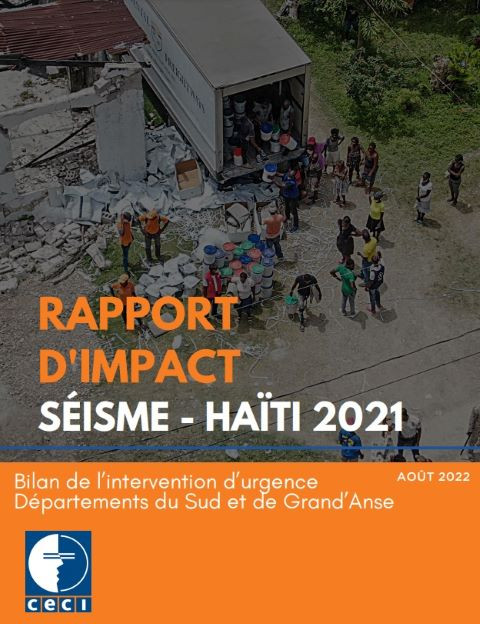 Impact Report-Earthquake-Haiti 2021 Year of publication: 2022 Corporate author: Centre for International Cooperation and Study (CECI) On August 14, 2021, a magnitude 7.2 earthquake struck the Great South of Haiti with full force, causing nearly of 2,300 dead and considerable material damage. This new natural disaster has come to worsen an already difficult socio-economic situation for families in this region of Haiti, which was barely within the devastating aftermath caused by Hurricane Matthew in 2016. From the first hours following the earthquake, CECI-Haiti, which was already carrying out 6 development in the departments of Grand-Anse and Sud, mobilized its teams to support government authorities, assess the needs of the population, in particular those of families and women, take stock of the damage and establish an action plan for recovery. The cities the most affected in the eastern region of the Grand'Anse department were the municipalities of Camp-Perrin, Roseaux, Coral, Beaumont, and Pestel.For the first emergency, the following priorities had been identified: Need for water supply; Need for drugs and agricultural inputs; Need for food and milk for the children; Need for tents and tarpaulins for temporary shelters; Need for sanitary products and clothing, portable toilets, etc.; Need for psychosocial support;To provide a rapid and significant response to urgent needs, CECI received funds from the public Canadian and obtained funding from the Ministry of International Relations and La Francophonie of the Government of Quebec. Rapport d'impact: SÉISME - HAÏTI 2021 Year of publication: 2022 Corporate author: Centre for International Cooperation and Study (CECI) Le 14 août 2021, un séisme de magnitude 7,2 a frappé de plein fouet le Grand Sud d’Haïti causant près de 2 300 morts et des dégâts matériels considérables. Cette nouvelle catastrophe naturelle est venue aggraver une situation socio-économique déjà difficile pour les familles de cette région d’Haïti qui se relevaient à peine des conséquences dévastatrices causées par l'ouragan Matthew en 2016.Dès les premières heures ayant suivi le passage du séisme, le CECI-Haïti qui menait déjà 6 projets de développement dans les départements de la Grand-Anse et du Sud, a mobilisé ses équipes pour appuyer les autorités gouvernementales, évaluer les besoins de la population, en particulier ceux des familles et des femmes, dresser un bilan des dégâts et établir un plan d’action pour le relèvement. Les communes les plus touchées dans la région Est du département de la Grand’Anse ont été les communes de Camp-Perrin, Roseaux, Corail, Beaumont et Pestel. Pour la première urgence, les priorités suivantes avaient été identifiées: Besoin d’approvisionnement en eau ; Besoin en médicaments et intrants agricoles ; Besoin en nourriture et lait pour les enfants ; Besoin en tentes et bâches pour des abris provisoires ; Besoin en produits hygiéniques et vêtements, toilettes portatives, etc. ; Besoin en appui psychosocial ;Pour apporter une réponse rapide et significative aux besoins urgents, le CECI a reçu des fonds du public canadien et obtenu un financement du ministère des Relations Internationales et de la Francophonie du gouvernement du Québec.
  Advocacy Note: The Role of Cross-Border Trade in Security Food in Border Areas During Periods of COVID-19 Pandemic Year of publication: 2022 Corporate author: Centre for International Cooperation and Study (CECI) The Role of Cross-Border Trade in Security food in border areas during periods of COVID-19 pandemic To limit the spread of Covid-19, the governments of Burkina Faso and Senegal have decided to close the borders in March 2020, thus limiting the movement of goods and people and cross-border exchanges. Faced with the measures taken and faced with the absolute necessity of survival, the Traders in cross-border areas bypass official checkpoints to continue trade. cross-border exchanges, necessary for their survival and food security, despite the risks of gender-based violence (GBV). In the event of a pandemic, for countries with still fragile economies such as Burkina Faso and Senegal, selective sanitary measures should rather be applied to enable formal trade and the movement of food across borders. Le rôle du commerce transfrontalier dans la sécurité alimentaire des zones frontalières en période de pandémie de COVID-19 Year of publication: 2022 Corporate author: Centre for International Cooperation and Study (CECI) Le rôle du commerce transfrontalier dans la sécurité alimentaire des zones frontalières en période de pandémie de COVID-19 Pour limiter la propagation de la Covid-19, les gouvernements du Burkina Faso et du Sénégal ont pris la décision de fermer les frontières en mars 2020, limitant ainsi le mouvement des biens et des personnes et les échanges transfrontaliers. Face aux mesures prises et devant la nécessité absolue de survie, les commerçant-e-s des zones transfrontalières contournent les postes de contrôle officiels pour continuer les échanges transfrontaliers, nécessaires pour leur survie et leur sécurité alimentaire, ce, malgré des risques de violence basée sur le genre (VBG). En cas de pandémie, pour des pays à économie encore fragile comme le Burkina Faso et le Sénégal, des mesures sanitaires sélectives devraient être plutôt appliquées afin de permettre des échanges formels et l’acheminement des denrées alimentaires à travers les frontières.
  Women Key Actors of Food Resilience: A Reconfiguration of Gender Relations in Times of the COVID-19 Pandemic Year of publication: 2021 Corporate author: Centre for International Cooperation and Study (CECI) The Covid-19 pandemic and its response measures have intensified the vulnerability and shortcomings of food systems in West Africa, affecting all activities and processes of production, distribution, and consumption of food. To this end, rural women in Senegal and Burkina Faso, ensured the resilience of poor and vulnerable households, thus generating recognition of this reality by men. It is therefore essential to give women decision-making power at all levels in the spheres related to the four pillars of security eating. It would be desirable to support and accompany the positive reconfiguration of relationships of power between women and men, already in progress in the communities studied, to ensure that they have the means and skills (social, cultural, economic, political, and legal) to be able to fully play this role. Support for farmer organizations and networks of women's organizations is essential. Les femmes actrices clés de résilience alimentaire: Une reconfiguration des rapports de genre en temps de pandémie de COVID-19 Year of publication: 2021 Corporate author: Centre for International Cooperation and Study (CECI) La pandémie de la Covid-19 et ses mesures de riposte ont intensifié la vulnérabilité et les insuffisances des systèmes alimentaires en Afrique de l’Ouest, en affectant l'ensemble des activités et des processus de production, de distribution et de consommation d'aliments. A cet effet, les femmes rurales au Sénégal et au Burkina Faso, ont assuré la résilience des ménages pauvres et vulnérables, suscitant ainsi une reconnaissance de cette réalité par les hommes. Il est donc essentiel de donner aux femmes du pouvoir décisionnel à tous les niveaux dans les sphères liées aux quatre (4) piliers de la sécurité alimentaire. Il serait souhaitable de soutenir et d’accompagner la reconfiguration positive des rapports de pouvoir entre les femmes et les hommes, déjà en cours dans les communautés étudiées, afin d'assurer qu'elles aient les moyens et habilités (sociales, culturelles, économiques, politiques et juridiques) pour pouvoir jouer pleinement ce rôle. Un appui aux organisations paysannes et aux réseaux d’organisations de femmes est essentiel.