
Resources
Explore a wide range of valuable resources on GCED to deepen your understanding and enhance your research, advocacy, teaching, and learning.
5 Results found
 Achieving gender equality in and through education Year of publication: 2019 Corporate author: GPE The purpose of this paper is to describe the current landscape in gender equality in education and spark discussion and debate around potential areas for Knowledge and Innovation Exchange (KIX) investment. The paper is part of a series of discussion papers, drafted to support the engagement and consultation of developing country partners and technical experts in the initial design of the GPE Knowledge and Innovation Exchange. Réaliser l’égalité entre les sexes, dans et par l’éducation Year of publication: 2019 Corporate author: GPE Le présent document a pour objet de décrire la situation actuelle de l’égalité entre les sexes dans l’éducation et d’encourager l’examen des domaines dans lesquels le KIX pourrait investir. Il fait partie d’une série de documents de travail établis pour soutenir la consultation des pays en développement partenaires et des experts techniques, et les faire participer à la conception initiale du Mécanisme de partage de connaissances et d’innovations du PME. Les idées qu’il présente doivent servir de point de départ aux discussions et pourraient sensiblement évoluer au fil du processus de consultation.
  Results Report 2019 Year of publication: 2019 Corporate author: GPE The Global Partnership for Education (GPE) is a multi-stakeholder partnership and fund dedicated to improving education in the world’s poorest countries, and those with the most children out of school. Founded in 2002, the partnership is designed to harness the power of collaboration among developing countries, donor countries, civil society, foundations, the private sector and youth (represented through civil society organizations) to support inclusive and quality education for all.The partnership is now implementing GPE 2020, its strategic plan for the 2016-2020 period that outlines an ambitious course of action to achieve three strategic goals:Strategic Goal 1: Improved and more equitable student learning outcomes through quality teaching and learningStrategic Goal 2: Increased equity, gender equality and inclusion for all in a full cycle of quality education, targeting the poorest and most marginalized, including by gender, disability, ethnicity and conflict or fragilityStrategic Goal 3: Effective and efficient education systems delivering equitable, quality educational services for allThese efforts are aligned with and support Sustainable Development Goal 4, the world’s commitment to inclusive and equitable quality education for all. Rapport sur les résultats 2019 Year of publication: 2019 Corporate author: GPE Le partenariat met en oeuvre le plan stratégique GPE 2020, son plan stratégique pour la période 2016-2020, qui définit une série de mesures ambitieuses pour la réalisation des trois buts stratégiques suivants: But stratégique 1: Des résultats d’apprentissage meilleurs et plus équitables grâce à un enseignement et un apprentissage de qualité But stratégique 2: Renforcement de l’équité, de l’égalité des sexes et de l’inclusion pour tous dans un cycle complet d’enseignement de qualité, en donnant la priorité aux plus démunis et aux plus marginalisés, notamment en raison de leur sexe, leur handicap, leur appartenance ethnique ou parce qu’ils se trouvent dans une situation de conflit ou de fragilité But stratégique 3: Des systèmes éducatifs efficaces et efficients offrant des services d’éducation équitables et de qualité pour tous Ces efforts sont alignés sur l’objectif de développement durable 4, l’engagement mondial en faveur d’une éducation inclusive et équitable de qualité pour tous.
 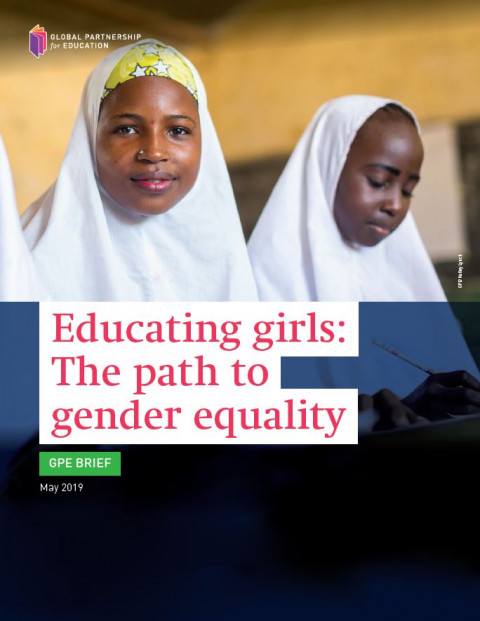 Educating Girls: The Path to Gender Equality; GPE Brief Year of publication: 2019 Corporate author: GPE Despite significant gains in recent years, education outcomes for girls in developing countries continue to lag behind those of boys. Adolescence is a particularly critical stage for girls, marked by rapid biological and psychological changes as well as powerful social expectations of how their lives should unfold. For many girls in developing countries, adolescence also marks a time of extreme vulnerability: to child marriage, teenage pregnancy, sexual violence, nutritional deficiency and exposure to HIV/AIDS. It also marks a time when pressures of social norms and cultural practices place new restrictions on what girls can do and who they can be. Lack of access to education increases vulnerability to these risks and constraints. Conversely, being in education acts as a powerful protective factor as well as a route to empowerment for girls to determine their own destiny. Achieving gender equality means delivering on three interlinked areas for girls: health, education and safety. GPE uses its results-based partnership model to work with developing countries to prioritize planning and spending on girls’ education throughout the education cycle, to achieve gender equality. Ensuring girls and boys have equal access to inclusive, quality education is a core principle of GPE’s strategic plan, GPE 2020, and GPE’s Gender Equality Policy and Strategy 2016-2020. At the advocacy level and in conjunction with its partners, GPE is also promoting working across sectors to meet the holistic needs of girls, from a gender equality perspective.