
Resources
Explore a wide range of valuable resources on GCED to deepen your understanding and enhance your research, advocacy, teaching, and learning.
89 Results found
 التعلّم من أجل العمل لصالح الناس والكوكب: التعليم وتغيّر المناخ Year of publication: 2024 Corporate author: Global Education Monitoring Report Team | Monitoring and Evaluating Climate Communication and Education Project (MECCE) | University of Sakatchewan ملخص مختصركيف يفضي التعليم إلى اتخاذ إجراءات بشأن تغيّر المناخ؟مع أن هنالك بيّنات دامغة على تأثير التعليم في سائر النتائج في مجال التنمية، وعلى الدور الذي يؤديه التعليم في تنمية القدرات المهنية اللازمة لعمليات الانتقال إلى التنمية المستدامة، فإن التعليم عادةً ما يكون غائباً عن اعتبارات سائر القطاعات عند اضطلاعها بوضع الاستراتيجيات والسياسات والتخطيط والتمويل. ولذا، استحدث التقرير العالمي لرصد التعليم سلسلة جديدة من المنشورات سعياً إلى تعزيز الحوار بشأن العلاقة المتبادلة بين التعليم وسائر أهداف التنمية المستدامة.وتتمحور الوثيقة الأولى في هذه السلسلة حول تغيّر المناخ. وتستعرض في مستهلها تنامي عواقب تغيّر المناخ على التعليم، ثم تتناول دور التعليم في العمل المناخي. وتبيّن الوثيقة أن مساهمة التعليم في تنمية القدرات المهنية اللازمة للانتقال إلى الاقتصاد المراعي للبيئة (الأخضر) لا تنال حقّ قدرها من التقدير. وهنالك قناعة شائعة أيضاً بأن التعليم، سواء النظامي أو غير النظامي أو غير الرسمي، يؤدي دوراً حاسماً في الحفز على اتخاذ الإجراءات الرامية إلى الحد من وطأة عواقب تغيّر المناخ والتكيف معها.بيد أن العلاقة الطردية بين التحصيل العلمي ومستويات الاستهلاك غير المستدام، فضلاً عن عدم توصل البحوث بشأن التأثير المباشر للتعليم في إجراءات التكيف مع عواقب تغيّر المناخ والحد من وطأتها إلى نتائج قاطعة، ساهما مساهمة جزئية في وضع مجال التعليم في أسفل سلم أولويات الخطط العالمية والوطنية المتعلقة بتغيّر المناخ.وتدّعي هذه الوثيقة ضرورة تكييف التعليم بشأن تغيّر المناخ لكي يتسنى تحقيق الإمكانيات الكامنة فيه. فلا يمكن أن يقتصر النموذج التربوي على نقل المعارف، بل لا بد له من التركيز أيضاً على التعلم الاجتماعي والعاطفي والعمل المنحى.وقد تمحور العديد من البحوث حول تأثير التحصيل العلمي والتعلم المعرفي. ولذا من الضروري إجراء المزيد من البحوث لتقييم سائر العوامل الحفازة التي يمكن للتعليم التأثير من خلالها في أنماط السلوك والحفز على اتخاذ إجراءات بشأن تغيّر المناخ. وتعدّ هذه البحوث ضرورية أيضاً من أجل إعداد برامج إصلاح قابلة للتطبيق في مجال التعليم تفضي إلى تحسين المناهج الدراسية، وتعزيز تأهب المدارس ونظم التعليم للتصدي لعواقب تغيّر المناخ، وإشراك المتعلمين، وإعداد المعلمين بما يتلاءم مع ذلك.
  Education and Climate Change: Learning to Act for People and Planet Year of publication: 2024 Corporate author: Global Education Monitoring Report Team | Monitoring and Evaluating Climate Communication and Education Project (MECCE) | University of Sakatchewan How can education lead to climate change action?Despite strong evidence on the impact of education on other development outcomes and the role it plays in developing professional capacity for sustainable development transitions, education is often absent from other sectors’ strategic, policy, planning and financing considerations. The Global Education Monitoring Report is introducing a new series to advance dialogue on the interrelationship of education with the other Sustainable Development Goals.The first paper in the series focuses on climate change. It starts by reviewing the growing impact of climate change on education before turning to the role of education in climate action. Education has a somewhat underappreciated contribution to developing professional capacities for the transition to a green economy. Formal, non-formal and informal learning are also commonly believed to be playing a critical role in motivating actions on climate change mitigation and adaptation.Yet a positive association between education attainment and unsustainable consumption levels, as well as inconclusiveness of much research on the direct impact of education on climate change adaptation and mitigation actions has in part contributed to education receiving low priority in global and national climate change agendas.This paper argues that climate change education needs to adapt to fulfil its potential. The education paradigm cannot rely solely on knowledge transfer but needs to focus on social and emotional, and action-oriented learning.Much of the research has focused on the impact of education attainment and cognitive learning. More research is therefore needed to assess other drivers through which education can influence behaviours and motivate climate change action. Such research is needed to formulate viable education reform packages that improve the curriculum, strengthen climate-readiness of schools and education systems, engage learners and prepare educators accordingly.
  Educación y cambio climático: aprender a cuidar de las personas y el planeta Year of publication: 2024 Corporate author: Global Education Monitoring Report Team | Monitoring and Evaluating Climate Communication and Education Project (MECCE) | University of Sakatchewan ¿Cómo puede la educación conducir a la acción contra el cambio climático?A pesar de las sólidas pruebas existentes sobre la repercusión de la educación en el logro de otros objetivos de desarrollo y la función que desempeña en el desarrollo de la capacidad profesional para las transiciones hacia el desarrollo sostenible, la educación suele estar ausente de las consideraciones estratégicas, políticas, de planificación y de financiación de otros sectores.El Informe de seguimiento de la educación en el mundo presenta una nueva serie destinada a fomentar el diálogo sobre la interrelación de la educación con los demás Objetivos de Desarrollo Sostenible. El primer documento de la serie se centra en el cambio climático, y empieza por analizar el creciente impacto del cambio climático en la educación antes de pasar a abordar la función de la educación en la acción climática.La contribución de la educación al desarrollo de capacidades profesionales para la transición a una economía verde está en cierta medida infravalorada. Al mismo tiempo, existe la conciencia de que el aprendizaje, tanto formal como no formal e informal, desempeña una función esencial a la hora de motivar la acción en materia de mitigación del cambio climático y adaptación a sus efectos.Sin embargo, la existencia de una correlación positiva entre el nivel de educación y los niveles de consumo insostenibles, así como la falta de conclusiones de muchas investigaciones sobre la repercusión directa de la educación en la mitigación del cambio climático y la adaptación a sus efectos, han contribuido en parte a que se otorgue escasa prioridad a la educación en las agendas mundiales y nacionales sobre el cambio climático.En este documento se sostiene que es necesario adaptar la educación sobre el cambio climático para que desarrolle todo su potencial. El paradigma educativo no puede basarse únicamente en la transferencia de conocimientos, sino que debe centrarse en el aprendizaje socioemocional y orientado a la acción. Gran parte de la investigación se ha centrado en analizar el logro educativo y los resultados que se alcanzan mediante el aprendizaje cognitivo. Por ello, es necesario seguir investigando para evaluar otros factores mediante los cuales la educación puede influir en los comportamientos y motivar la acción contra el cambio climático. Estas investigaciones son necesarias para formular paquetes de reformas educativas viables que mejoren los planes de estudios, refuercen la preparación de las escuelas y los sistemas educativos para el cambio climático, impliquen a los educandos y preparen a los educadores en consecuencia.
  Rapport mondial de suivi sur l'éducation 2019: Migration, déplacement et éducation: bâtir des ponts, pas des murs Year of publication: 2018 Corporate author: UNESCO | Global Education Monitoring Report Team Le Rapport mondial de suivi sur l’éducation 2019 examine l’incidence des migrations et des déplacements sur l’éducation à travers tous les mouvements de population : à l’intérieur et à l’extérieur des frontières, volontaires ou forcés, motivés par l’emploi ou par les études. Le Rapport fait également le point sur les progrès accomplis dans le domaine de l’éducation dans le cadre du Programme de développement durable à l’horizon 2030.Deux nouveaux pactes mondiaux sur les migrants et les réfugiés reconnaissent le rôle de l’éducation et fixent des objectifs conformes à l’engagement pris par la communauté internationale pour que personne ne soit laissé pour compte. Ce Rapport, guide pratique indispensable au service de ces deux pactes, aborde des questions d’ordre politique concernant les migrants saisonniers, le regroupement des écoles rurales, les programmes interculturels, l’intégration des réfugiés aux systèmes éducatifs nationaux, la lutte contre la ségrégation, la reconnaissance des qualifications, le financement ciblé des écoles, le renforcement de l’efficacité de l’aide humanitaire allouée à l’éducation et une formation qui prépare les enseignants à la diversité dans les classes.Ce Rapport invite les pays à considérer l’éducation comme un outil de gestion des migrations et des déplacements et comme une chance pour ceux qui en ont besoin. Informe de seguimiento de la educación en el mundo, 2019: Migración, desplazamientos y educación: construyendo puentes, no muros Year of publication: 2018 Corporate author: UNESCO | Global Education Monitoring Report Team La edición 2019 del Informe de Seguimiento de la Educación en el Mundo examina la incidencia de la migración y los desplazamientos en la educación considerando todos los movimientos de población: dentro y fuera de las fronteras, voluntarios y forzados, con fifines de empleo y de educación. Examina asimismo los progresos realizados con miras a la consecución del objetivo de educación de la Agenda 2030 para el Desarrollo Sostenible.Dos nuevos pactos mundiales sobre los migrantes y refugiados reconocen el papel de la educación y establecen objetivos acordes con el compromiso mundial de no dejar a nadie atrás. Este informe es un conjunto de herramientas vital para la aplicación de estos pactos. Aborda temas de política que abarcan los migrantes estacionales, la concentración de las escuelas rurales, los planes de estudio interculturales, la inclusión de los refugiados en los sistemas educativos nacionales y la lucha contra la segregación, el reconocimiento de las cualifificaciones, la orientación de la fifinanciación escolar a destinos específificos, una ayuda humanitaria más efificaz dedicada a la educación, y la preparación de los docentes para hacer frente a un alumnado de gran diversidad.Este informe exhorta a los países a considerar la educación como una herramienta para gestionar la migración y los desplazamientos y una oportunidad para quienes la necesitan.
 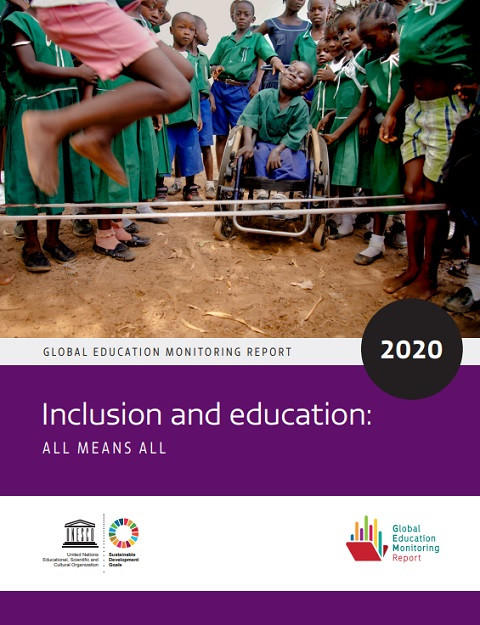 Global Education Monitoring Report 2020: Inclusion and Education; All Means All Year of publication: 2020 Corporate author: Global Education Monitoring Report Team | UNESCO The 2020 Global Education Monitoring Report looks at social, economic and cultural mechanisms that discriminate against disadvantaged children, youth and adults, keeping them out of education or marginalized in it. Spurred by their commitment to fulfil the right to inclusive education, countries are expanding their vision of inclusion in education to put diversity at the core of their systems. Yet implementation of well-meaning laws and policies often falters. Released at the start of the decade of action to 2030, and in the middle of the Covid-19 crisis, which has exacerbated underlying inequalities, the Report argues that resistance to addressing every learner’s needs is a real threat to achieving global education targets. Inclusion and education: All means all identifies the practices in governance and finance; curricula, textbooks and assessments; teacher education; school infrastructure; and relations with students, parents and communities that can unlock the process to inclusion. It provides policy recommendations to make learner diversity a strength to be celebrated, a force for social cohesion. Two new websites complement the fourth edition of the Global Education Monitoring Report. PEER describes how countries approach inclusion, serving as a resource for policy dialogue. SCOPE offers an opportunity to interact with the data and explore selected SDG 4 indicators. Rapport mondial de suivi sur l’éducation 2020: Inclusion et éducation ; Tous, sans exception Year of publication: 2020 Corporate author: Global Education Monitoring Report Team | UNESCO L’édition 2020 du Rapport mondial de suivi sur l’éducation examine les mécanismes sociaux, économiques et culturels qui discriminent les enfants, les jeunes et les adultes défavorisés, les tenant à l’écart de l’éducation ou les marginalisant en son sein. Encouragés par leur engagement à réaliser le droit à l’éducation inclusive, les pays élargissent leur vision de l’inclusion dans l’éducation afin de placer la diversité au cœur de leurs systèmes. Pourtant, la mise en œuvre de lois et de politiques bien intentionnées échoue souvent. Publié au début de la décennie d’action à l’horizon 2030, et en pleine crise de COVID-19 qui a exacerbé les inégalités existantes, rapport affirme que la résistance à la prise en compte des besoins de chaque apprenant constitue une menace réelle pour la réalisation des objectifs mondiaux d’éducation. Inclusion et éducation : Tous, sans exception recense les pratiques en matière de gouvernance et de financement, de programmes, de manuels et d’évaluations, de formation des enseignants, d’infrastructures scolaires et de relations avec les élèves, les parents et les communautés, qui peuvent enclencher le processus menant à l’inclusion. Il fournit des recommandations stratégiques pour faire de la diversité des apprenants une force à célébrer, une force de cohésion sociale. Deux nouveaux sites web complètent cette quatrième édition du Rapport mondial de suivi sur l’éducation. PEER décrit la manière dont les pays abordent l’inclusion, et sert de ressource pour le dialogue sur les politiques. SCOPE offre la possibilité d’interagir avec les données et d’explorer un choix d’indicateurs de l’ODD 4. 全球教育监测报告2019:移徙、流离失所和教育:要搭建桥梁,不要筑起高墙 Year of publication: 2018 Corporate author: UNESCO | Global Education Monitoring Report Team 2019年《全球教育监测报告》结合各种形式的人口流动情况 (境内和跨境、自愿和强迫、寻找工作和求学深造),深入探讨 了移徙和流离失所问题在教育方面产生的影响。本报告还回顾了 《2030年可持续发展议程》的教育内容取得的进展。关于移民和难民问题的两项新的全球契约承认教育的作用,并依据 “不让任何一个人掉队”的全球承诺制定了目标。本报 告是这两份契约的重要工具包,其中涉及的政策问题包括以下方 面:季节性移徙者的教育;农村学校合并;跨文化课程;将难民 纳入国家教育系统并消除隔离;承认资历;着力解决学校资金问 题;提供更有成效的人道主义教育援助;培养教师学会应对各种 课堂情况。报告呼吁各国将教育作为管理移徙和流离失所问题的工具,并认识到教育为需要这项工具的国家带来了机会。 Global Education Monitoring Report, 2019: Migration, Displacement and Education: Building Bridges, Not Walls Year of publication: 2018 Corporate author: UNESCO | Global Education Monitoring Report Team The 2019 Global Education Monitoring Report examines the education impact of migration and displacement across all population movements: within and across borders, voluntary and forced, for employment and education. It also reviews progress on education in the 2030 Agenda for Sustainable Development.Two new global compacts on migrants and refugees recognize education’s role and set objectives aligned with the global commitment to leave no one behind. This report is a vital toolkit for these compacts. It covers policy issues that address seasonal migrants, rural school consolidation, intercultural curricula, refugee inclusion in national education systems and elimination of segregation, qualifications recognition, targeting of school funding, more effective humanitarian education aid and teacher preparedness for diverse classrooms in emergency, protracted and “new normal” contexts.The report calls on countries to see education as a tool to manage migration and displacement and an opportunity for those needing one.
 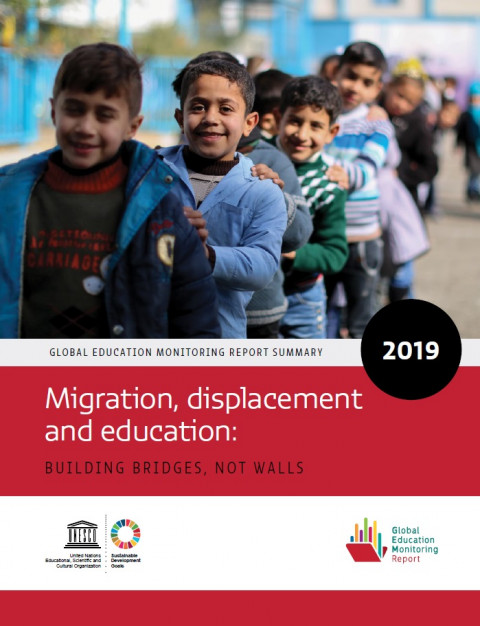 [Summary] Global Education Monitoring Report Summary 2019: Migration, Displacement and Education: Building Bridges, Not Walls Year of publication: 2018 Corporate author: UNESCO | Global Education Monitoring Report Team This Report points directly to a major challenge: How can teachers be supported to practise inclusion? It offers us fascinating insights into humanity and the age-old phenomenon of migration. I invite you to consider its recommendations and to act on them. This report is a vital toolkit for these compacts. It covers policy issues that address seasonal migrants, rural school consolidation, intercultural curricula, refugee inclusion in national education systems and elimination of segregation, qualifications recognition, targeting of school funding, more effective humanitarian education aid and teacher preparedness for diverse classrooms in emergency, protracted and “new normal” contexts. This summary of the 2019 GEM Report calls on countries to see education as a tool to manage migration and displacement and an opportunity for those needing one.