
Resources
Explore a wide range of valuable resources on GCED to deepen your understanding and enhance your research, advocacy, teaching, and learning.
10 Results found
 Education for citizenship and democracy in a globalized world: a comparative perspective Year of publication: 2005 Corporate author: Inter-American Development Bank The present document, Education for Citizenship and Democracy in a Globalized World: A Comparative Perspective, was developed in response to a request from the members of the Regional Policy Dialogue/Education Network. The studies in this document were presented and discussed during the VII Regional Policy Dialogue meeting held in January 2005 at the Inter-American Development Bank ’s headquarters in Washington, D.C. Within the general context of recent economic and political developments in Latin America and the Caribbean, experts regard free market and democracy as the fundamental economic and political paradigm leading to modernization and development in the global market. There is a concern in a number of democratic nation-states about levels of political engagement, particularly among the youths. This is cited as a reason for strengthening citizenship education.The studies presented in this document discuss Education for Citizenship and Democracy and the role of schools as systematic providers of the civic knowledge and the participatory practices that are the foundation of democracy. Among all of the institutions that facilitate the acquisition and development of skills for democratic participation, the school is the one that provide students with the competencies to effectively participate as citizens in a democracy. There has been an increasing interest in citizenship education both in the national and international contexts. At the national level, the aim is to pursue commitment and political participation, particularly from youth. In the international sphere, the objective is to find answers to the challenges such as immigration, global communications and trade across international borders and to a new level of awareness and appreciation for human rights. By providing a comprehensive overview of progress made by industrialized countries in the field of citizenship education, this study intents to share lessons learnt and effective practices which may be applied in the context of Latin America and the Caribbean. In addition, this study includes three experiences from Latin American countries (Chile, Colombia and Mexico) that were presented during the VII Regional Policy Dialogue. The three experiences show a practical and positive approach to the feasibility of introducing citizenship education in the schools of the Region. The cases present examples of reforms that evolved from the traditional civic education into an engaging education for citizenship and democracy. The Inter American Development Banks trusts that this publication will contribute to the discussions among member countries and create alternatives for the strengthening of democracy in the Region through education and citizenship. Education à la citoyenneté et de la démocratie dans un monde globalisé: une perspective comparative Year of publication: 2005 Corporate author: Inter-American Development Bank Le présent document, Éducation à la Citoyenneté et la Démocratie dans un monde globalisé: une perspective comparative, a été développé en réponse à une demande des membres du Dialogue Politique Régionale / Réseau Education. Les études présentées dans ce document ont été présentés et discutés lors de la réunion de dialogue politique régionale VII tenue en Janvier 2005 au siège de l'Organisation interaméricaine de la Banque de développement à Washington, DC Dans le contexte général des développements économiques et politiques récents en Amérique latine et dans les Caraïbes , les experts considèrent le marché libre et la démocratie comme le paradigme économique et politique fondamentale qui a conduit à la modernisation et le développement sur le marché mondial. Il y a une préoccupation dans un certain nombre d'Etats-nations démocratiques sur les niveaux d'engagement politique, en particulier chez les jeunes. Elle est citée comme une raison pour le renforcement de l'éducation civique. Les études présentées dans ce document discutent éducation à la citoyenneté et la démocratie et le rôle des écoles en tant que prestataires systématiques des connaissances civiques et les pratiques participatives qui sont le fondement de la démocratie. Parmi toutes les institutions qui facilitent l'acquisition et le développement des compétences pour la participation démocratique, l'école est celle qui fournit aux étudiants les compétences nécessaires pour participer efficacement en tant que citoyens dans une démocratie. Il y a eu un intérêt croissant pour l'éducation à la citoyenneté à la fois dans les contextes nationaux et internationaux. Au niveau national, l'objectif est de poursuivre l'engagement et la participation politique, en particulier des jeunes. Sur le plan international, l'objectif est de trouver des réponses aux défis tels que l'immigration, les communications mondiales et le commerce à travers les frontières internationales et à un nouveau niveau de conscience et l'appréciation des droits de l'homme. En fournissant une vue d'ensemble des progrès réalisés par les pays industrialisés dans le domaine de l'éducation civique, cette étude des intentions de partager les leçons apprises et les pratiques efficaces qui peuvent être appliquées dans le contexte de l'Amérique latine et les Caraïbes. En outre, cette étude comprend trois expériences des pays d'Amérique latine (Chili, Colombie et Mexique) qui ont été présentées lors du Dialogue Politique Régionale VII. Les trois expériences montrent une approche pratique et positive à la possibilité d'introduire l'éducation à la citoyenneté dans les écoles de la région. Les cas présentent des exemples de réformes qui ont évolué à partir de l'éducation civique traditionnelle en une éducation engageante pour la citoyenneté et la démocratie. Les banques de développement américaines Inter veut croire que cette publication contribuera aux discussions entre les pays membres et de créer des solutions de rechange pour le renforcement de la démocratie dans la région par l'éducation et la citoyenneté.
  The Effects of AI on the Working Lives of Women Year of publication: 2022 Author: Clementine Collett | Gina Neff | Livia Gouvea Gomes Corporate author: UNESCO | Inter-American Development Bank | Organisation for Economic Co-operation and Development (OECD) The use of AI technologies will affect women’s opportunities for work, and their position, status and treatment in the workplace. Around the globe, women in the labour force earn less than men, spend more time undertaking unpaid child- and elder-care jobs, hold fewer senior positions, participate less in science, technology, engineering and mathematics (STEM) fields, and tend to hold more precarious jobs overall. In harnessing AI, governments, institutions and companies must narrow gender gaps rather than perpetuate or exacerbate them. This report, by the IDB, OECD and UNESCO, outlines current knowledge of the impact that AI systems have on women’s opportunities for work, and their position, treatment and status in the workforce. It does so by exploring how AI is used within and outside the workplace, and how it could be used in the future. It looks at the potential impact of new and emerging AI technologies on the skills that employers will require, on how women look for and are hired for jobs, and on how jobs are structured through automated monitoring and oversight. The report maps the opportunities and challenges that AI presents for the working lives of women and highlights the complexities that varying national and regional contexts present for understanding the impact of AI on the work of women. The report also notes that current research does not offer a complete or definite picture of how AI impacts the working lives of women and calls for further research and analysis in this area. Les effets de l’IA sur la vie professionnelle des femmes Year of publication: 2022 Author: Clementine Collett | Gina Neff | Livia Gouvea Gomes Corporate author: UNESCO | Inter-American Development Bank | Organisation for Economic Co-operation and Development (OECD) L'utilisation des technologies d'IA aura une incidence sur les opportunités de travail des femmes, ainsi que sur leur position, leur statut et leur traite,ent sur le lieu de travail. Partout dans le monde, les femmes dans la population active gagnent moins que les hommes, passent plus de temps à s'occuper des enfants et des personnes âgées sans être rémunérées, occupent moins de postes à responsabilités, sont moins présentes dans les domaines des sciences, de la technologie, de l'ingénierie et des mathématiques(STEM) et ont tendance à occuper des emplois plus précaires dans l'ensemble. En exploitant l'IA, les gouvernements, les institutions et les entreprises doivent réduire les inégalités femmes-hommes plutôt que les perpétuer ou de les exacerber. Ce rapport, rédigé par la BID, l'OCDE et l'UNESCO, présente les connaissances actuelles sur position, leur traitement et leur statut dans la population active. Pour ce faire, il explore à l'avenir. Il examine l'impact potentiel des technologies d'IA nouvelles et naissantes sur les cométences dont les employeurs auront besoin, sur la manière dont les femmes structurés grâce à un contrôle et une surveillance automatisée. Le rapport dresse la liste des opportunités et des défis que l'IA présente pour la vie professionnelle des femmes et souligne les complexités que présentent les différents contextes nationaux et régionaux pour comprendre l'impact de l'IA sur le travail des femmes. Le rapport note également que les recherches actuelles ne permettent pas de dresser un tableau complet ou précis de l'impact de l'IA sur la vie professionnelle des femmes et appelle à poursuivre les recherches et les analyses dans ce domaine. Los efectos de la IA en la vida laboral de las mujeres Year of publication: 2022 Author: Clementine Collett | Gina Neff | Livia Gouvea Gomes Corporate author: UNESCO | Inter-American Development Bank | Organisation for Economic Co-operation and Development (OECD) El uso de tecnologías de IA afectará las oportunidades de las mujeres en el trabajo y su posición, status y tratamiento en el ámbito laboral. Alrededor del mundo, en la fuerza laboral las mujeres ganan menos que los varones, dedican más tiempo a trabajo no remunerado cuidando a niños y ancianos, tienen menos puestos sénior, participan menos en los campos de ciencia, tecnología, ingeniería y matemáticas (STEM por sus siglas en inglés) y tienden, en general, a tener trabajos más precarios. Al utilizar la IA, los gobiernos, las instituciones y las empresas deberán achicar las brechas de género y no perpetuarlas o exacerbarlas. Este informe del BID, la OCDE y UNESCO resume el conocimiento actual respecto del impacto que tienen los sistemas de IA sobre las oportunidades laborales de las mujeres, y sobre su posición, tratamiento y estatus en la fuerza laboral. En esta línea, el informe explora cómo se usa la IA dentro y fuera del ámbito laboral y cómo podría ser usada en el futuro. Mira el impacto potencial de las tecnologías de IA nuevas y emergentes sobre las habilidades que requerirán los empleadores, la manera en que las mujeres buscan empleo y son contratadas y cómo se estructuran los empleos a través del monitoreo y la supervisión automatizados. El informe presenta un mapa de las oportunidades y los desafíos que presenta la IA para la vida laboral de las mujeres y pone de manifiesto las complejidades que los diversos contextos nacionales y regionales presentan para comprender el impacto de la IA sobre el trabajo de las mujeres. El informe también toma nota de que la investigación actual no ofrece una mirada completa o definitiva respecto de cómo impacta la IA sobre la vida laboral de las mujeres e insta a la realización de más investigación y análisis en este campo.
  Education for Transformation Year of publication: 2012 Author: Marcelo Cabrol | Miguel Székely Corporate author: Inter-American Development Bank This book presents a diagnosis of the state of educational quality and its priorities (academic achievement, citizenship education, adolescent desertion, and teacher training) in Latin America and the Caribbean at the beginning of the 21st century. It also shows the public policies that can modify this reality. Educación para la transformación Year of publication: 2012 Author: Marcelo Cabrol | Miguel Székely Corporate author: Inter-American Development Bank Este libro presenta un diagnóstico sobre el estado de la calidad educativa y sus prioridades (logro académico, formación en ciudadanía, deserción adolescente y formación docente) en América Latina y el Caribe a inicios del siglo XXI. También muestra las políticas públicas que pueden modificar dicha realidad.
  Educar para la vida: El desarrollo de las habilidades socioemocionales y el rol de los docentes Year of publication: 2020 Author: Elena Arias Ortiz | Diana Hincapié | Diana Paredes Corporate author: Inter-American Development Bank Esta nota técnica presenta un diagnóstico sobre la incorporación de las habilidades socioemocionales en 12 países de América Latina y el Caribe, y la formación que reciben los docentes para desarrollar estas habilidades en los estudiantes. Si bien se han registrado avances, resaltamos los principales desafíos que se deben enfrentar para desarrollar las habilidades socioemocionales. Educate for Life: The Development of Socio-Emotional Skills and the Role of Teachers Year of publication: 2020 Author: Elena Arias Ortiz | Diana Hincapié | Diana Paredes Corporate author: Inter-American Development Bank This technical note presents a diagnosis on the incorporation of socio-emotional skills in 12 countries in Latin America and the Caribbean, and the training that teachers receive to develop these skills in students. Although progress has been made, we highlight the main challenges that must be faced to develop socio-emotional skills.
 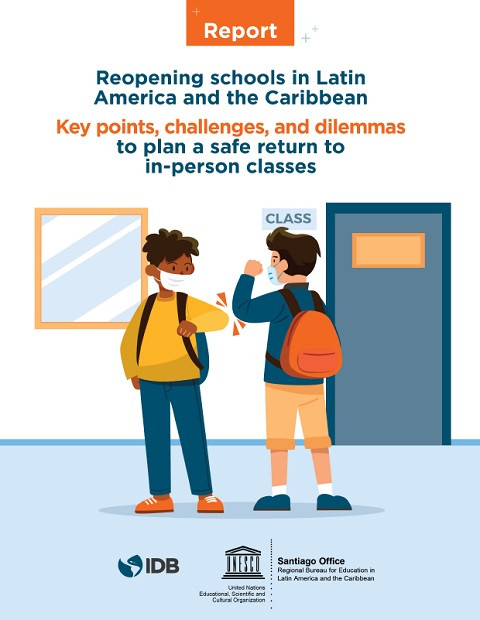 Reopening Schools in Latin America and the Caribbean: Keys, Challenges, and Dilemmas to Plan for a Safe Return to in-Person Classes Year of publication: 2021 Author: Alejandro Vera | Martín Scasso | Alejandro Morduchowicz | Cecilia Berlanga Alessio Robles Corporate author: UNESCO Santiago | Inter-American Development Bank The suspension of in-person classes as a consequence of the COVID-19 pandemic profoundly affected the education systems in Latin America and the Caribbean (LAC) and compromised the achievements reached around the goals established in the SDG4-Education 2030 Agenda. The most vulnerable people have been the most affected by this situation, which widened the preexisting gaps. The countries of the region have carried out great efforts to guarantee the continuity of learning. However, these have been limited by the challenges that this unprecedented crisis brought, aggravated by unequal conditions in access to infrastructure and other resources that affect broad sectors of the population.This report analyzes the possibilities, restrictions and needs that the countries of the region will face during the process of returning to in-person classes, considering five dimensions: (i) safe schools (school infrastructure, access to water and sanitation); (ii) human resources (principals and teachers); (iii) access to ITC and connectivity; (iv) education financing and (v) information and planning.