
Resources
Explore a wide range of valuable resources on GCED to deepen your understanding and enhance your research, advocacy, teaching, and learning.
38 Results found
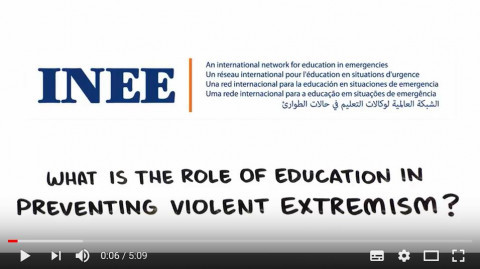 [Video] Preventing Violent Extremism (English w/subtitles) Year of publication: 2017 Corporate author: Inter-agency Network for Education in Emergencies (INEE) The number of violent extremist attacks committed across the world has increased sharply in recent years. And there are more attacks on schools and students than ever before. So, why is this happening and what can be done to change this pattern?The Inter-Agency Network for Education in Emergencies (INEE) has developed a whiteboard video to illustrate education’s role in preventing violent extremism (PVE). The 5-minute video -- available in English, Arabic, French, Spanish, and Portuguese -- looks at some definitions of PVE and education’s role in fostering inclusive and equitable environments, encouraging critical thinking, promoting tolerance and respect for diversity, and thereby contributing to wider social cohesion and the reduction of violence in all forms.For further information on education and PVE, please visit the INEE website (www.ineesite.org/preventing-violent-extremism), where you can find key activities and resources, including a curated catalogue of PVE resources. [Vídeo] Previniendo el Extremismo Violento (subtítulos en español) Year of publication: 2017 Corporate author: Inter-agency Network for Education in Emergencies (INEE) El número de ataques extremistas violentos cometidos en todo el mundo ha aumentado considerablemente en los últimos años. Y hay más ataques que nunca en las escuelas y hacia estudiantes. Entonces, ¿por qué está sucediendo esto y qué se puede hacer para cambiar este patrón?La Red Interinstitucional para la Educación en Situaciones de Emergencia (INEE) ha desarrollado un video de pizarra para ilustrar el papel de la educación en la prevención del extremismo violento (PVE). El video de 5 minutos - disponible con subtítulos en inglés, árabe, francés, español y portugués - examina algunas definiciones de PVE y el papel de la educación en fomentar ambientes inclusivos y equitativos, fomentar el pensamiento crítico, promover la tolerancia y el respeto a la diversidad, Contribuyendo así a una mayor cohesión social ya la reducción de la violencia en todas sus formas.Para más información sobre educación y PVE, visite el sitio web de la INEE (www.ineesite.org/preventing-violent-extremism), donde encontrará actividades clave y recursos, incluyendo un catálogo de recursos de PVE.
 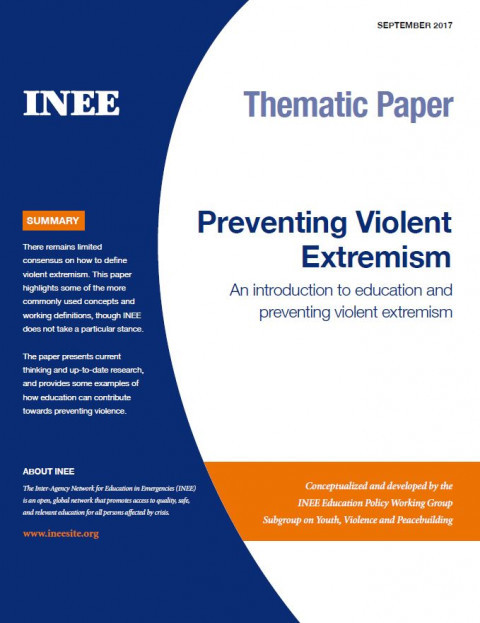 INEE Thematic Paper: An Introduction to Education and Preventing Violent Extremism Year of publication: 2017 Corporate author: Inter-agency Network for Education in Emergencies (INEE) This paper was conceptualized and developed by the INEE Education Policy Working Group subgroup on Youth, Violence and Peacebuilding. Though there remains limited consensus on how to define violent extremism, this paper highlights some of the more commonly used concepts and working definitions, presents current thinking and up-to-date research, and provides some examples of how education can contribute to preventing violent extremism. INEE does not take a particular stance.The paper is the most recent addition to the INEE’s work gathering resources on education and preventing violent extremism (PVE) from around the world, which may help policy-makers, teachers, principals, trainers, and researchers understand better the link between education and violent extremism and promote the positive ‘face’ of education. Documento temático de la INEE: una introducción a la educación y la prevención del extremismo violento Year of publication: 2017 Corporate author: Inter-agency Network for Education in Emergencies (INEE) Sigue habiendo un consenso limitado sobre cómo definir el extremismo violento. Este documento destaca algunos de los conceptos y definiciones comúnmente utilizadas, aunque la INEE no adopta ninguna particular.El documento presenta el pensamiento actual y la investigación actualizada, y proporciona algunos ejemplos de cómo la educación puede contribuir a la prevención de la violencia. Document thématique de l'INEE: Introduction à l'éducation et prévention de l'extrémisme violent Year of publication: 2017 Corporate author: Inter-agency Network for Education in Emergencies (INEE) Le sous-groupe de travail sur la jeunesse, la violence et la consolidation de la paix du Groupe de travail sur les politiques d'éducation de l'INEE a eu l'idée de cette thématique et a développé le document.Le consensus sur la définition de l'extrémisme violent reste limité. Cet article présente certains des concepts et des définitions pratiques les plus usuels, sachant toutefois que l'INEE ne prend pas de position sur la question. Le document présente les réflexions actuelles et la recherche à jour, et fournit quelques exemples de la façon dont l'éducation peut contribuer à la prévention de la violence. [Vidéo] Prévention de l'extrémisme violent (sous-titres en français) Year of publication: 2017 Corporate author: Inter-agency Network for Education in Emergencies (INEE) Le nombre d’attaques extrémistes violentes perpétrées dans le monde ces dernières années a gravement augmenté. Il y a de plus en plus d’attaques contre les écoles et les étudiants qu’avant. Pourquoi cela se passe-t-il et que pouvons nous faire pour changer ce schéma?Cette vidéo de 5 minutes-- disponible avec des sous-titres en anglais, français, espagnol et portugais-- présente des définitions de PVE et du rôle de l’éducation afin de promouvoir des environnements inclusifs et équitables, qui encouragent la pensée critique, la promotion de la tolérance et du respect pour la diversité et contribuent ainsi à une plus grande cohésion sociale et à la réduction de la violence sous toutes ses formes.Pour plus d’informations sur l’éducation et PVE, veuillez visiter la page web de l’INEE (www.ineesite.org/preventing-violent-extremism),où vous pourrez trouver des activités clés et des ressources, y compris un catalogue des ressources PVE.
 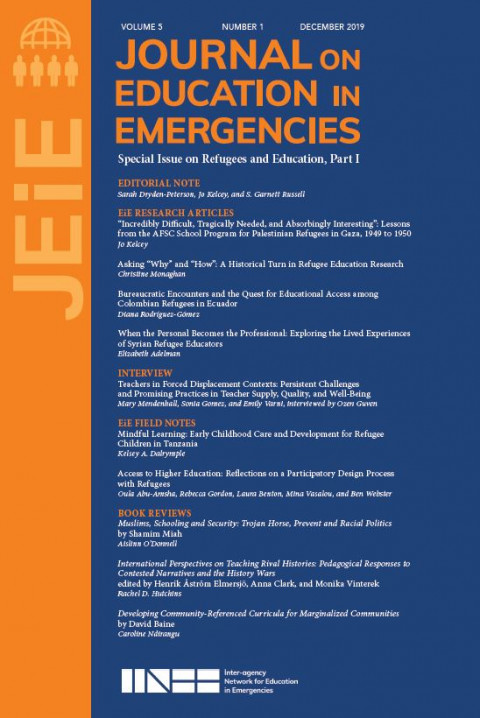 Journal on Education in Emergencies: Special Issue on Refugees and Education, Part I (Vol. 5, No.1 December 2019) Year of publication: 2019 Author: Sarah Dryden-Peterson | Jo Kelcey | S. Garnett Russell Corporate author: Inter-agency Network for Education in Emergencies (INEE) This special issue of JEiE—the first of two parts—showcases research on important developments in the field of refugee education across several regions, including the Middle East, Latin America, and Africa. The issue includes four research articles, one interview, two field notes, and three book reviews.The contributing authors describe and analyze how international agencies, state bureaucracies, local organizations and their partners, and refugees shape the structures that influence the education of refugees, both historically and in the present, and how these actors imagine their roles. In so doing, the authors help to untangle key questions about how responsibility for meeting refugees’ educational needs and aspiration is taken up and shared. The articles in this issue include immediate and long-term lessons for how refugee education is designed and experienced.
 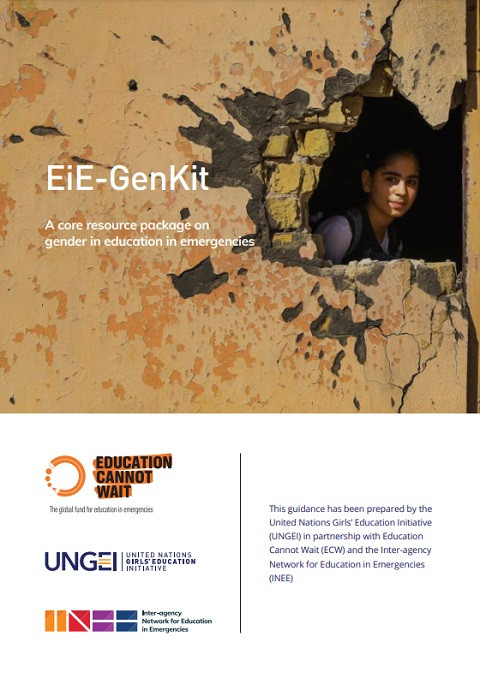 EiE-GenKit: A Core Resource Package on Gender in Education in Emergencies Year of publication: 2021 Corporate author: Education Cannot Wait (ECW) | Inter-agency Network for Education in Emergencies (INEE) | United Nations Girls' Education Initiative (UNGEI) When gender-responsive, quality education is available to all it has the potential to transform societies and build sustainable peace. A joint initiative from the Inter-agency Network for Education in Emergencies (INEE), Education Cannot Wait (ECW) and the UN Girls’ Education Initiative (UNGEI), the EiE-GenKit is a core resource package for gender in education in emergencies. The EiE-GenKit is the first resource of its kind, providing education practitioners with practical tools to promote gender-responsive programming from crisis to peace and sustainable development.The EiE-GenKit is based on extensive research and consultation with the latest resources, evidence, new tools and good practice available in one easy-to-use package. The EiE-GenKit builds on existing humanitarian processes for a streamlined approach to gender-responsive EiE. The EiE-GenKit offers tools for practical and immediate use including checklists, tipsheets and assessment templates supporting practitioners to ensure that each phase of an EiE intervention is gender-responsive. Bridging the gap between what we know about gender-responsive EiE and the tools we need to make it happen, the EiE-GenKit aims to promote improved gender and education outcomes of learners living in crises.