
Resources
Explore a wide range of valuable resources on GCED to deepen your understanding and enhance your research, advocacy, teaching, and learning.
8 Results found
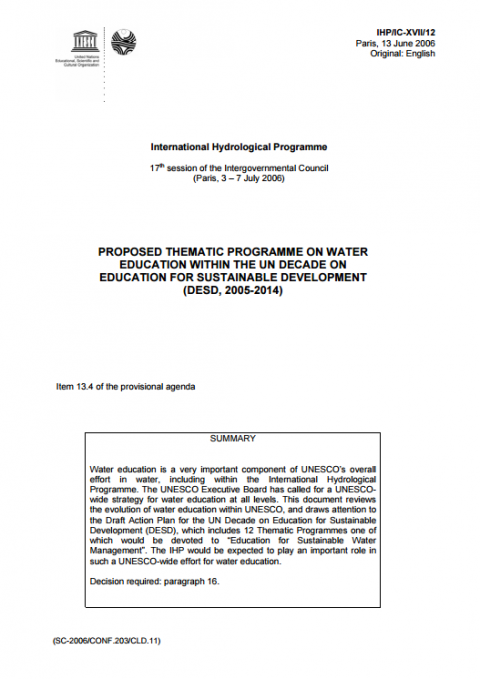 Proposed thematic programme on water education within the UN Decade on Education for Sustainable Development (DESD, 2005-2014) Year of publication: 2006 Corporate author: International Hydrological Programme (IHP) Water education is a very important component of UNESCO’s overall effort in water, including within the International Hydrological Programme. The UNESCO Executive Board has called for a UNESCO-wide strategy for water education at all levels. This document reviews the evolution of water education within UNESCO, and draws attention to the Draft Action Plan for the UN Decade on Education for Sustainable Development (DESD), which includes 12 Thematic Programmes one of which would be devoted to “Education for Sustainable Water Management”. The IHP would be expected to play an important role in such a UNESCO-wide effort for water education.
  Water education for sustainable development: a global synthesis Year of publication: 2012 Corporate author: International Hydrological Programme (IHP) Water education is key to achieve the water related MDGs. While there is a range of materials and projects focusing on water-related education, these are not well connected to offer customised solutions to individual countries. Some of the limitations identified with the existing water education include use of outdated, biased or irrelevant information; poor medium of instruction; lack of continuity between different levels of water education; lack of integration with the wider curriculum and with local knowledge; lack of practical relevance to local and community needs; lack of resources; and poor linkages with locally available professional bodies. The programme on “Water Education” is an initiative of the International Hydrological Programme (IHP) of UNESCO, Water and Sustainable Education focused on an integrated understanding of biological and hydrological processes at a catchment’s scale in order to create a scientific basis for a new, cost-effective and systemic approach to the sustainable management of freshwater resources. L'éducation relative à l'eau pour le développement durable: une synthèse globale Year of publication: 2012 Corporate author: International Hydrological Programme (IHP) L'éducation relative à l'eau est essentielle pour atteindre les OMD(Objectifs du Millénaire pour le Développement) liées à l'eau. Bien qu'il existe toute une gamme de matériels et de projets axés sur l'éducation relative à l'eau, ceux-ci ne sont pas bien reliés pour offrir des solutions personnalisées à chaque pays. Certaines des limitations identifiées avec l'éducation en matière d'eau existante incluent l'utilisation d'information périmée, biaisée ou non pertinente; Milieu pauvre d'instruction; Manque de continuité entre les différents niveaux de l'éducation relative à l'eau; Le manque d'intégration avec le programme d'études plus large et avec les connaissances locales; Manque de pertinence pratique pour les besoins locaux et communautaires; manque de ressources; Et les faibles liens avec les organismes professionnels disponibles sur place. Le programme sur l'éducation à l'eau est une initiative du Programme Hydrologique International (PHI) de l'UNESCO, Eau et éducation durable, axé sur une compréhension intégrée des processus biologiques et hydrologiques à l'échelle d'un bassin versant afin de créer une base scientifique pour une nouvelle, Rentable et systémique de la gestion durable des ressources en eau douce. Предлагаемая тематическая программа по образованию в области водных ресурсов в рамках Десятилетия образования в интересах устойчивого развития ООН (ДОУР, 2005-2014 ГГ.) Year of publication: 2006 Corporate author: International Hydrological Programme (IHP) Water education is a very important component of UNESCO’s overall effort in water, including within the International Hydrological Programme. The UNESCO Executive Board has called for a UNESCO-wide strategy for water education at all levels. This document reviews the evolution of water education within UNESCO, and draws attention to the Draft Action Plan for the UN Decade on Education for Sustainable Development (DESD), which includes 12 Thematic Programmes one of which would be devoted to “Education for Sustainable Water Management”. The IHP would be expected to play an important role in such a UNESCO-wide effort for water education.
 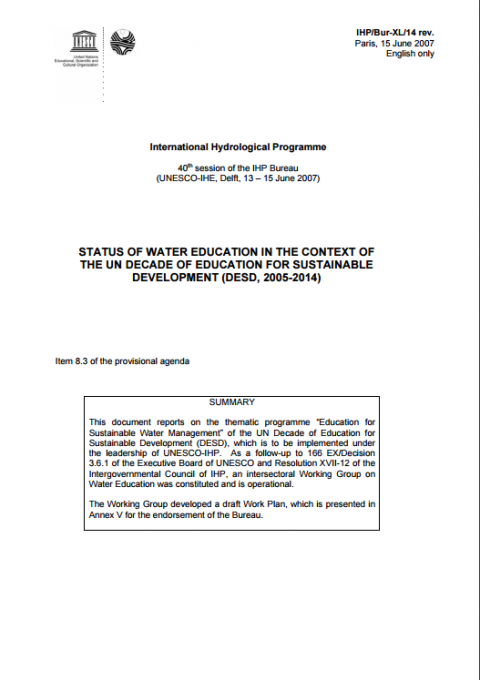 Status of water education in the context of the UN Decade of Education for Sustainable Development (DESD, 2005-2014) Year of publication: 2007 Corporate author: International Hydrological Programme (IHP) This document reports on the thematic programme “Education for Sustainable Water Management” of the UN Decade of Education for Sustainable Development (DESD), which is to be implemented under the leadership of UNESCO-IHP. As a follow-up to 166 EX/Decision 3.6.1 of the Executive Board of UNESCO and Resolution XVII-12 of the Intergovernmental Council of IHP, an intersectoral Working Group on Water Education was constituted and is operational. The Working Group developed a draft Work Plan, which is presented in Annex V for the endorsement of the Bureau. Situation de l'éducation relative à l'eau dans le contexte de la Décennie des Nations Unies pour l'éducation au service du développement durable (DEDD, 2005-2014) Year of publication: 2007 Corporate author: International Hydrological Programme (IHP) Ce document rend compte du programme thématique «Education pour une gestion durable de l'eau» de la Décennie des Nations Unies pour l'éducation au service du développement durable (DEDD), qui sera mis en œuvre sous la direction du PHI de l'UNESCO. Conformément à la décision 166 EX / 3.6.1 du Conseil exécutif de l'UNESCO et à la Résolution XVII-12 du Conseil intergouvernemental du PHI, un groupe de travail intersectoriel sur l'éducation relative à l'eau a été créé et est opérationnel. Le groupe de travail a élaboré un projet de plan de travail qui est présenté à l'annexe V pour approbation par le Bureau. Programa temático propuesto sobre la educación relativa al agua en el marco del Decenio de las Naciones Unidas de la Educación para el Desarrollo Sostenible (2005-2014) Year of publication: 2006 Corporate author: International Hydrological Programme (IHP) Water education is a very important component of UNESCO’s overall effort in water, including within the International Hydrological Programme. The UNESCO Executive Board has called for a UNESCO-wide strategy for water education at all levels. This document reviews the evolution of water education within UNESCO, and draws attention to the Draft Action Plan for the UN Decade on Education for Sustainable Development (DESD), which includes 12 Thematic Programmes one of which would be devoted to “Education for Sustainable Water Management”. The IHP would be expected to play an important role in such a UNESCO-wide effort for water education. Proposition de programme thématique sur l'éducation relative à l'eau dans le cadre de la décennie des Nations Unies pour L'Education au Service du Développement Durable (DEDD, 2005-2014) Year of publication: 2006 Corporate author: International Hydrological Programme (IHP) Water education is a very important component of UNESCO’s overall effort in water, including within the International Hydrological Programme. The UNESCO Executive Board has called for a UNESCO-wide strategy for water education at all levels. This document reviews the evolution of water education within UNESCO, and draws attention to the Draft Action Plan for the UN Decade on Education for Sustainable Development (DESD), which includes 12 Thematic Programmes one of which would be devoted to “Education for Sustainable Water Management”. The IHP would be expected to play an important role in such a UNESCO-wide effort for water education.