
Resources
Explore a wide range of valuable resources on GCED to deepen your understanding and enhance your research, advocacy, teaching, and learning.
8 Results found
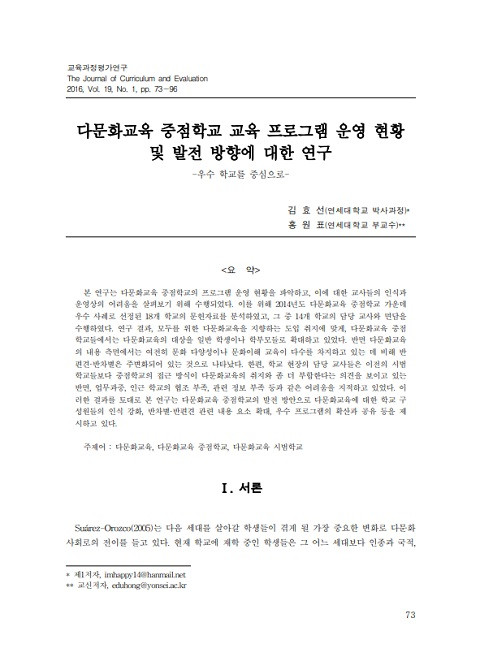 Effects and Limits of Core Schools for Multicultural Education (The Journal of Curriculum and Evaluation; Vol. 19, No. 1) Year of publication: 2016 Author: Hyosun Kim | Wonpyo Hong Corporate author: Korea Institute for Curriculum and Evaluation (KICE) This study investigates curriculum programs of core schools for multicultural education and teachers’ responses to their effects and limits. To address these topics, this study analyzes curricular documents collected from 18 elementary and secondary schools selected as exemplary cases in 2014. It also conducted in-depth interviews with 14 teachers who are in charge of planing and implementing multicultural programs in core schools. Major results support that multicultural core schools expand the targets of multicultural education to mainstream students, their parents and local residents beyond minority students and their parents. It turned out, however, that multicultural core schools still tend to untouch structural biases and discriminations, while focusing on extending students’ awareness of cultural and racial diversities. This study also reveals that participating teachers face such difficulties as heavy workloads, lack of collaboration from local schools, and lack of relevant experiences and instructional materials. Based on these results, this study suggests the sharing of successful programs, enhancing teachers awareness of the significance of multicultural education, and further supports for teachers in charge of multicultural education to achieve the targeted goals of multicultural core schools. 다문화교육 중점학교 교육 프로그램 운영 현황 및 발전 방향에 대한 연구 (교육과정평가연구; Vol. 19, No. 1) Year of publication: 2016 Author: 김혜선 | 홍원표 Corporate author: 한국교육과정평가원 본 연구는 다문화교육 중점학교의 프로그램 운영 현황을 파악하고, 이에 대한 교사들의 인식과 운영상의 어려움을 살펴보기 위해 수행되었다. 이를 위해 2014년도 다문화교육 중점학교 가운데 우수 사례로 선정된 18개 학교의 문헌자료를 분석하였고, 그 중 14개 학교의 담당 교사와 면담을 수행하였다. 연구 결과, 모두를 위한 다문화교육을 지향하는 도입 취지에 맞게, 다문화교육 중점학교들에서는 다문화교육의 대상을 일반 학생이나 학부모들로 확대하고 있었다. 반면 다문화교육의 내용 측면에서는 여전히 문화 다양성이나 문화이해 교육이 다수를 차지하고 있는 데 비해 반편견·반차별은 주변화되어 있는 것으로 나타났다. 한편, 학교 현장의 담당 교사들은 이전의 시범학교들보다 중점학교의 접근 방식이 다문화교육의 취지와 좀 더 부합한다는 의견을 보이고 있는 반면, 업무과중, 인근 학교의 협조 부족, 관련 정보 부족 등과 같은 어려움을 지적하고 있었다. 이러한 결과를 토대로 본 연구는 다문화교육 중점학교의 발전 방안으로 다문화교육에 대한 학교 구성원들의 인식 강화, 반차별·반편견 관련 내용 요소 확대, 우수 프로그램의 확산과 공유 등을 제시하고 있다.
  A Comparative Study on Global Citizenship Education between Korea and ASEAN Year of publication: 2015 Corporate author: Korea Institute for Curriculum and Evaluation (KICE) This research is the second-year study for a three-year project (2013-2015) focused on the global citizenship education of ASEAN (Association of Southeast Asian Nations). In the first-year study (2013), the current global citizenship education presented in the social studies curriculum of each country was analyzed based on literature research, and the global citizenship of students from each country was examined through surveys. Based on the analysis of the current global citizenship education of Korea and ASEAN overall and the characteristics of global citizenship of students from each country, this study is designed to make an in-depth analysis of global citizenship education and to seek direction for the joint global citizenship education programs between Korea and ASEAN to be employed in the third-year research.The students from the two countries, Indonesia and Thailand, among the 10 ASEAN countries are selected as participants because these two countries also participated in the previous international comparison study. The purposes of this study are as follows; (1) comparing the current global citizenship education of the national-level curriculum of Korea, Indonesia, and Thailand, (2) finding the similarities and differences by analysing the characteristics of global citizenship education of Korean, Indonesian, and Thai students, and (3) proposing the direction and themes of global citizenship education which will be mutually applied in Korea and ASEAN countries based on the research results.To conduct this study, various methods including literature study, interviews through visits to local schools, conferences for specialists, and international seminars were used. First, the meaning and goals of global citizenship education were established by reviewing literature and the concepts of ‘Humanity’, ‘Global Identity’, and ‘Global Participation’, which are the three sub-indices for global citizenship extracted from the first-year study, were used. Based on this framework, interview protocols for students, teachers, and policy makers were composed.The research team visited Indonesia and Thailand, carried out semi-structured interviews with students, teachers, and policy makers of national-level curriculum and classroom observations, and collected data related to global citizenship education. In addition, by conducting an international seminar with policy makers of curriculum of each country’s Ministry of Education and UNESCO specialists, we aimed to seek direction for joint global citizenship education in Korea and ASEAN and to reinforce educational cooperation.The major findings of this research can be suggested according to the research purposes in the following way.First, in the analysis of the national-level curriculum made for the comparison of current global citizenship education of Korea, Indonesia, and Thailand, the curriculum of each country is found to include elements of global citizenship education. However, countries show discrepancies in their actualization of curriculum, and citizenship education is still centered on national citizenship rather than global citizenship. Therefore, a more systematic attempt is needed for the advancement of citizenship education from nation-centered to globally oriented.Second, the findings from the interviews with students of each country carried out to define the characteristics of global citizenship of Korean, Indonesian, and Thai students indicate that while students’ responses showed a number of similarities in general, differences were found in specific answers as well. High school students provided more logical answers with greater depth compared to middle school students, and their responses differed based on their cultural contexts and experiences rather than their gender or religion. Therefore, while taking an approach which considers the level of students’ cognitive development as well as the cultural distinctiveness of each country, a way to expand opportunities for specific activities and experiences rather than an abstract way of teaching should be considered.Third, based on the analysis results, the directions and themes for global citizenship education to be jointly applied in Korea and ASEAN countries are proposed as follows: (1) The curriculum for global citizenship education should be focused on reinforcing the competency of citizens to participate in communities rather than that of individuals to ensure international competitiveness. (2) It is necessary to educate students to confront various conflicts and solve them by themselves rather than teaching them the abstract answers to the conflicts. (3) Global citizenship education should move beyond knowledge-based education and aim to lead bring changes in students’ behavior thereby empowering them to settle global issues. (4) For the actual implementation of curriculum, the cultural distinctiveness of each country and the differences by groups should be considered. (5) It is important to help students spread their interest to diverse countries beyond Western countries or ‘developed countries’.With these points in consideration, the objective of global citizenship education to be jointly promoted in Korea and ASEAN is suggested as the following: “Citizens are cultivated to form their identity as Asians based on their interest and knowledge of Asia and to participate in settling global issues. Through this, their qualities to participate in issues concerning all humanity are eventually cultivated.” The specific themes may include understanding Asia and ASEAN, social justice and equality, diversity, globalization and interdependence, conflict and peace, as well as sustainable development and environment. To improve effectiveness of joint global citizenship education of Korea and ASEAN and to reinforce educational cooperation, we made the following three suggestions.First, the standardization of global citizenship education across the nation is required. Having defined global citizenship education as the cultivation of the qualities of citizens based on the perception of human rights (Humanity) and with the identity as a global citizen (Global Identity) who can participate in settling the issues of global society (Participation), global citizenship education will yield the greatest efficiency when carried out together by all beyond national boundaries. Therefore, it is suggested that research for developing and expanding the joint curriculum by regions be supported and close cooperation be formed between policy makers of national curriculum and officials of International Training and Cooperation.Second, the reinforcement of global citizenship education through teacher training is required. For the effective implementation of joint global citizenship education in each country through the standardization of global citizenship education, the cultural diversity and distinctiveness of each country should be reflected. For these reasons, various practical bottom-up strategies are needed. Teacher training is a mandatory prerequisite for global citizenship education that is appropriate for the situations and contexts of each country. Therefore, it is suggested that researchers find out how to reinforce global citizenship education in teacher training based on solid research.Third, global citizenship education should be expanded by the exchange of human resources. As confirmed in this study, the exchange itself can bring a positive influence on the cultivation of global citizenship, and the sharing of the strategies for global citizenship education in each country can contribute to the development of a model for better global citizenship education. Therefore, it is suggested that the research for the joint promotion of project-based global citizenship education and the opportunities for mutual exchange of students and teachers between Korea and ASEAN countries should be expanded. Une Étude Comparative sur L'éducation à la Citoyenneté Mondiale (ECM) entre le Coréen et l'ASEAN Year of publication: 2015 Corporate author: Korea Institute for Curriculum and Evaluation (KICE) Pour réaliser cette étude, diverses méthodes, y compris l'étude de la littérature, des entrevues par des visites dans les écoles locales, des conférences pour les spécialistes et séminaires internationaux ont été utilisés. Premièrement, le sens et les objectifs de L'éducation à la citoyenneté Mondiale (ECM) ont été établies en examinant la littérature et les concepts de «l'humanité», «Global Identity» et «Participation globale», qui sont les trois sous-indices pour mondiale la citoyenneté extraite de l'étude de première année, ont été utilisés. Sur la base de ce cadre, les protocoles d'entrevue pour les étudiants, les enseignants et les responsables politiques ont été composées.L'équipe de recherche a visité l'Indonésie et de la Thaïlande, a mené des entretiens semi-structurés avec les étudiants, les enseignants et les décideurs des observations du curriculum et de la classe au niveau national, et a recueilli des données relatives à l'éducation à la citoyenneté mondiale. En outre, en procédant à un séminaire international avec les décideurs du curriculum du ministère de l'Éducation et de l'UNESCO spécialistes de chaque pays, nous avons cherché à obtenir des directives pour joint L'éducation à la citoyenneté Mondiale (ECM) en Corée et l'ASEAN et de renforcer la coopération éducative.Les principaux résultats de cette recherche peuvent être proposées en fonction des fins de recherche de la manière suivante.Tout d'abord, dans l'analyse du programme au niveau national fait pour la comparaison du courant L'éducation à la citoyenneté Mondiale (ECM) de la Corée, l'Indonésie et la Thaïlande, le programme d'études de chaque pays se trouve à inclure des éléments d'éducation à la citoyenneté mondiale. Toutefois, les pays montrent des divergences dans leur actualisation du programme, et de l'éducation à la citoyenneté est toujours centrée sur la citoyenneté nationale plutôt que la citoyenneté mondiale. Par conséquent, une tentative plus systématique est nécessaire pour l'avancement de l'éducation à la citoyenneté d'un pays centré à vocation mondiale.Deuxièmement, les résultats des entrevues avec les étudiants de chaque pays menées pour définir les caractéristiques de la citoyenneté mondiale de la Corée, l'Indonésie, et les étudiants thaïlandais indiquent que, bien que les réponses des élèves ont montré un certain nombre de similitudes en général, des différences ont été trouvées dans des réponses précises que bien. Les élèves du secondaire ont fourni des réponses plus logiques avec une plus grande profondeur par rapport aux élèves des écoles moyennes, et leurs réponses différaient en fonction de leurs contextes et des expériences culturelles plutôt que de leur sexe ou de religion. Par conséquent, tout en adoptant une approche qui tient compte du niveau de développement cognitif des élèves, ainsi que les particularités culturelles de chaque pays, un moyen d'accroître les possibilités pour les activités et les expériences spécifiques plutôt que d'une manière abstraite de l'enseignement devrait être considéré.Troisièmement, sur la base des résultats d'analyse, les orientations et les thèmes de L'éducation à la citoyenneté Mondiale(ECM) à appliquer conjointement en Corée et les pays de l'ASEAN sont proposées comme suit: (1) Le programme de L'éducation à la citoyenneté Mondiale (ECM) devrait se concentrer sur le renforcement de la compétence des citoyens à participer à des communautés plutôt que celle des individus pour assurer la compétitivité internationale. (2) Il est nécessaire d'éduquer les étudiants pour faire face à divers conflits et de les résoudre par eux-mêmes plutôt que de leur enseigner les réponses abstraites aux conflits. (3) L'éducation à la citoyenneté Mondiale (ECM) devrait aller au-delà de la connaissancel'éducation et visent à entraîner apporter des changements dans le comportement des élèves autonomisation qui leur permet de régler les problèmes mondiaux. (4) Pour la mise en œuvre effective du programme, la spécificité culturelle de chaque pays et les différences par groupes devraient être considérés. (5) Il est important d'aider les élèves propagent leur intérêt de divers pays au-delà de l'Ouestpays ou «pays développés».Avec ces points en considération, l'objectif de L'éducation à la citoyenneté Mondiale (ECM) pour être promu conjointement en Corée et l'ASEAN est proposé comme suit: «Les citoyens sont cultivées pour former leur identité en tant Asiatiques en fonction de leur intérêt et de connaissance de Asie et de participer dans le règlement des problèmes mondiaux. Grâce à cela, leurs qualités de participer à des questions concernant toute l'humanité sont finalement cultivées. "Les thèmes spécifiques peuvent inclure la compréhension de l'Asie et de l'ASEAN, la justice sociale et l'égalité, la diversité, la mondialisation et l'interdépendance, les conflits et la paix, ainsi que le développement durable et l'environnement. Pour améliorer l'efficacité de l'articulation L'éducation à la citoyenneté Mondiale (ECM) de Corée et l'ASEAN etde renforcer la coopération éducative, nous avons fait les trois suggestions suivantes. Premièrement, la normalisation de L'éducation à la citoyenneté Mondiale (ECM) à travers le pays est nécessaire. Après avoir défini L'éducation à la citoyenneté Mondiale (ECM) comme la culture des qualités de citoyens fondées sur la perception des droits de l'homme (l'humanité) et de l'identité en tant que citoyen du monde (GlobalIdentity) qui peut participer au règlement des problèmes de la société globale (Participation), L'éducation à la citoyenneté Mondiale (ECM) donnera la plus grande efficacité lorsqu'elle est effectuée conjointement par tous au-delà des frontières nationales. Par conséquent, il est suggéré que la recherche pour le développement et l'expansion du programme commun par les régions être soutenu et une coopération étroite se former entre les décideurs du curriculum national et les responsables de la formation et la coopération internationale.Deuxièmement, le renforcement de L'éducation à la citoyenneté Mondiale (ECM) à travers la formation des enseignants est nécessaire. Pour la mise en œuvre effective de l'articulation L'éducation à la citoyenneté Mondiale (ECM) dans chaque pays grâce à la normalisation de l'éducation à la citoyenneté mondiale, la diversité culturelle et la spécificité de chaque pays doivent être pris en compte. Pour ces raisons, diverses stratégies ascendantes pratiques sont nécessaires. La formation des enseignants est une condition préalable obligatoire pour L'éducation à la citoyenneté Mondiale (ECM) qui est approprié pour les situations et les contextes de chaque pays. Par conséquent, il est suggéré que les chercheurs découvrent comment renforcer L'éducation à la citoyenneté Mondiale (ECM) dans la formation des enseignants sur la base de recherche solide.Troisièmement, L'éducation à la citoyenneté Mondiale (ECM) devrait être élargi par l'échange des ressources humaines. Comme l'a confirmé dans cette étude, l'échange lui-même peut apporter une influence positive sur la culture de la citoyenneté mondiale, et le partage des stratégies pour L'éducation à la citoyenneté Mondiale (ECM) dans chaque pays peut contribuer au développement d'un modèle pour une meilleure éducation à la citoyenneté mondiale. Par conséquent, il est suggéré que la recherche pour la promotion conjointe de par projet L'éducation à la citoyenneté Mondiale (ECM) et les possibilités d'échange mutuel d'étudiants et d'enseignants entre les pays de l'ASEAN et la Corée devrait être élargi.
 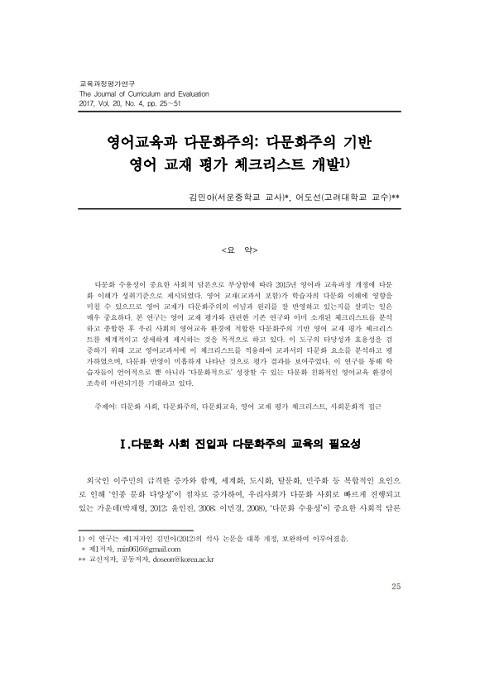 Multicultural Education through ELT Textbooks: Developing a Checklist for English Materials Evaluation Based on Multiculturalism (The Journal of Curriculum and Evaluation; Vol. 20, No. 4) Year of publication: 2017 Author: Minah Kim | Doseon Eur Corporate author: Korea Institute for Curriculum and Evaluation (KICE) Multicultural education is recommended as an effort to resolve significant social challenges in Korea. This is reflected in the 2015 reform of national curriculum and instruction as it promotes cultural diversity and competence. As English textbooks are widely used in EFL classrooms in Korea by both students and teachers, it is useful to examine how much English textbooks are multiculturalism-friendly and -responsive. This study has 3 parts: 1) It makes a critical review of previous research on English textbooks evaluation checklists, 2) it then synthesizes them and proposes a new tentative multiculturalism-based criteria for English textbooks evaluation, and finally, 3) it applies the new subset of the criteria to an English textbook used in EFL classrooms in Korea to test its validity and practicality. Developing a multiculturalism-responsive criteria for English textbooks evaluation will provide multiculturalism-friendly classroom environments in which EFL learners can grow not only linguistically but also 'multiculturally'.
 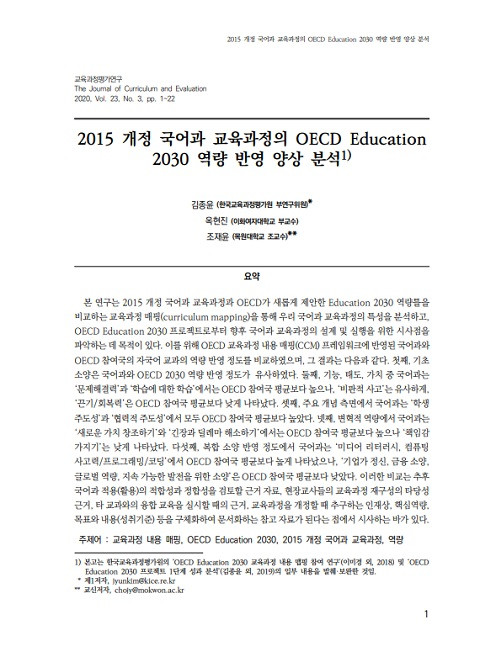 Analysis of the 2015 Revised Korean Languages Curriculum in Terms of the OECD Education 2030 Competencies (Journal of Curriculum and Evaluation; Vol. 23. No. 3) Year of publication: 2020 Author: Jongyun Kim | Hyounjin Ok | Jaeyoon Cho Corporate author: Korea Institute for Curriculum and Evaluation (KICE) The purpose of this study is to analyze the characteristics of the Korean language curriculum through curriculum content mapping (CCM) in the OECD Education 2030 project, which is later compared with the international curricular of the national languages. The CCM framework consists of a “competency code” that presents OECD competencies and a “content code” that contains the content of the curriculum. In this study, the degree of the competencies in the Korean language curriculum is analyzed and compared with the international curricular in terms of the OECD perspective. The result is analyzed as follows. First, foundational literacies of Korean were similar to the international national language curricular. Second, in the competencies of skills, attitudes and values, “problem-solving” and “learning about learning” were higher in the Korean language curriculum than the OECD average, “critic thinking” was similar to, and “persistence” was lower than the OECD average. Third, in terms of key concepts, both “student agency” and “co-agency” were higher in the Korean language curriculum. Fourth, “creating values” and “solving dilemmas” in terms of the degree of reflection of CCM framework competency related to transformational competencies, the Korean Language was higher than the average of OECD member countries in terms of “creating new values” and “resolving tensions and dilemmas” were higher but “taking responsibilities” were lower than the OECD countries. Fifth, the competencies in the compound literacies were also compared. These comparison results provide as reference materials that describes the suitability of the Korean language curriculum and contributes to future revisions of the Korean language curriculum for the students in 2030s.
  A study of the middle school social studies and moral education curriculum to foster global citizenship Year of publication: 2009 Author: Geunho Lee | Deokgeun Kim | Byungsu Min | Hyunjeong Oh | Hyojeong Kim | Junsik Park | Jeongmin Eom Corporate author: Korea Institute for Curriculum and Evaluation (KICE) This study was conducted to analyze the determinants (i.e. multicultural acceptability, national identity, and moral values) influencing global citizenship in order to examine the construct of global citizenship as well as to find the moral education about global citizenship for teacher education. Hierarchical regression was used to analyze the survey of 116 college students in university of education. The results are following. Firstly, The hierarchical regression analysis of ModelⅢ with influencing three factors to global citizenship explained 25% of the variance in student’s global citizenship, and it was found common good among moral values and experience of living a life in the foreign countries as important factors in the model. Second, They regressed into the variance of moral values even though a few ones of multi-cultural acceptability and national identity were influential factors before modelⅢ. Contrary to theoretical expectations, they are turned into be a half of influential factors to global citizenship. Based on the results, we suggested that to solve the global problems need to be strengthen in the developing the education curriculum for global citizenship. Furthermore, future research with stratified sampling will be conducting to generalize the result of this study. L’Étude sur l'Éducation à la Citoyenneté Mondiale dans l'enseignement de premier cycle Year of publication: 2009 Author: Geunho Lee | Deokgeun Kim | Byungsu Min | Hyunjeong Oh | Hyojeong Kim | Junsik Park | Jeongmin Eom Corporate author: Korea Institute for Curriculum and Evaluation (KICE) Cette étude a été menée pour analyser les déterminants (à savoir d'aceptabilité multiculturelle, identité nationale, et les valeurs morales) qui influent sur la citoyenneté mondiale en vue d'examiner la construction de la citoyenneté mondiale, ainsi que de trouver l'éducation morale de la citoyenneté mondiale pour la formation des enseignants. Régression hiérarchique a été utilisé pour analyser le sondage auprès des 116 étudiants de niveau collégial à l'université de l'éducation. Les résultats suivent. Tout d'abord, l'analyse de régression hiérarchique des ModelⅢ d'influencer trois facteurs à la citoyenneté mondiale explique 25% de la variance de la citoyenneté mondiale de l'étudiant, et il a été trouvé bien commun entre les valeurs morales et de l'expérience d'une vie dans les pays étrangers comme des facteurs importants dans la modèle. Deuxièmement, ils ont régressé dans la variance des valeurs morales, même si quelques uns d'aCECptabilité multi-culturelle et l'identité nationale sont des facteurs influents avant modelⅢ. Contrairement aux attentes théoriques, ils sont transformés en une moitié de facteurs influents à la citoyenneté mondiale. D'après les résultats, nous avons proposé que pour résoudre les problèmes mondiaux doivent être renforcer dans le développement du programme d'éducation à la citoyenneté mondiale. En outre, les recherches futures avec échantillonnage stratifié sera conduit à généraliser le résultat de cette étude.