
Resources
Explore a wide range of valuable resources on GCED to deepen your understanding and enhance your research, advocacy, teaching, and learning.
14 Results found
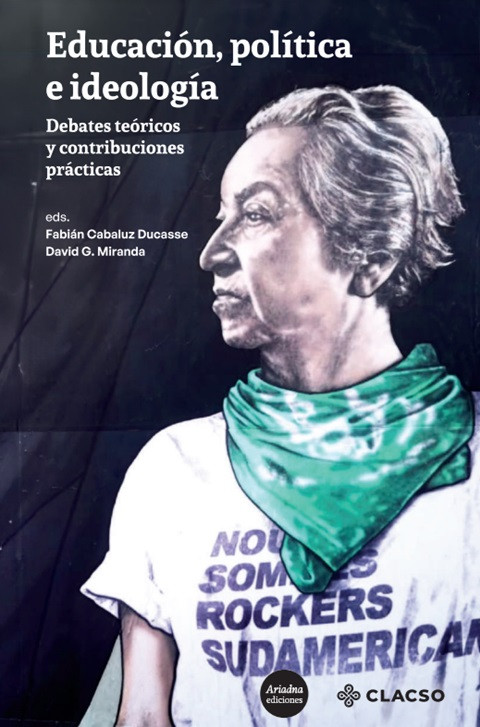 Education, Politics and Ideology: Theoretical Debates and Practical Contributions Year of publication: 2024 Author: David G. Miranda | Jorge Fabián Cabaluz Ducasse Corporate author: Latin American Council of Social Sciences (CLACSO) This book, "Education, Politics and Ideology: Theoretical Debates and Practical Contributions", is a work by the Latin American Pedagogies Research Group at the University of Playa Ancha, which is positioned from a critical perspective in the educational and pedagogical field. This currently implies, among other things, the relevance of discussing, polemizing and confronting those perspectives that have technified and instrumentalized pedagogy, reducing it to a merely practical, technical field, unrelated to epistemological, ethical, philosophical and/or political issues. In this direction, the essays that make up the book distance themselves substantially from those perspectives that conceive our field as a terrain that must advocate for neutrality, impartiality, and asepsis; and they propose clear and explicit positions with respect to social justice, democracy, equality, and dignity. Educación, política e ideología: Debates teóricos y contribuciones prácticas Year of publication: 2024 Author: David G. Miranda | Jorge Fabián Cabaluz Ducasse Corporate author: Latin American Council of Social Sciences (CLACSO) Este libro "Educación, política e ideología: debates teóricos y contribuciones prácticas", surge desde el Grupo de Investigación de Pedagogías Latinoamericanas de la Universidad de Playa Ancha, el cual se encuentra posicionado desde las perspectivas críticas del campo educativo y pedagógico, lo que implica en la actualidad, entre otras cosas, la relevancia de discutir, polemizar y confrontar aquellas perspectivas que han tecnificado e instrumentalizado la pedagogía, reduciéndola a un campo meramente práctico, técnico, ajeno a cuestiones epistemológicas, éticas, filosóficas y/o políticas. En esta dirección, los ensayos que componen el libro se distancian sustancialmente de aquellas perspectivas que conciben nuestro campo como un terreno que debe abogar por la neutralidad, la imparcialidad, la asepsia; y proponen posicionamientos claros y explícitos con respecto a la justicia social, la democracia, la igualdad, la dignidad.
  For a Transnational History of Disability: Argentina, Brazil and Spain 20th Century Year of publication: 2022 Author: Gildas Bregain Corporate author: Latin American Council of Social Sciences (CLACSO) Publications on disability have been mostly limited to health, rehabilitation and education editorials. On the other hand, this new Editorial Series, open to social movements, platforms of struggle, academic groups, collaboration networks, public policy makers, citizens of all of our Latin America and the Caribbean and other latitudes of the global South, combines a multiplicity of edges, perspectives and approaches. This volume comes to occupy a vacant place in critical studies on disability in Latin America, which is to record the struggles for the rights of these people in our region. Introducing a historical problematization in this regard not only has an epistemological and political relevance, but also makes a contribution to the present and to contemporary disability policies. Para una historia transnacional de la discapacidad: Argentina, Brasil y España Siglo XX Year of publication: 2022 Author: Gildas Bregain Corporate author: Latin American Council of Social Sciences (CLACSO) Las publicaciones sobre discapacidad han estado circunscriptas mayoritariamente a las editoriales de salud, rehabilitación y educación. En cambio, esta nueva Serie Editorial, abierta a los movimientos sociales, a las plataformas de lucha, a los grupos académicos, a las redes de colaboración, a los hacedores de políticas públicas, a los ciudadanos y ciudadanas de toda nuestra América Latina y el Caribe y otras latitudes del Sur global, conjuga una multiplicidad de aristas, perspectivas y enfoques. El presente volumen viene a ocupar un lugar de vacancia en los estudios críticos sobre discapacidad en América Latina, que es el historiar las luchas por los derechos de dichas personas en nuestra región. Introducir una problematización histórica al respecto no solo posee una relevancia espistemológica y política, sino que también realiza una contribución al presente y a las políticas contemporáneas de discapacidad.
  Environment, Climate Change and Good Living in Latin America and the Caribbean Year of publication: 2022 Author: Tatiana Cuenca Castelblanco | Letícia Larín | Juan Manuel Delgado Estrada | Luz Carina Durán Solarte | Cindy Vanessa Quintero Ramírez | Manuel Alejandro Henao Restrepo | Sara Latorre | Andrea Bravo | Marisabel García Acelas | Robert Adrián Quintero Leguizamón | Marisela Pilquimán Vera | Stepfanie Ramírez | Clarena Rodríguez Jaramillo | Melisa Argento | Ariel Slipak | Florencia Puente | Sarah Patricia Cerna Villagra | Agustín Carrizosa | María Irene Rodríguez | Stefannia Parrado Morales Corporate author: Latin American Council of Social Sciences (CLACSO) This book is the result of the call launched by CLACSO in February 2020 for the development of research projects on "Environment, climate change and good living in Latin America and the Caribbean". The essays presented bring together more than twenty researchers from eight Latin American countries, who approached the proposed themes from different perspectives, considering the links between the concept of "good living" and the environmental and economic phenomena that are occurring throughout the world, as the undeniable climate change, and in particular in Latin American countries, as the extractivist model of exploitation of nature. Ambiente, cambio climático y buen vivir en America Latina y el Caribe Year of publication: 2022 Author: Tatiana Cuenca Castelblanco | Letícia Larín | Juan Manuel Delgado Estrada | Luz Carina Durán Solarte | Cindy Vanessa Quintero Ramírez | Manuel Alejandro Henao Restrepo | Sara Latorre | Andrea Bravo | Marisabel García Acelas | Robert Adrián Quintero Leguizamón | Marisela Pilquimán Vera | Stepfanie Ramírez | Clarena Rodríguez Jaramillo | Melisa Argento | Ariel Slipak | Florencia Puente | Sarah Patricia Cerna Villagra | Agustín Carrizosa | María Irene Rodríguez | Stefannia Parrado Morales Corporate author: Latin American Council of Social Sciences (CLACSO) Este libro es el resultado de la convocatoria lanzada por CLACSO en febrero de 2020 para el desarrollo de proyectos de investigación sobre «Ambiente, cambio climático y buen vivir en América Latina y el Caribe». Los ensayos presentados reúnen a más de veinte investigadoras e investigadores de ocho países latinoamericanos, que abordaron las temáticas propuestas desde diferentes perspectivas, considerando los vínculos entre el concepto de "buen vivir" y los fenómenos ambientales y económicos que están ocurriendo en todo el mundo, como el innegable cambio climático, y en particular en los países latinoamericanos, como el modelo extractivista de explotación de la naturaleza.
 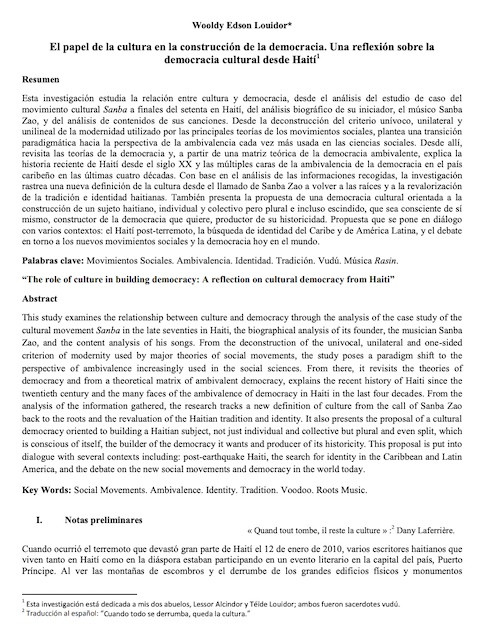 The Role of Culture in the Construction of Democracy: A Reflection on Cultural Democracy From Haiti Year of publication: 2015 Author: Wooldy Edson Louidor Corporate author: Latin American Council of Social Sciences (CLACSO) This research studies the relationship between culture and democracy, from the analysis of the case study of the Sanba cultural movement in the late seventies in Haiti, from the biographical analysis of its initiator, the musician Sanba Zao, and from the analysis of the content of its songs. From the deconstruction of the univocal, unilateral and unilinear criterion of modernity used by the main theories of social movements, it proposes a paradigmatic transition towards the perspective of ambivalence increasingly used in the social sciences. From there, he revisits the theories of democracy and, based on a theoretical matrix of ambivalent democracy, explains the recent history of Haiti since the 20th century and the multiple faces of the ambivalence of democracy in the Caribbean country in the last four years. decades. Based on the analysis of the information collected, the research traces a new definition of culture from Sanba Zao's call to return to the roots and to the revaluation of Haitian tradition and identity. El papel de la cultura en la construcción de la democracia: Una reflexión sobre la democracia cultural desde Haití Year of publication: 2015 Author: Wooldy Edson Louidor Corporate author: Latin American Council of Social Sciences (CLACSO) Esta investigación estudia la relación entre cultura y democracia, desde el análisis del estudio de caso del movimiento cultural Sanba a finales del setenta en Haití, del análisis biográfico de su iniciador, el músico Sanba Zao, y del análisis de contenidos de sus canciones. Desde la deconstrucción del criterio unívoco, unilateral y unilineal de la modernidad utilizado por las principales teorías de los movimientos sociales, plantea una transición paradigmática hacia la perspectiva de la ambivalencia cada vez más usada en las ciencias sociales. Desde allí, revisita las teorías de la democracia y, a partir de una matriz teórica de la democracia ambivalente, explica la historia reciente de Haití desde el siglo XX y las múltiples caras de la ambivalencia de la democracia en el país caribeño en las últimas cuatro décadas. Con base en el análisis de las informaciones recogidas, la investigación rastrea una nueva definición de la cultura desde el llamado de Sanba Zao a volver a las raíces y a la revalorización de la tradición e identidad haitianas.
  Artificial Intelligence and Democracy Year of publication: 2024 Author: Daniel Innerarity Corporate author: UNESCO Montevideo | Latin American Council of Social Sciences (CLACSO) UNESCO’s Recommendation on the Ethics of Artificial Intelligence, adopted by all Member States in November 2021, is the first global policy framework for artificial intelligence (AI) and outlines different aspects of this technology that directly impact political life. The initial considerations of the Recommendation outline the potential ramifications of AI across diverse domains, notably its implications for democracy. This report builds on these analyses and recommendations, aligning with the core values and principles outlined in the Recommendation. It delves into the current and potential impact of artificial intelligence on democracy and the benefits that both artificial intelligence and digitalization, in general, could bring to enhancing collective decision-making processes. This analysis is structured around four key topics:1. The democratic expectations and disappointments of digitization2. The new digital public space: the democratic conversation3. The democracy of data: the politics of Big Data4. Democracy as a form of political decision-making: algorithmic governance Finally, this report offers recommendations for the democratic governance of artificial intelligence aimed at mitigating neative impacts and fostering a more democratic approach to AI governance. Inteligencia artificial y democracia Year of publication: 2024 Author: Daniel Innerarity Corporate author: UNESCO Montevideo | Latin American Council of Social Sciences (CLACSO) La Recomendación sobre la ética de la inteligencia artificial de la UNESCO, aprobada por todos los Esta- 1 dos miembros en noviembre de 2021, es el primer marco político global para la inteligencia artificial (IA) y señala diversos aspectos de esta tecnología que tienen impacto directo en la vida política. En sus consideraciones iniciales alude a sus posibles efectos en diversos ámbitos y, concretamente, en la de- mocracia. El presente informe pretende ampliar y concretar esos análisis y recomendaciones, desde los valores y principios de la Recomendación, poniendo foco en el impacto que la inteligencia artificial tie- ne y puede tener en la democracia, así como en las virtualidades que tanto la IA como la digitalización en general pueden tener en la mejora de los procedimientos de toma de decisión colectiva. Para abordar esta temática se plantean cuatro grandes asuntos:1. Las expectativas y las decepciones democráticas de la digitalización A modo de introducción se presentarán las principales demandas y expectativas sociales respecto al impacto de la digitalización en la democracia que se han ido configurando en los últimos años, tanto por personas expertas como por la opinión pública en general.2. El nuevo espacio público digital: la conversación democrática La democracia requiere de una conversación social de calidad y un espacio público que reúna deter- minadas propiedades, sin las cuales la democracia no puede sobrevivir o se verá debilitada. En este documento se abordarán las características de esta necesaria conversación en el entorno digital, se identificarán los problemas subyacentes y se propondrán posibles medidas para mejorarla.3. La democracia de los datos: la política del big data Los tres elementos que modificarán la política de este siglo son los sistemas cada vez más inteligentes y automatizados, una tecnología más integrada e interoperable y una sociedad más cuantificada. Si bien los datos son fundamentales para el gobierno de la sociedad, el documento se preguntará críticamente por la dimensión política y democrática de la big data.4. La democracia como forma de decisión política: gobernanza algorítmica La democracia es una forma de decisión colectiva. El documento examinará la compatibilidad de la proliferación de sistemas automáticos de decisión con los principios normativos del autogobierno de- mocrático. El incremento de la gobernanza algorítmica plantea diversos problemas y desafíos para la democracia, principalmente la identificación de las tareas que pueden ser resueltas por un algoritmo sin dañar los valores democráticos y el conjunto de condiciones que asegurarían esa compatibilidad. Por último, se efectuarán algunas recomendaciones para la gobernanza democrática de la inteli- gencia artificial para evitar o mitigar los impactos negativos y hacer que la gobernanza de la inteligen- cia artificial sea más democrática.