
Resources
Explore a wide range of valuable resources on GCED to deepen your understanding and enhance your research, advocacy, teaching, and learning.
25 Results found
 Media Education and Citizenship: An Analysis of the Quebec Preschool and Elementary Education Program (No. 80) Year of publication: 2018 Author: Normand Landry | Chantal Roussel Corporate author: Lien social et Politiques In Canada, the limited level of knowledge on media education content that is conveyed by academic curricula hinders its critical evaluation. This article presents the ways in which media education is introduced in the Quebec Education Program (QEP) at the preschool and elementary level. More specifically, it highlights the connections at work between media education, childhood and citizenship in the program. Our method tracks and extracts a set of statements related to information and communications technologies (ICTs) and the media, then conducts their automated classification into four principal categories: speech, verbs used that reflect the actions undertaken by categories of actors (school, pupils, teachers), learning objectives and suggestions. A subsequent classification allows for the emergence of verbs and learning objectives associated to the notion of citizenship. The latter are then subject to speech analysis. Our analysis intends to demonstrate the message conveyed by the QEP on media and ICTs. It highlights the roles, tasks and responsibilities of its various actors in relation to the acquisition of knowledge and skill development. In addition, it features the actions taken by these actors to operationalize the academic goals of the program. Our conclusion indicates a low subject implementation of the statements associated to media education and citizenship, relevant content, although thematically limited, along with the conception of students as capable of a reflection and critical thinking process. Articuler éducation aux médias et citoyenneté : Une analyse du Programme de formation de l’école québécoise préscolaire-primaire (nº 80) Year of publication: 2018 Author: Normand Landry | Chantal Roussel Corporate author: Lien social et Politiques Au Canada, le faible niveau de connaissance des contenus en éducation aux médias véhiculés par les curricula scolaires proscrit leur évaluation critique. Cet article présente les façons selon lesquelles l’éducation aux médias est introduite dans le Programme de formation de l’école québécoise (PFEQ) des niveaux préscolaire et primaire. Plus spécifiquement, il témoigne des articulations entre éducation aux médias, enfance et citoyenneté. La méthode utilisée procède au repérage et à l’extraction d’énoncés associés aux technologies de l’information et de la communication (TIC) et aux médias, puis à leur classement en quatre catégories principales : discours, verbes témoignant des actions de chaque catégorie d’acteurs (école, élève, enseignant), objets d’apprentissage et suggestions d’utilisation des TIC. Une classification permet de faire émerger les verbes et les objets d’apprentissage référant à la notion de citoyenneté en utilisant la définition et les composantes associées. Ces derniers sont ensuite soumis à une analyse de discours. Notre analyse fait émerger les discours véhiculés par le PFEQ sur les médias et les TIC. Elle met en exergue les rôles, les tâches et les responsabilités des différents acteurs en lien avec l’acquisition de connaissances et le développement de compétences. En outre, elle présente les actions menées par ces acteurs afin d’opérationnaliser les intentions pédagogiques du programme. La conclusion montre un faible ancrage disciplinaire des énoncés traitant de l’éducation aux médias et à la citoyenneté, des contenus pertinents, mais limités thématiquement, ainsi qu’une représentation de l’élève en tant qu’individu capable de réflexion et de pensée critique.
  Understanding Policy Instrument Choice Concerning Citizenship in Education and Youth Policies: A Typology of Public Tools (Citoyenneté des enfants et des adolescents; no. 80) Year of publication: 2018 Author: Valérie Becquet Corporate author: Lien social et Politiques This article proposes a typology of public action instruments mobilized in the education and youth sectors. Three main ones currently coexist: legislative and regulatory, conventional and incentive, informative and communicational. They favor dimensions of citizenship (legal, political and civil) and are aimed at both pupils and young people. This typology is a tool for grasping the meaning of public action, highlighting the preferences of decision-makers for certain types of devices2 and recalling that heterogeneous devices coexist and structure juvenile experiences. In this regard, the taking into account of these devices in the analysis of careers and youth engagement practices is very uneven in the surveys, even though they constitute markers in the same way as other experiences contributing to political socialization, such as participation in protest actions. Given the development of public systems, this marginalization is not without effects on the understanding of the role of the latter in the construction of juvenile practices. After a general presentation of the typology, the main characteristics of the three identified instruments are analyzed. Comprendre l’instrumentation des questions de citoyenneté dans les politiques d’éducation et de jeunesse: Une typologie des dispositifs d’action publique (Citoyenneté des enfants et des adolescents; no. 80) Year of publication: 2018 Author: Valérie Becquet Corporate author: Lien social et Politiques Cet article propose une typologie des instruments d’action publique mobilisés dans les secteurs de l’éducation et de la jeunesse. Trois princi-paux coexistent actuellement : législatif et réglementaire, conventionnel et incitatif, informatif et communicationnel. Ils privilégient des dimensions de la citoyenneté (juridique, politique et civile) et s’adressent autant aux élèves qu’aux jeunes. Cette typologie constitue un outil pour saisir le sens de l’action publique, mettre en évidence les préférences des décideurs pour certains types de dispositifs2 et rappeler que des dispositifs hétérogènes cohabitent et structurent les expériences juvéniles. À ce sujet, la prise en compte de ces dispositifs dans l’analyse des carrières et des pratiques d’engagement des jeunes est très inégale dans les enquêtes alors qu’ils constituent des mar-queurs au même titre que d’autres expériences concourant à la socialisation politique, comme la participation à des actions protestataires. Compte tenu du développement des dispositifs publics, cette marginalisation n’est pas sans effets sur la compréhension du rôle de ces derniers dans la construction des pratiques juvéniles. Après une présentation générale de la typologie, les principales caractéristiques des trois instruments repérés sont analysées.
  Participation and Exercising Pupils’ Citizenship at French-Language Elementary School in Ontario Year of publication: 2018 Author: Nathalie Bélanger Corporate author: Lien social et Politiques This article first describes the evolution which allowed the child to be considered as an actor. In this vein, citizenship education programs at school are discussed, although they do not often take into account exercising citizenship in the school context and children’s voice. Research results from a broader project on how students represent their school experience in French-language schools in Ontario are analyzed specifically with respect to what a welcoming school means for them. The methodology uses an inductive approach and the data were gathered from administering a questionnaire designed for children, observation and semi-directed interviews. The results show the impact of school culture and school form on the exercise of students' citizenship, the topics they address, their concerns and priorities. The greater the predominance of settlement and integration issues are, the less the exercise of citizenship includes deliberative opportunities regarding school functioning. Participation et exercice de la citoyenneté des élèves à l’école Year of publication: 2018 Author: Nathalie Bélanger Corporate author: Lien social et Politiques Cet article retrace les courants théoriques qui permettent de penser l’enfant en tant que sujet et donne la parole aux enfants au sujet de leur expérience scolaire. Dans ce contexte, des programmes d’éducation à la citoyenneté sont apparus, sans toutefois que l’exercice de la citoyenneté des élèves et leur prise de parole soient pris en compte et valorisés. Pour y remédier, il s’agit d’interroger des élèves au sujet de ce que représente pour eux une école accueillante. La méthodologie recourt à une approche inductive et les données ont été recueillies à partir de l’administration d’un questionnaire conçu pour des enfants, d’observation et d’entretiens semi-dirigés. Les résultats montrent l’incidence de la culture de l’école et de la forme scolaire sur l’exercice de la citoyenneté des élèves, sur les thèmes qu’ils abordent, les soucis et les priorités qui sont les leurs. Plus les enjeux d’installation et d’intégration sont prédominants, moins l’exercice de la citoyenneté inclut de possibilités délibératives quant au fonctionnement scolaire.
  Understanding Policy Instrument Choice Concerning Citizenship in Education and Youth Policies: A Typology of Public Tools Year of publication: 2018 Author: Valérie Becquet Corporate author: Lien social et Politiques Whether at European or at national level, issues relating to the citizenship of young people are present in public debates and give to the implementation of specific tools. The past and the recurrence of setting up this issue on the agenda invites to reflect on the dynamics of public action. This article presents a typology of the tools gradually developed in two public sectors that concern young people: education and youth. Based on a policy instrument choice approach, it highlights that the choices made by public decision-makers to deal with citizenship issues lead to a multiplication and a diversification of the tools. This proliferation introduces suppose to reflect on the legibility of public action: if those mechanisms can be seen as complementary and as an opportunity for young people, they can also enter into tension. In a context of generational renewal of the electorate, it also calls for reflection on the consequences for young people’s practices and on the building of the perception of citizenship. Comprendre l’instrumentation des questions de citoyenneté dans les politiques d’éducation et de jeunesse : une typologie des dispositifs d’action publique Year of publication: 2018 Author: Valérie Becquet Corporate author: Lien social et Politiques Que ce soit au niveau européen qu’au niveau national, les enjeux relatifs à la citoyenneté des jeunes sont présents dans les débats publics et donnent lieu à la mise en place de dispositifs spécifiques. L’ancienneté et la récurrence de la mise à l’agenda de cette question invitent à réfléchir sur les dynamiques de l’action publique. Cet article propose une typologie des dispositifs progressivement développés dans deux secteurs publics qui interviennent auprès des jeunes : l’éducation et la jeunesse. En mobilisant une approche par les instruments d’action publique, il met en évidence que les choix opérés par les décideurs publics pour traiter des questions de citoyenneté conduisent à une multiplication et à une diversification des dispositifs. Cette prolifération interroge la lisibilité de l’action publique : si les dispositifs peuvent apparaître complémentaires et constituer une opportunité pour les jeunes, ils peuvent aussi entrer en tension. Dans un contexte de renouvellement générationnel du corps électoral, elle invite également à réfléchir sur les conséquences sur les pratiques des jeunes et sur la construction de leur représentation de la citoyenneté.
  Citoyenneté des enfants et des adolescents Year of publication: 2018 Author: Stéphanie Gaudet Corporate author: Lien social et Politiques Chacune des contributions de ce numéro révèle clairement un ou plusieurs de ces défis selon différences échelles d’analyse. La première partie du numéro porte sur les normativités et les représentations sociales de la citoyenneté enfantine et adolescente véhiculées par les instruments de politiques publiques en France et au Québec. La deuxième section porte sur les institutions qui répondent directement des politiques publiques et qui ont pour mandat de socialiser et d’éduquer les enfants et les adolescents aux pratiques de citoyenneté démocratique. La troisième section de ce numéro présente deux contributions qui rendent compte de l’agencéité (agency) des jeunes et de leurs pratiques citoyennes, c’est-à-dire leur capacité à développer des intentions politiques et à les mettre en action les uns avec les autres. Ce terme se distingue de celui d’agentivité qui est utilisé davantage en sciences cognitives et s’intéresse plus spécifiquement aux mécanismes de l’action individuelle (Glossaire, 2009). Finalement, nous terminons le numéro par des analyses à l’échelle des quartiers et des organisations jeunesse. On y voit comment les intervenants de première ligne, et leurs organisations locales, négocient différentes visions de l’éducation citoyenne, allant de l’éducation à la civilité jusqu’à l’intervention démocratique. Ces échelles d’analyse nous permettent d’observer les représentations de la citoyenneté en fonction des rapports de classe et d’ethnicité.
 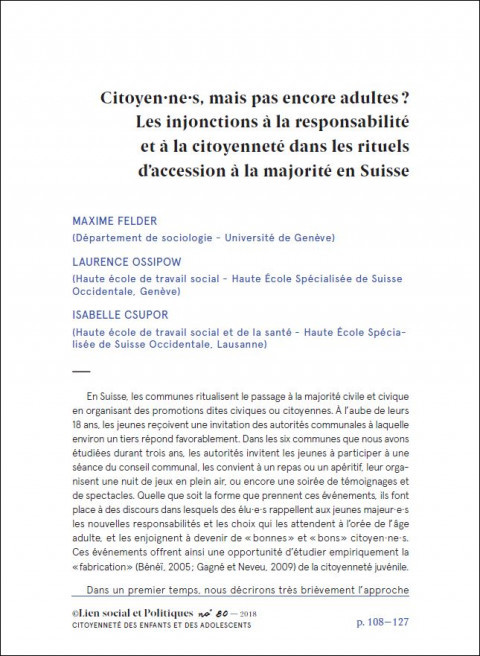 Citizens but not Adults? Injunction to be Responsible and Citizens in Official Coming of Age Rituals in Switzerland Year of publication: 2018 Author: Maxime Felder | Laurence Ossipow | Isabelle Csupor Corporate author: Lien social et Politiques Swiss municipalities organize ceremonies for their residents reaching the official age of full citizenship. In the six studied municipalities, local authorities invite them to a municipal council’s meeting, offer them a dinner or an aperitif, or organize them a show and a debate with role models. Speeches are central to these ceremonies, and authority representatives encourage their audience to be “good” citizens. Call to vote is the leitmotiv, but discourses reveal broader definitions of citizenship, insisting sometimes on a local commitment and volunteering, and sometimes on the necessity to fight climate change and inequalities. Comparing officials’ speeches to statements of young people participating in these events reveals “tensions”. Indeed, authority representatives address young citizens without considering them as fully adult, and they do not consider themselves as such neither. However, some of them are already involved in forms of vernacular citizenship, and are progressively leaving the municipality to study, work or travel. Ultimately, these ceremonies allow officials to stage their interest in the youth, which they consider as both uncompleted and essential to the renewal of democracy.