
Resources
Explore a wide range of valuable resources on GCED to deepen your understanding and enhance your research, advocacy, teaching, and learning.
48 Results found
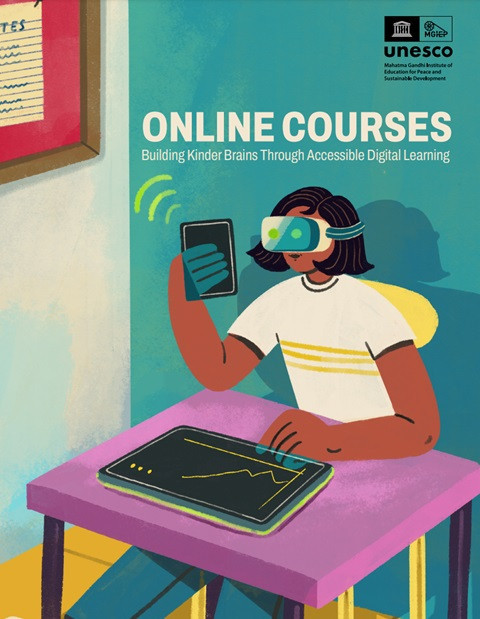 Online Courses: Building Kinder Brains Through Accessible Digital Learning Course Brochure Year of publication: 2023 Corporate author: Mahatma Gandhi Institute of Education for Peace and Sustainable Development (MGIEP) UNESCO MGIEP focuses on achieving the United Nations (UN) Sustainable Development Goal (SDG) 4, Target 7 towards education for building peaceful and sustainable societies across the world by developing programmes that promote social and emotional learning, innovate digital pedagogies and empower the youth. UNESCO MGIEP‘s Social Emotional Learning (SEL) courses are research and evidence based with built-in assessments. The courses are multi-modal, interactive and self-paced, and are designed to build intellectual and emotional intelligence among learners. Currently the courses are available in English and are being adapted to Hindi, Spanish and Russian.
  Ensuring Well-Being through Social-Emotional Learning in the Digital World Year of publication: 2023 Corporate author: Mahatma Gandhi Institute of Education for Peace and Sustainable Development (MGIEP) This document aims to identify the important elements addressed during the various TAGe discussions (social media discussion and live event) in addition to offering key recommendations for decision-makers. Concretely, this document has sought to highlight two social and emotional challenges faced today by youth, with a third issue present in each of them –(1) educational and employment disparities (economic exclusion),(2) poor civic engagement, and(3) the impact of the digital divide and misuse of social media platforms– in addition to showing how SEL competencies can be a tool to address the social and emotional challenges that may be encountered, supported by technological tools.
 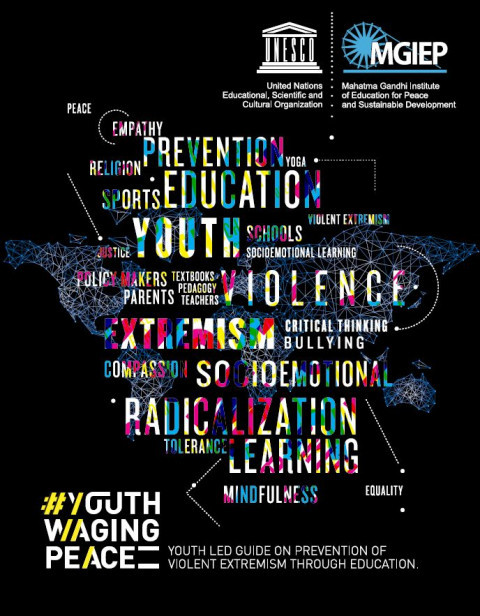 Youth Led Guide on Prevention of Violent Extremism through Education Year of publication: 2017 Author: Carolyn Nash | Yulia Nesterova | Kenneth Primrose | Wing Yu Alice Chan | Rios, Paul A. Chan | María José Velásquez Flores | Aniqah Zowmi Corporate author: Mahatma Gandhi Institute of Education for Peace and Sustainable Development (MGIEP) In September 2016, the education sector from the UNESCO headquarters and the UNESCO category 1 research Institute, the UNESCO Mahatma Gandhi Institute of Education for Peace and Sustainable Development(MGIEP) organised the first International Conference on Prevention of Violent Extremism through Education: Taking Action, in New Delhi, India. The usual plethora of reports and guides produced by experts on the subject, roundtables and expert panels were organised.But something different also happened. UNESCO MGIEP brought 50 youth from across the world rigorously selected through six week online discussion on the subject to participate in a first of its kind, “Talking Across Generations on Education (TAGe)” event. This event organised as a plenary session—not a side or lunch event—brought together these youth in a non-hierarchical “flat” dialogue with about 12 senior policymakers on the challenges and opportunities the youth see in preventing violent extremism through education.The conference culminated with the presentation of a “Youth Action Plan” containing three clear tangible action points. One action point was the development of a youth-led guide on Prevention of Violent Extremism through Education. This Guide is the result of that call to action.The Institute circulated a global call to youth who were willing to take up the challenge of producing the Guide. After a rigorous search based on a well-defined set of criteria, two coordinating lead authors were identified. These authors were then tasked to find the remaining authors who they saw fit to contribute to the Guide and this team then reached out to the wider group of youth to solicit their experiences and guidance in producing the Guide. The youth have done their part. They have reached out to more than 2,000 young people from more than 50 countries, collated their ideas and experiences and finally featured more than 150 unique voices into this document.
 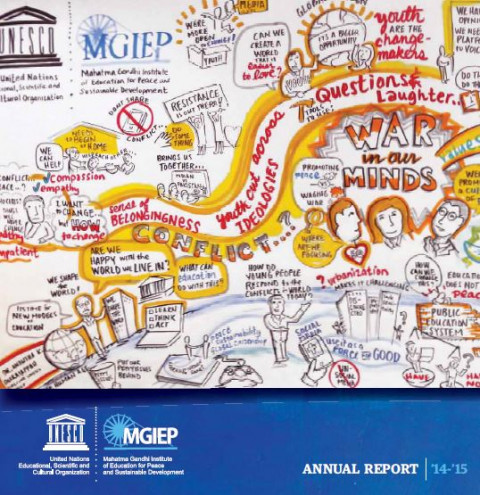 MGIEP Annual Report '14-'15 Year of publication: 2016 Corporate author: Mahatma Gandhi Institute of Education for Peace and Sustainable Development (MGIEP) The Mahatma Gandhi Institute of Education for Peace and Sustainable Development (MGIEP) is UNESCO’s first Category I institute in the Asia-Pacific region, established with the generous support of the Government of India. UNESCO MGIEP focuses on transforming current education policies and practices by developing innovative teaching and learning methods.Their objective is to build generations of young people equipped to create peaceful and sustainable societies. This annual report describes MGIEP’s main works and various educational programmes for peace and sustainable development.
  Empathy, Perspective and Complicity: How Digital Games can Support Peace Education and Conflict Resolution Year of publication: 2016 Author: Paul Darvasi Corporate author: Mahatma Gandhi Institute of Education for Peace and Sustainable Development (MGIEP) This paper will address how digital games may be uniquely suited to further the work of peace education and conflict resolution. There is a scarcity of research that specifically studies how digital games, as dynamic and interreactive learning tools, can be leveraged to support and enhance the closely related fields of peace education or conflict resolution; however, research in a number relevant sectors will be recruited to better understand the topic and expose gaps for further work. After defining basic terms, the first section will briefly discuss the aims of peace education and interactive conflict resolution and how digital games can assist in facilitating intergroup contact and collaboration. The heart of the paper will examine several serious games for their potential to cultivate perspective-taking and empathy, explore ethical dilemmas, promote intercultural understanding and encourage a sense of complicity, all crucial components in the work of peace education and conflict resolution. The final section will discuss the importance of context and reflection when implementing digital games and consider whether they can produce long-term, sustainable changes to behaviors and attitudes.
  MGIEP Annual Report 2015-2016 Year of publication: 2017 Corporate author: Mahatma Gandhi Institute of Education for Peace and Sustainable Development (MGIEP) The Mahatma Gandhi Institute of Education for Peace and Sustainable Development (MGIEP) is UNESCO’s first Category I institute in the Asia-Pacific region, established with the generous support of the Government of India.UNESCO MGIEP focuses on transforming current education policies and practices by developing innovative teaching and learning methods. Their objective is to build generations of young people equipped to create peaceful and sustainable societies.This annual report describes MGIEP’s main works and various educational programmes for peace and sustainable development.
 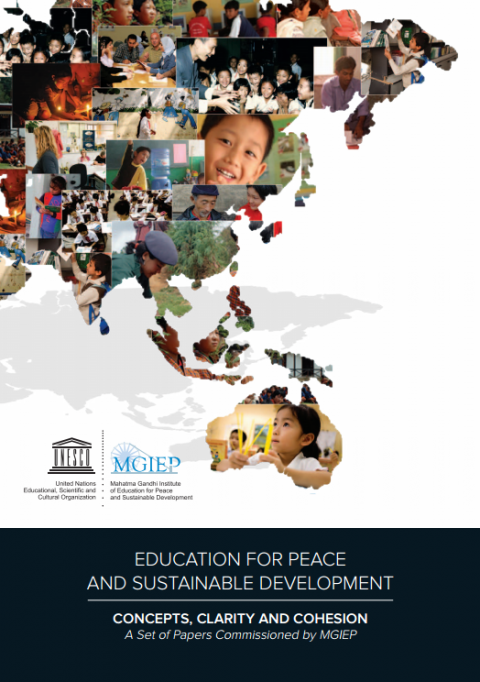 Education for peace and sustainable development: concepts, clarity and cohesion Year of publication: 2013 Corporate author: Mahatma Gandhi Institute of Education for Peace and Sustainable Development (MGIEP) UNESCO MGIEP's focus lies in exploring and engaging with the strong interlinkages between peace and sustainable development and making interventions in the education systems to impart these principles. The first publication from the Institute Education for Peace and Sustainable Development: Concepts, Clarity and Cohesion explores the interlinkages and interdependencies of Education for Peace and Education for Sustainable Development. The monograph contains four concept papers which elaborate on the interlinkages between education, peace and sustainable development, define the gaps in the current approach to education for peace and sustainable development and argue for a comprehensive approach to issues of peace and sustainability to be incorporated in education systems. UNESCO MGIEP aims to develop a theoretical framework to look at the interlinkages between peace and sustainability in a holistic manner and this monograph is the first exercise towards building this discourse. L'éducation pour la paix et le développement durable: concepts, la clarté et la cohésion Year of publication: 2013 Corporate author: Mahatma Gandhi Institute of Education for Peace and Sustainable Development (MGIEP) La mise au point de l'UNESCO MGIEP réside dans l'exploration et la collaboration avec les liens étroits entre la paix et le développement durable et faire des interventions dans les systèmes éducatifs pour communiquer ces principes. La première publication de «L'éducation pour la paix et le développement durable: concepts, la clarté et la cohésion de l'Institut explore les liens et les interdépendances de l'éducation pour la paix et l'éducation pour le développement durable. La monographie contient quatre documents de réflexion qui élaborent sur les liens entre l'éducation, la paix et le développement durable, définissent les lacunes dans l'approche actuelle de l'éducation pour la paix et le développement durable et plaident en faveur d'une approche globale des questions de paix et de développement durable à incorporer dans l'éducation systèmes. UNESCO MGIEP vise à développer un cadre théorique pour examiner les liens entre la paix et le développement durable d'une manière holistique et cette monographie est le premier exercice à la construction de ce discours.
  Mahatma Gandhi Institute of Education for Peace and Sustainable Development: a joint initiative by UNESCO and the government of India Year of publication: 2013 Corporate author: Mahatma Gandhi Institute of Education for Peace and Sustainable Development (MGIEP) The United Nations Educational, Scientific and Cultural Organization (UNESCO) and the Government of India are embarking on a major new partnership to create the Mahatma Gandhi Institute of Education for Peace and Sustainable Development. Through research and capacity-building, the Institute aims to develop and promote new approaches to education, empowering learners to transform their lives and build a more peaceful and sustainable world. Based in New Delhi, this will be the first UNESCO specialized education Institute in India, and the first in the Asia-Pacific region. It is particularly fitting that the Institute is hosted by India, the birthplace of Mahatma Gandhi and a country that has made a significant commitment to education over the past decades. Institut Mahatma Gandhi d'éducation pour la paix et le développement durable: une initiative conjointe de l'UNESCO et le gouvernement de l'Inde Year of publication: 2013 Corporate author: Mahatma Gandhi Institute of Education for Peace and Sustainable Development (MGIEP) L'Organisation des Nations Unies pour l'éducation, la science et la culture (UNESCO) et le Gouvernement de l'Inde se lancent dans un nouveau partenariat majeur pour créer l'Institut Mahatma Gandhi d'éducation pour la paix et le développement durable. Grâce à la recherche et le renforcement des capacités, l'Institut vise à développer et promouvoir de nouvelles approches de l'éducation, l'autonomisation des apprenants pour transformer leur vie et construire un monde plus pacifique et durable. Basé à New Delhi, ce sera le premier Institut de l'UNESCO spécialisé de l'éducation en Inde, et la première dans la région Asie-Pacifique. Il est particulièrement approprié que l'Institut est hébergé par l'Inde, le lieu de naissance du Mahatma Gandhi et un pays qui a pris un engagement important à l'éducation au cours des dernières décennies.