
Resources
Explore a wide range of valuable resources on GCED to deepen your understanding and enhance your research, advocacy, teaching, and learning.
48 Results found
 Mahatma Gandhi Institute of Education for Peace and Sustainable Development: UNESCO's first category 1 Institute in the Asia-Pacific Year of publication: 2014 Corporate author: Mahatma Gandhi Institute of Education for Peace and Sustainable Development (MGIEP) The Mahatma Gandhi Institute of Education for Peace and Sustainable Development (MGIEP) is UNESCO’s first Category 1 Institute in the Asia-Pacific. The Institute will be a key strategic player in UNESCO’s work towards quality Education for All and the transformative shift envisioned for the Post 2015 agenda. Established in cooperation with the Government of India, MGIEP has been created to play a leading role in research, knowledge sharing, capacity building and policy formulation in the area of peace and sustainability education. The Institute aims to promote, assimilate and generate high quality research to lead the intellectual and policy discourse for education and global citizenship in the region. It was named after Mahatma Gandhi, as a tribute to his ideas of non-violence and sustainable living. The President of India and the Director-General of UNESCO jointly announced the establishment of the Institute in November, 2012. It is located in New Delhi. Mahatma Gandhi Institute of Education for Peace and Sustainable Development: UNESCO's first category 1 Institute in the Asia-Pacific Year of publication: 2014 Corporate author: Mahatma Gandhi Institute of Education for Peace and Sustainable Development (MGIEP) L'Institut Mahatma Gandhi d'éducation pour la paix et le développement durable (MGIEP) est la première catégorie de l'UNESCO 1 Institut dans la région Asie-Pacifique. L'Institut sera un acteur stratégique clé dans le travail de l'UNESCO à l'éducation de qualité pour tous et le changement de transformation envisagé pour le programme post 2015. Fondée en coopération avec le Gouvernement de l'Inde, MGIEP a été créé pour jouer un rôle de premier plan dans la recherche, le partage des connaissances, le renforcement des capacités et la formulation des politiques dans le domaine de l'éducation de la paix et de la durabilité. L'Institut vise à promouvoir, d'assimiler et de générer des recherches de haute qualité pour diriger le discours intellectuel et politique de l'éducation et la citoyenneté mondiale dans la région. Il a été nommé d'après le Mahatma Gandhi, comme un hommage à ses idées de non-violence et de vie durable. Le Président de l'Inde et le Directeur général de l'UNESCO ont annoncé conjointement la mise en place de l'Institut en Novembre 2012. Il est situé à New Delhi. Mahatma Gandhi Institute of Education for Peace and Sustainable Development: UNESCO's first category 1 institute in the Asia-Pacific brochure Year of publication: 2014 Corporate author: Mahatma Gandhi Institute of Education for Peace and Sustainable Development (MGIEP) The Mahatma Gandhi Institute of Education for Peace and Sustainable Development (MGIEP) is UNESCO’s first Category 1 Institute in the Asia-Pacific. The Institute will be a key strategic player in UNESCO’s work towards quality Education for All and the transformative shift envisioned for the Post 2015 agenda. Established in cooperation with the Government of India, MGIEP has been created to play a leading role in research, knowledge sharing, capacity building and policy formulation in the area of peace and sustainability education. The Institute aims to promote, assimilate and generate high quality research to lead the intellectual and policy discourse for education and global citizenship in the region. It was named after Mahatma Gandhi, as a tribute to his ideas of non-violence and sustainable living. The President of India and the Director-General of UNESCO jointly announced the establishment of the Institute in November, 2012. It is located in New Delhi. Institut Mahatma Gandhi d'Éducation pour la Paix et le Développement Durable: UNESCO premier institut de catégorie 1 dans la brochure Asie-Pacifique Year of publication: 2014 Corporate author: Mahatma Gandhi Institute of Education for Peace and Sustainable Development (MGIEP) L'Institut Mahatma Gandhi d'éducation pour la paix et le développement durable (MGIEP) est la première catégorie de l'UNESCO 1 Institut dans la région Asie-Pacifique. L'Institut sera un acteur stratégique clé dans le travail de l'UNESCO à l'éducation de qualité pour tous et le changement de transformation envisagé pour le programme post 2015. Fondée en coopération avec le Gouvernement de l'Inde, MGIEP a été créé pour jouer un rôle de premier plan dans la recherche, le partage des connaissances, le renforcement des capacités et la formulation des politiques dans le domaine de l'éducation de la paix et de la durabilité. L'Institut vise à promouvoir, d'assimiler et de générer des recherches de haute qualité pour diriger le discours intellectuel et politique de l'éducation et la citoyenneté mondiale dans la région. Il a été nommé d'après le Mahatma Gandhi, comme un hommage à ses idées de non-violence et de vie durable. Le Président de l'Inde et le Directeur général de l'UNESCO ont annoncé conjointement la mise en place de l'Institut en Novembre 2012. Il est situé à New Delhi.
  One World, One People, One Future: Imagine a World that Understands, Embraces & Practices Peace and Sustainable Development Year of publication: 2014 Corporate author: Mahatma Gandhi Institute of Education for Peace and Sustainable Development (MGIEP) One World, One People, One Future: Imagine a World that Understands, Embraces & Practices Peace and Sustainable Development
  The Elusive and Exclusive Global Citizen Year of publication: 2015 Author: Jill Koyama Corporate author: Mahatma Gandhi Institute of Education for Peace and Sustainable Development (MGIEP) In this paper, the author interrogate the notion of global citizenship, both as an aspiration and an improbable practice, by situating it within contemporary understandings of citizenship and globalization.It is a conceptualization that suffers from the dangers inherent in the term “citizenship” and misconceptions of the terms “global,” and it is rooted in the West’s long engagement in normative undertakings in non-Western countries. The writer refute ideas of the autonomous and agentic global citizen. he encourage a rethinking of global citizenship and global citizenship education (GCE) and offer recommendations for redirecting attention to contemporary global stratifications and issues of human rights to address the issues of social justice and inequality that, due to the problematic definition of global citizenship, are currently inadequately covered in existing GCE curricula.
  The war in our minds: is global citizenship the answer? (Blue Dot issue 1) Year of publication: 2015 Corporate author: Mahatma Gandhi Institute of Education for Peace and Sustainable Development (MGIEP) Feature Global Citizenship Education: A New Educational, Pedagogical and Political Narrative in the World System? (by Carlos A. Torres) In Pursuit of a Global Civics (by Hakan Altinay) Global Citizenship: Necessary and Possible (by Paul and Anne Ehrlich) Cover Story YOUth Speak for a better today and tomorrow (by Piyali Sarkar Debnath, UNESCO MGIEP) Essays Unlocking the Civic Sense of Young Minds (by Karthik Shankar) Shared Home, Shared Hopes and Shared Actions (by Trang T. Nguyen) Redesigning the Education System for Global Citizenship (by Ayodeji Ojo) Youth Voices Who is a global citizen? News What we have been up to UNESCO MGIEP Crossword Event Calendar
 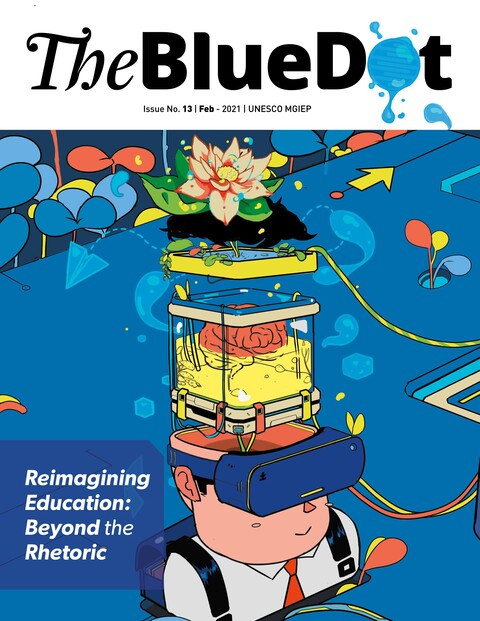 Reimagining Education: Beyond the Rhetoric (The Blue Dot; No.13, 2021) Year of publication: 2021 Corporate author: Mahatma Gandhi Institute of Education for Peace and Sustainable Development (MGIEP) The events of the year 2020, driven predominantly by the COVID-19 pandemic, have forced governments, policymakers, educators and organisations to rethink the purpose, structure and modality of existing education systems. Even while the world is struggling with climate change, decreased empathy, violent extremism, xenophobia and an increase in mental health issues in children, with a recent report by WHO highlighting that 800,000 people between the ages of 15-29 are dying by suicide ever year, globally1 , the COVID-19 virus singlehandedly shut down access to face-to-face school education for roughly half of the world’s student population. These ongoing and unexpected challenges bring to light the urgent need for education systems to be more adaptable, responsive, and resilient to future shocks and disasters. We can work to transform education in many ways, such as by translating our understanding of how the brain learns from the research laboratory to the classroom and leveraging the power of technology to ensure that learning can reach every child who hungers to learn. It is time we reimagine education to ensure learning continues with minimal disruption but also empowers students as compassionate human beings, prepared for an unpredictable future, but also as global citizens seeking a peaceful and kinder world. The purpose of education needs to change from being instrumental (based on human capital) to one that is constitutive (human-flourishing), accessible to all and structured such that learning can happen anytime and anywhere and always.
  Rethinking Schooling for the 21st Century: The State of Education for Peace, Sustainable Development and Global Citizenship in Asia Year of publication: 2017 Corporate author: Mahatma Gandhi Institute of Education for Peace and Sustainable Development (MGIEP) Calls to gear up schools for the 21st century are ubiquitous today. Dominant international educational discourse hails the potential of 'the youth dividend' and digital technology for enhancing growth. Some Asian education systems are held up as models for an innovation-led utopian future. But across much of Asia, neither the reality of schooling nor the patterns of development with which it is associated give cause for blithe optimism.This study is informed by UNESCO’s commitment to realising the Sustainable Development Goals (SDGs) through educational reform worldwide. Since its inception, UNESCO has championed a humanistic vision of education — a vision today encapsulated in SDG 4.7. These ideals need to be strongly restated and defended in an era when educational debate worldwide has come to be framed by a narrowly economistic and instrumentalist agenda.Deriving urgent significance from this broader context, the present report analyses how far the ideals of SDG 4.7 – of 'education for peace, sustainable development and global citizenship' - are embodied in policies and curricula across 22 Asian societies. At one level, it seeks to develop benchmarks against which future progress can be assessed. It also argues forcefully that conceptions of the fundamental purposes of schooling need to be reconfigured, if the ideals to which the global community has subscribed are actually to be realised.
  Transforming Education Conference for Humanity: TECH 2017, December 16-18, 2017; Post Event Report Year of publication: 2018 Corporate author: Mahatma Gandhi Institute of Education for Peace and Sustainable Development (MGIEP) The three-day Transforming Education Conference for Humanity (TECH) 2017 organised by UNESCO Mahatma Gandhi Institute of Education for Peace and Sustainable Development (MGIEP) was held at Novotel Varun Beach, Visakhapatnam City, State of Andhra Pradesh, India from December 16 – 18, 2017. The first edition of TECH focused on digital pedagogies for building peaceful and sustainable societies through 21st century skills, schools and policies, towards achieving the United Nations Sustainable Development Goal 4, Target 7.TECH 2017 was attended by over 1,700 registered participants (including teachers, educators, learners, policy-makers, technology and gaming experts, amongst others) from 75 countries and witnessed highly engaging deliberations on the future of education, particularly on the innovative methods of teaching using technology.The Conference was generously supported by the State Government of Andhra Pradesh, India and the Ministry of Human Resource Development, Government of India and sponsored by Microsoft India (Education Technology Partner), Samsung India, Dassault Systems, Veative (Immersive Learning Partner) and McGraw Hill (Learning Science Partner). The Knowledge Partners of the Conference included NMIMS, Ubisoft, Quebec Government, ISTE, Social Alpha, EDB and IYC.TECH will be held annually over the next five years with a long term aim of affecting global policy change on the usage of digital pedagogies to render quality and inclusive education for all.