
Resources
Explore a wide range of valuable resources on GCED to deepen your understanding and enhance your research, advocacy, teaching, and learning.
28 Results found
 Le rôle des enseignants dans l’éducation et la démocratie : impacts d’un projet de recherche sur la perception de futurs enseignants Year of publication: 2015 Author: Gina Thésée | Paul R. Carr | Franck Potwora Corporate author: McGill University. Faculty of Education Cet article étudie les réflexions suscitées par un questionnaire d’enquête portant sur les liens entre l’éducation et la démocratie. Un échantillon de 157 étudiants d’un programme de formation initiale des enseignants à Montréal a répondu à un questionnaire de suivi (seconde étude) après avoir rempli un questionnaire d’enquête (première étude) portant sur leurs perceptions et leurs expériences des liens entre l’éducation et la démocratie. La première étude révèle une expérience démocratique faible et un parcours éducatif pratiquement sans lien avec la démocratie, ce qui concorde avec les résultats d’études antérieures. Cependant, les résultats du questionnaire de suivi indiquent que la participation à l’enquête a suscité des réflexions d’ordre socioéducatif, épistémologique, pédagogique et méthodologique, qui pourraient avoir des retombées significatives sur leur perception du rôle de l’enseignant. The Role of Teachers in Education and Democracy: The Impact of a Research Project on Preservice Teacher Perceptions Year of publication: 2015 Author: Gina Thésée | Paul R. Carr | Franck Potwora Corporate author: McGill University. Faculty of Education This article presents reflections on a survey questionnaire related to the connection between education and democracy. A sample of 157 teacher-education students in Montreal completed a follow-up questionnaire after having participated in a research questionnaire (first study) concerning their perception and experience of the linkage between education and democracy. The first study underscored a weak democratic experience as well as an educational journey without a strong linkage to democracy, which concurs with our previous findings. However, the results of the follow-up survey indicate that participation in this inquiry generated socio-educational, epistemological, pedagogical, and methodological reflections, which could have significant implications for the perception of the role of educators.
  From Ethnocultural Diversity to Living Together: Examples of Future Teachers Using a Multicultural Approach to Education Year of publication: 2010 Author: Mirela Moldoveanu Corporate author: McGill University. Faculty of Education This text looks at how future teachers define multicultural education in order to discover its relevance and objectives in the context of living together. Nine masters students in an initial teacher training program at an Ontario university participated in an exploratory research study using qualitative data. The interpretation of the results led to the construction of a multicultural education model that attempts to legitimize the data within the framework of a differentiated pedagogical approach.
  The Contribution of Teachers to the Relevance of Basic Education in West Africa: The Case of Senegal Year of publication: 2016 Author: Thibaut Lauwerier Corporate author: McGill University. Faculty of Education This paper seeks to understand the contribution of teachers to quality basic education in Senegal, with a particular focus on the concept of education “relevance.” After a detour looking at the characterization of the concepts of quality and relevance, we contextualize the situation of teachers in Senegal, then present the benefits of exploring the links between these concepts and the teacher issue. From a methodological point of view, the data mainly come from interviews and observations. It is clear from our analysis that, in general, teachers are not in a position to enable relevant education. However, the research highlights some factors that enhance relevance. La contribution des enseignants à la pertinence de l’éducation de base en Afrique de l’Ouest: le cas du Sénégal Year of publication: 2016 Author: Thibaut Lauwerier Corporate author: McGill University. Faculty of Education Cet article vise à comprendre quelle est la contribution des enseignants à une éducation de base de qualité au Sénégal, avec un accent particulier sur le concept d’éducation « pertinente ». Après avoir fait un détour par la caractérisation des concepts de qualité et de pertinence, nous contextualisons la situation des enseignants au Sénégal, puis nous présentons l’intérêt d’explorer les liens entre ces concepts et la question enseignante. D’un point de vue méthodologique, les données proviennent essentiellement d’entretiens et d’observations. Il ressort de nos analyses que les enseignants de manière générale ne sont pas en capacité de permettre une éducation pertinente. Toutefois, cette recherche met en avant certains facteurs favorables à plus de pertinence. De la diversité ethnoculturelle au vivre ensemble: représentations de futurs enseignants de l’approche multiculturelle en éducation Year of publication: 2010 Author: Mirela Moldoveanu Corporate author: McGill University. Faculty of Education Ce texte explore les sens que de futurs enseignants attribuent à l’éducation multiculturelle, afin d’en déceler l’importance et les objectifs dans une perspective de vivre ensemble. Une recherche exploratoire utilisant des données qualitatives a été menée auprès de neuf étudiants-maîtres inscrits au programme de formation initiale à l’enseignement dans une université ontarienne. L’interprétation des résultats a conduit à la construction d’un modèle d’éducation multiculturelle qui essaie de la légitimiser dans le cadre d’une approche pédagogique différenciée.
  Can “Living Together” Be Taught? Year of publication: 2013 Author: Maxime Plante Corporate author: McGill University. Faculty of Education The need to teach how to “live together” demonstrates its problematic nature. Indeed, is not living together problematic because it implies that we must by all means coexist, self and other, that is to say, to “live together” despite difference? Is it really possible to bring about a respect for this injunction through education? Two pitfalls are to be avoided. On one hand, that of an hermeneutical approach to education, which may violate the principle of respect for otherness even as it purports to teach it. On the other hand, that of considering ethics simply as total openness to difference. Between these two pitfalls is a difficult path to negotiate, that of a responsibility to educational choices inevitably bound to betray the Other. Peut-on enseigner le vivre-ensemble ? Year of publication: 2013 Author: Maxime Plante Corporate author: McGill University. Faculty of Education La nécessité de former au vivre-ensemble témoigne du caractère problématique de celui-ci. Pourquoi le vivre-ensemble est-il problématique sinon parce qu’il sous-entend qu’il nous faut à tout prix coexister, soi et l’autre, c’est-à-dire vivre ensemble dans la différence ? Le respect d’une telle injonction grâce au support de l’éducation est-il possible ? Deux écueils à éviter tracent la voie à emprunter. Celui, d’une part, d’une éducation dont l’herméneutique ne peut que violer le principe de respect de l’altérité au moment même où elle prétend l’enseigner. De l’autre, celui de considérer l’éthique simplement comme ouverture totale à la différence. Entre ces deux écueils, une voie difficile à négocier, celle d’une responsabilité face à des choix éducatifs immanquablement voués à trahir l’Autre.
 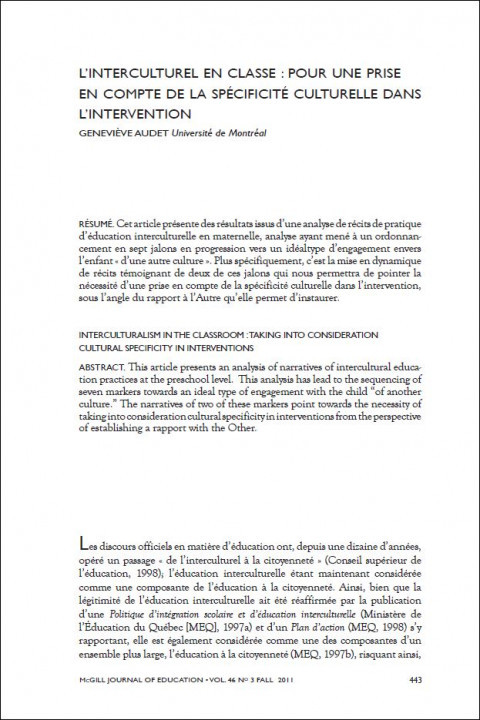 Interculturalism in the Classroom: Taking into Consideration Cultural Specificity in Interventions Year of publication: 2011 Author: Geneviève Audet Corporate author: McGill University. Faculty of Education This article presents an analysis of narratives of intercultural education practices at the preschool level. This analysis has lead to the sequencing of seven markers towards an ideal type of engagement with the child “of another culture.” The narratives of two of these markers point towards the necessity of taking into consideration cultural specificity in interventions from the perspective of establishing a rapport with the Other. L’interculturel en classe: pour une prise en compte de la spécificité culturelle dans l’intervention Year of publication: 2011 Author: Geneviève Audet Corporate author: McGill University. Faculty of Education Cet article présente des résultats issus d’une analyse de récits de pratique d’éducation interculturelle en maternelle, analyse ayant mené à un ordonnancement en sept jalons en progression vers un idéaltype d’engagement envers l’enfant « d’une autre culture ». Plus spécifiquement, c’est la mise en dynamique de récits témoignant de deux de ces jalons qui nous permettra de pointer la nécessité d’une prise en compte de la spécificité culturelle dans l’intervention, sous l’angle du rapport à l’Autre qu’elle permet d’instaurer.