
Resources
Explore a wide range of valuable resources on GCED to deepen your understanding and enhance your research, advocacy, teaching, and learning.
10 Results found
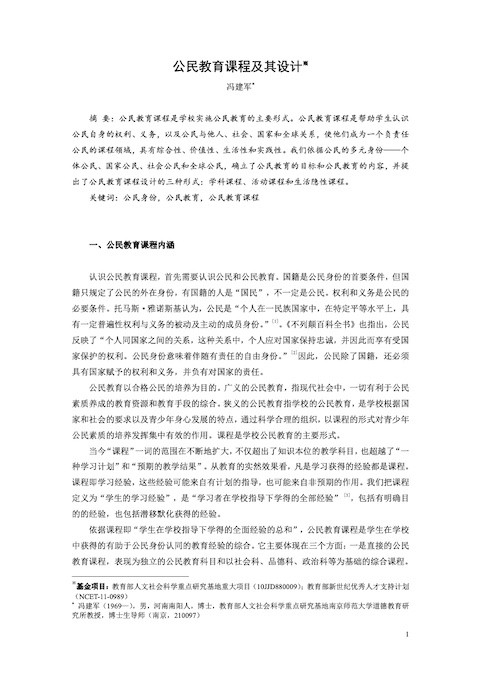 Curriculum of Citizenship Education and its Design Year of publication: 2015 Author: Feng Jianjun Corporate author: Northeast Normal University This paper discusses curriculum for citizenship education, including its nature, its content, its structure etc. 公民教育课程及其设计 Year of publication: 2015 Author: Feng Jianjun Corporate author: Northeast Normal University 本文讨论了关于公民教育课程的相关内容,包括公民教育课程的内涵、内容以及课程结构等。
 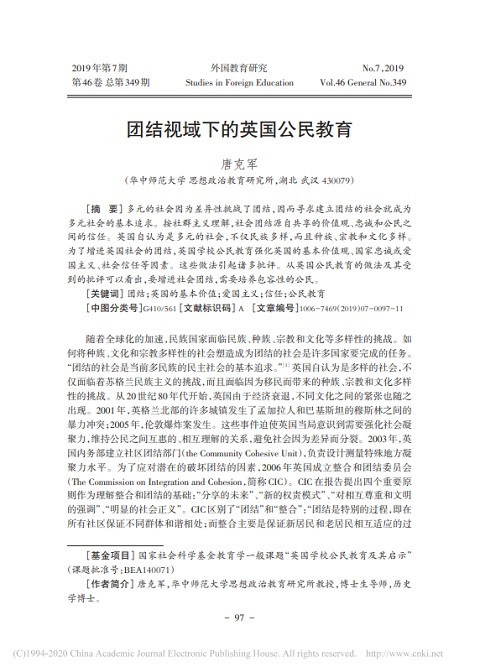 Examining the Citizenship Education in the UK from Perspective of Solidarity (Studies in Foreign Education; Vol. 46, No. 7) Year of publication: 2019 Author: Tang Kejun Corporate author: Northeast Normal University It is claimed to build a cohesive community in plural society because of diversity undermining social cohesion. According to communitarianism, the grounds of solidarity include shared values, loyalty and civic trust. Britain is seen as a plural society which made up of a diverse range of ethnicities, cultures nations and religions. So citizenship education are expected to place emphasis on promoting the fundamental British values national loyalty or patriotism and social trust in schools of the UK, which has caused a number of criticism. It is concluded from examining the approaches of citizenship education and its criticism that a cohesive society depends on an inclusive citizenship. 团结视域下的英国公民教育 (外国教育研究; Vol. 46, No. 7) Year of publication: 2019 Author: Tang Kejun Corporate author: Northeast Normal University 多元的社会因为差异性挑战了团结,因而寻求建立团结的社会就成为多元社会的基本追求。按社群主义理解,社会团结源自共享的价值观、忠诚和公民之间的信任。英国自认为是多元的社会,不仅民族多样,而且种族、宗教和文化多样。为了增进英国社会的团结,英国学校公民教育强化英国的基本价值观、国家忠诚或爱 国主义、社会信任等因素。这些做法引起诸多批评。从英国公民教育的做法及其受 到的批评可以看出,要增进社会团结,需要培养包容性的公民。
  可欲且可行的全球公民教育实践路径: 苏格兰“全球故事情节法”探析 (外国教育研究; Vol. 47, No. 3) Year of publication: 2020 Author: Rao Shuqi Corporate author: Northeast Normal University 研究发现,全球公民教育的热度不高与其实践层面的三重困境有关。“全球故事情节法”之所以成为苏格兰实施全球公民教育的最有效路径,正是源自于其对实践困境的有效回应:其一,政府对全球公民教育的倡导营造了相对宽松的政策环境,“全球故事情节法”与现有课程体系相融合获得了灵活的实践空间,实现了安全的课程地位。其二,通过对“故事情节法”和教育戏剧的运用,使全球社会和全球议题通俗化,实现了学生的体验式学习,弥合了学生认知能力和认知需求间的矛盾。其三,西苏格兰发展教育中心通过职业培训传播了理论知识和实践能力,构建了围绕全球公民教育的共同体,为教师提供了教学支持。
 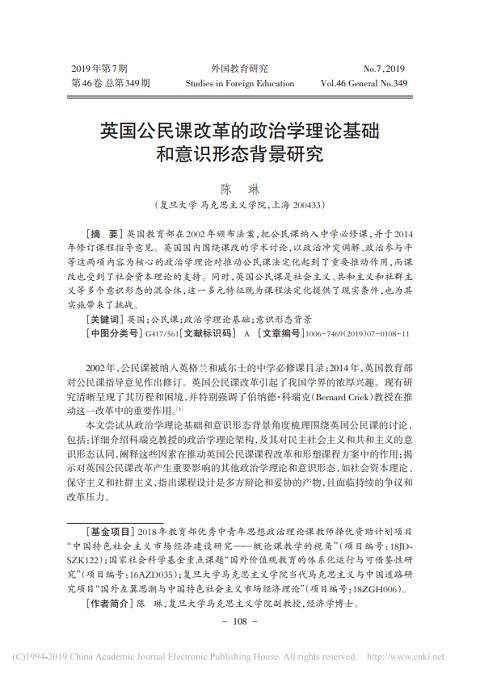 英国公民课改革的政治学理论基础 和意识形态背景研究 (外国教育研究; Vol. 46, No. 7) Year of publication: 2019 Author: Chen Lin Corporate author: Northeast Normal University 英国教育部在2002年颁布法案,把公民课纳入中学必修课,并于2014年修订课程指导意见。英国国内围绕课改的学术讨论,以政治冲突调解、政治参与平等这两项内容为核心的政治学理论对推动公民课法定化起到了重要推动作用,而课改也受到了社会资本理论的支持。同时,英国公民课是社会主义、共和主义和社群主义等多个意识形态的混合体,这一多元特征既为课程法定化提供了现实条件,也为其实施带来了挑战。 The Theoretical Foundation and Ideological Background of the Citizenship Curriculum Reform in England (Studies in Foreign Education; Vol. 46, No. 7) Year of publication: 2019 Author: Chen Lin Corporate author: Northeast Normal University Citizenship became part of the compulsory courses of secondary schools in England in 2002. The guideline was revised in 2014. Fierce academic debates shaped the curriculum reform. Political theory of political conflict mediation and political participative equality played an important role in promoting the legalization of Citizenship education. The wide acceptance of social capital theory also helps to win the necessary support. The current curriculum is a mixture of various ideologies such as socialism, republicanism and communitarianism. This multi-feature provides both pragmatic conditions for the curriculum’s legalization and challenges for its implementation. A Desirable and Practical Approach to Global Citizenship Education: An Exploration of “Global Storylines” in Scotland (Studies in Foreign Education; Vol. 47, No. 3) Year of publication: 2020 Author: Rao Shuqi Corporate author: Northeast Normal University The problems that global citizenship education has to deal with are threefold. “Global Storylines”, which provides corresponding solutions to practical difficulties, has emerged as the most effective approach to global citizenship education in Scotland. Firstly, global citizenship education has enjoyed a long continuity of government support. Through integrating with the current curriculum landscape, “Global Storylines” experiences secure curriculum status. Secondly, by utilizing “storylines” and educational drama, global society and global issues are introduced in subtle forms, which benefits students’ experienced-based learning. The contradiction between students’ cognitive need and ability is resolved accordingly. Thirdly, WOSDEC as the co-creator of “Global Storylines” offers a professional learning program. Teachers are universally supported in terms of theoretical knowledge, practical skills and being involved in the teaching community of global citizenship education.
 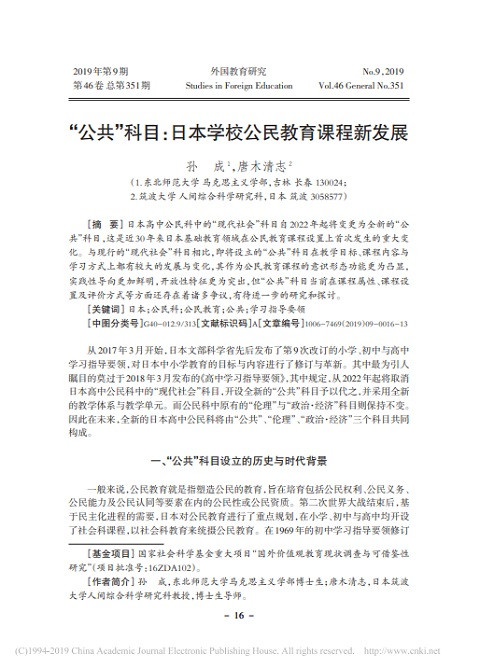 Subject of "Public": The New Development of School Citizenship Education Curriculum of Japan (Studies in Foreign Education; Vol. 46, No. 9) Year of publication: 2018 Author: Sun Cheng | Karaki Kiyoshi Corporate author: Northeast Normal University The “Modern Society” subject of the Japanese high school will be completely changed to the “public” subject since 2022. Compared with the current “modern society” subject, the upcoming “public” subject have a lot of developments and changes in the objectives, content and learning methods. As a civic education curriculum, the “public” subject’s ideological function is more prominent, the practical orientation is more distinct, and the open characteristics are more prominent. However, there are still many controversies and topics in the course attributes, curriculum settings and evaluation methods of the “public” subject, which need to be further studied and discussed. "公共" 科目:日本学校公民教育课程新发展 (外国教育研究; Vol. 46, No. 9) Year of publication: 2018 Author: Sun Cheng | Karaki Kiyoshi Corporate author: Northeast Normal University 日本高中公民科中的“现代社会”科目自2022年起将变更为全新的“公 共”科目,这是近30年来日本基础教育领域在公民教育课程设置上首次发生的重大变 化。与现行的“现代社会”科目相比,即将设立的“公共”科目在教学目标、课程内容与 学习方式上都有较大的发展与变化,其作为公民教育课程的意识形态功能更为凸显, 实践性导向更加鲜明,开放性特征更为突出,但“公共”科目当前在课程属性、课程设 置及评价方式等方面还存在着诸多争议,有待进一步的研究和探讨。