
Resources
Explore a wide range of valuable resources on GCED to deepen your understanding and enhance your research, advocacy, teaching, and learning.
6 Results found
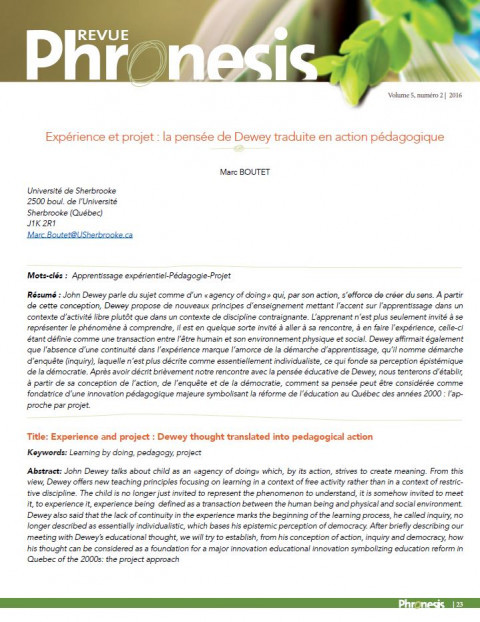 Expérience et projet : la pensée de Dewey traduite en action pédagogique Year of publication: 2016 Author: Marc Boutet Corporate author: Phronesis John Dewey parle du sujet comme d’un « agency of doing » qui, par son action, s’efforce de créer du sens. À partir de cette conception, Dewey propose de nouveaux principes d’enseignement mettant l’accent sur l’apprentissage dans un contexte d’activité libre plutôt que dans un contexte de discipline contraignante. L’apprenant n’est plus seulement invité à se représenter le phénomène à comprendre, il est en quelque sorte invité à aller à sa rencontre, à en faire l’expérience, celle-ci étant définie comme une transaction entre l’être humain et son environnement physique et social. Dewey affirmait également que l’absence d’une continuité dans l’expérience marque l’amorce de la démarche d’apprentissage, qu’il nomme démarche d’enquête (inquiry), laquelle n’est plus décrite comme essentiellement individualiste, ce qui fonde sa perception épistémique de la démocratie. Après avoir décrit brièvement notre rencontre avec la pensée éducative de Dewey, nous tenterons d’établir, à partir de sa conception de l’action, de l’enquête et de la démocratie, comment sa pensée peut être considérée comme fondatrice d’une innovation pédagogique majeure symbolisant la réforme de l’éducation au Québec des années 2000 : l’approche par projet. Experience and Project: Dewey thought Translated into Pedagogical Action Year of publication: 2016 Author: Marc Boutet Corporate author: Phronesis John Dewey talks about child as an «agency of doing» which, by its action, strives to create meaning. From this view, Dewey offers new teaching principles focusing on learning in a context of free activity rather than in a context of restrictive discipline. The child is no longer just invited to represent the phenomenon to understand, it is somehow invited to meet it, to experience it, experience being defined as a transaction between the human being and physical and social environment. Dewey also said that the lack of continuity in the experience marks the beginning of the learning process, he called inquiry, no longer described as essentially individualistic, which bases his epistemic perception of democracy. After briefly describing our meeting with Dewey’s educational thought, we will try to establish, from his conception of action, inquiry and democracy, how his thought can be considered as a foundation for a major innovation educational innovation symbolizing education reform in Quebec of the 2000s: the project approach.
 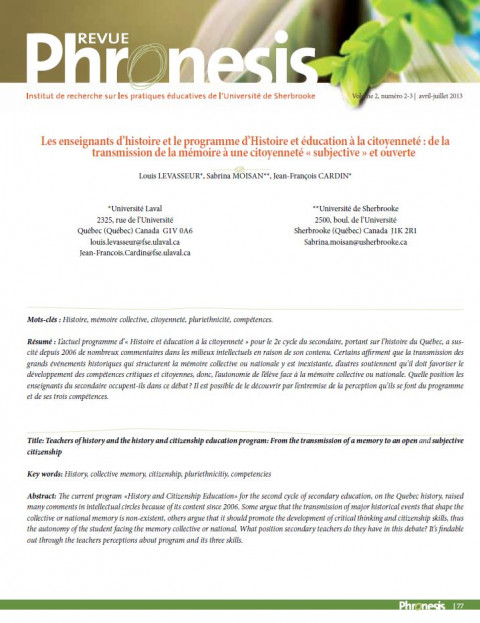 Teachers of History and the History and Citizenship Education Program: From the Transmission of a Memory to an Open and Subjective Citizenship Year of publication: 2013 Author: Louis LeVasseur | Sabrina Moisan | Jean-François Cardin Corporate author: Phronesis The current program «History and Citizenship Education» for the second cycle of secondary education, on the Quebec history, raised many comments in intellectual circles because of its content since 2006. Some argue that the transmission of major historical events that shape the collective or national memory is non-existent, others argue that it should promote the development of critical thinking and citizenship skills, thus the autonomy of the student facing the memory collective or national. What position secondary teachers do they have in this debate? It’s findable out through the teachers perceptions about program and its three skills. Les enseignants d’histoire et le programme d’Histoire et éducation à la citoyenneté: de la transmission de la mémoire à une citoyenneté « subjective » et ouverte Year of publication: 2013 Author: Louis LeVasseur | Sabrina Moisan | Jean-François Cardin Corporate author: Phronesis L’actuel programme d’« Histoire et éducation à la citoyenneté » pour le 2e cycle du secondaire, portant sur l’histoire du Québec, a suscité depuis 2006 de nombreux commentaires dans les milieux intellectuels en raison de son contenu. Certains affirment que la transmission des grands événements historiques qui structurent la mémoire collective ou nationale y est inexistante, d’autres soutiennent qu’il doit favoriser le développement des compétences critiques et citoyennes, donc, l’autonomie de l’élève face à la mémoire collective ou nationale. Quelle position les enseignants du secondaire occupent-ils dans ce débat ? Il est possible de le découvrir par l’entremise de la perception qu’ils se font du programme et de ses trois compétences.
 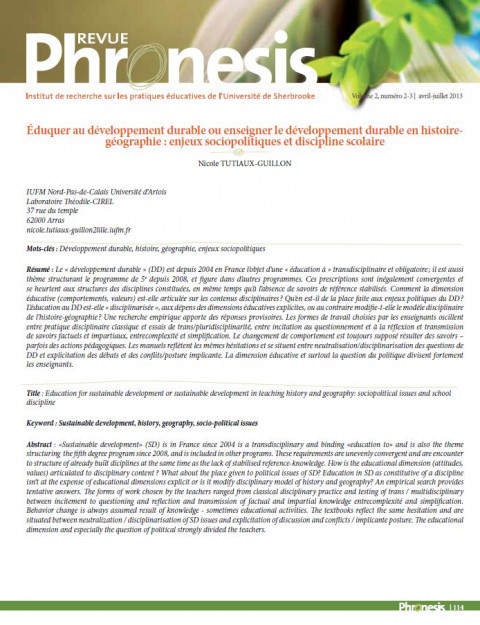 Education for Sustainable Development or Sustainable Development in Teaching History and Geography: Sociopolitical Issues and School Discipline Year of publication: 2013 Author: Nicole Tutiaux-Guillon Corporate author: Phronesis «Sustainable development» (SD) is in France since 2004 is a transdisciplinary and binding «education to» and is also the theme structuring the fifth degree program since 2008, and is included in other programs. These requirements are unevenly convergent and are encounter to structure of already built diciplines at the same time as the lack of stabilised reference-knowledge. How is the educational dimension (attitudes, values) articulated to disciplinary content ? What about the place given to political issues of SD? Education in SD as constitutive of a discipline isn’t at the expense of educational dimensions explicit or is it modify disciplinary model of history and geography? An empirical search provides tentative answers. The forms of work chosen by the teachers ranged from classical disciplinary practice and testing of trans / multidisciplinary between incitement to questioning and reflection and transmission of factual and impartial knowledge entrecomplexité and simplification. Behavior change is always assumed result of knowledge - sometimes educational activities. The textbooks reflect the same hesitation and are situated between neutralization / disciplinarisation of SD issues and explicitation of discussion and conflicts / implicante posture. The educational dimension and especially the question of political strongly divided the teachers. Éduquer au développement durable ou enseigner le développement durable en histoire-géographie : enjeux sociopolitiques et discipline scolaire Year of publication: 2013 Author: Nicole Tutiaux-Guillon Corporate author: Phronesis Le « développement durable » (DD) est depuis 2004 en France l’objet d’une « éducation à » transdisciplinaire et obligatoire ; il est aussi thème structurant le programme de 5e depuis 2008, et figure dans d’autres programmes. Ces prescriptions sont inégalement convergentes et se heurtent aux structures des disciplines constituées, en même temps qu’à l’absence de savoirs de référence stabilisés. Comment la dimension éducative (comportements, valeurs) est-elle articulée sur les contenus disciplinaires ? Qu’en est-il de la place faite aux enjeux politiques du DD ? L’éducation au DD est-elle « disciplinarisée », aux dépens des dimensions éducatives explicites, ou au contraire modifie-t-elle le modèle disciplinaire de l’histoire-géographie ? Une recherche empirique apporte des réponses provisoires. Les formes de travail choisies par les enseignants oscillent entre pratique disciplinaire classique et essais de trans/pluridisciplinarité, entre incitation au questionnement et à la réflexion et transmission de savoirs factuels et impartiaux, entrecomplexité et simplification. Le changement de comportement est toujours supposé résulter des savoirs – parfois des actions pédagogiques. Les manuels reflètent les mêmes hésitations et se situent entre neutralisation/disciplinarisation des questions de DD et explicitation des débats et des conflits/posture implicante. La dimension éducative et surtout la question du politique divisent fortement les enseignants.