
Resources
Explore a wide range of valuable resources on GCED to deepen your understanding and enhance your research, advocacy, teaching, and learning.
5 Results found
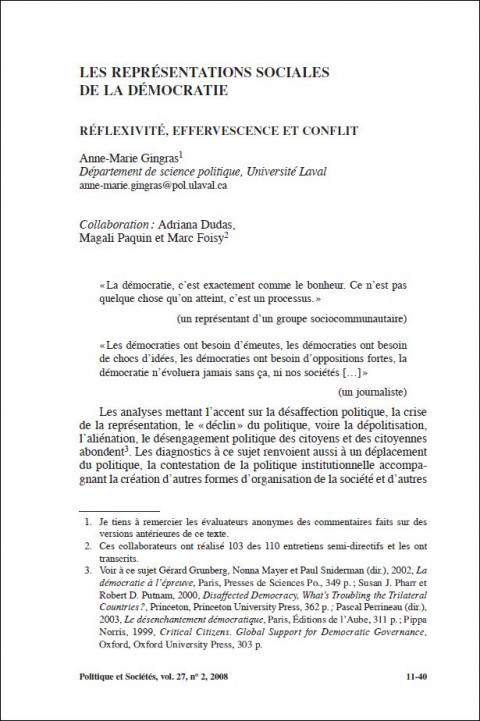 The Social Representations of Democracy: Reflexivity, Efferevescence and Conflict Year of publication: 2008 Author: Anne-Marie Gingras | Adriana Dudas | Magali Paquin | Marc Foisy Corporate author: Politique et Sociétés (Canada) This paper deals with “democracy within society” that appears predominantly in our research on social representations of democracy. We have interviewed 110 persons who have a regular access to the public sphere to perceive their understanding of democracy, its many dimensions, and its main stakes. Democracy within society, or democracy as a state of society, is opposed to institutional democracy (that is, political practices and Rule of law) toward which critics abound. Democracy within society is twofold: on the one hand, emphasis on effervescence and reflexivity that crystallize in collective organisations and in debate and communication and, on the other hand, assimilation of democracy to conflict, considered in terms of normality and processes. Moreover, democracy within society needs an actor, the citizen, who does not respond to the call of democracy, as shown in the many social sciences studies of the last decades. Les représentations sociales de la démocratie: réflexivité, effervescence et conflit Year of publication: 2008 Author: Anne-Marie Gingras | Adriana Dudas | Magali Paquin | Marc Foisy Corporate author: Politique et Sociétés (Canada) Cet article porte sur la « démocratie sociale », un concept qui ressort avec force dans notre recherche sur les représentations sociales sur la démocratie. Nous avons interviewé 110 personnes ayant accès à l’espace public dans le but de saisir leur compréhension de la démocratie, de ses diverses dimensions et des principaux enjeux qui l’affectent. La démocratie sociale, ou démocratie comme état de société, s’oppose à la démocratie institutionnelle (pratiques politiques institutionnelles et État de droit) à l’égard de laquelle les critiques abondent. La démocratie sociale comporte deux volets : d’une part, l’insistance sur l’effervescence et la réflexivité qui s’incarnent dans l’organisation collective et dans le débat et la communication et, d’autre part, l’assimilation de la démocratie au conflit qui est pensé en termes de normalité et de processus. Cependant, la démocratie sociale a besoin d’un acteur, le citoyen, qui, comme le montrent les travaux en sciences sociales depuis des décennies, ne répond pas à l’appel de la construction de la démocratie.
 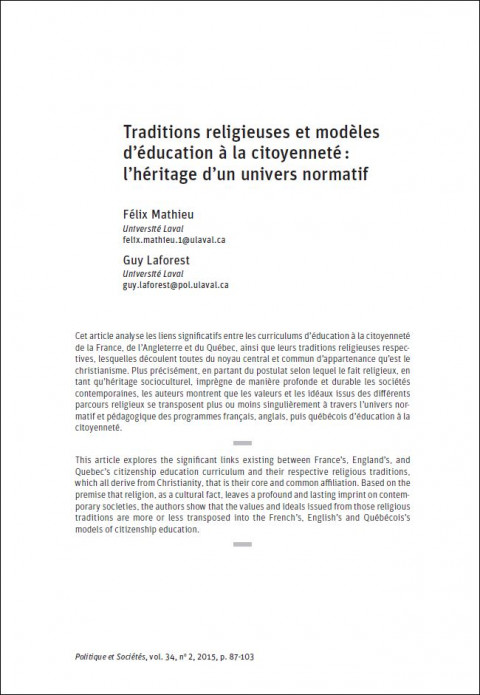 Religious Traditions and Models of Citizenship Education: The Heritage of a Normative Universe Year of publication: 2015 Author: Félix Mathieu | Guy Laforest Corporate author: Politique et Sociétés (Canada) This article explores the significant links existing between France’s, England’s, and Quebec’s citizenship education curriculum and their respective religious traditions, which all derive from Christianity, that is their core and common affiliation. Based on the premise that religion, as a cultural fact, leaves a profound and lasting imprint on contemporary societies, the authors show that the values and ideals issued from those religious traditions are more or less transposed into the French’s, English’s and Québécois’s models of citizenship education. Traditions religieuses et modèles d’éducation à la citoyenneté: l’héritage d’un univers normatif Year of publication: 2015 Author: Félix Mathieu | Guy Laforest Corporate author: Politique et Sociétés (Canada) Cet article analyse les liens significatifs entre les curriculums d’éducation à la citoyenneté de la France, de l’Angleterre et du Québec, ainsi que leurs traditions religieuses respectives, lesquelles découlent toutes du noyau central et commun d’appartenance qu’est le christianisme. Plus précisément, en partant du postulat selon lequel le fait religieux, en tant qu’héritage socioculturel, imprègne de manière profonde et durable les sociétés contemporaines, les auteurs montrent que les valeurs et les idéaux issus des différents parcours religieux se transposent plus ou moins singulièrement à travers l’univers normatif et pédagogique des programmes français, anglais, puis québécois d’éducation à la citoyenneté.
 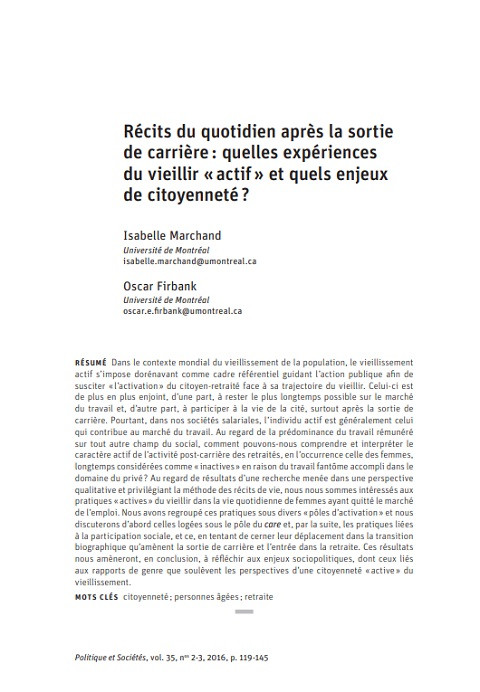 Récits du quotidien après la sortie de carrière: Quelles expériences du vieillir « actif » et quels enjeux de citoyenneté ? Year of publication: 2016 Author: Isabelle Marchand | Oscar Firbank Corporate author: Politique et Sociétés (Canada) | Société québécoise de science politique Dans le contexte mondial du vieillissement de la population, le vieillissement actif s’impose dorénavant comme cadre référentiel guidant l’action publique afin de susciter « l’activation » du citoyen-retraité face à sa trajectoire du vieillir. Celui-ci est de plus en plus enjoint, d’une part, à rester le plus longtemps possible sur le marché du travail et, d’autre part, à participer à la vie de la cité, surtout après la sortie de carrière. Pourtant, dans nos sociétés salariales, l’individu actif est généralement celui qui contribue au marché du travail. Au regard de la prédominance du travail rémunéré sur tout autre champ du social, comment pouvons-nous comprendre et interpréter le caractère actif de l’activité post-carrière des retraités, en l’occurrence celle des femmes, longtemps considérées comme « inactives » en raison du travail fantôme accompli dans le domaine du privé ? Au regard de résultats d’une recherche menée dans une perspective qualitative et privilégiant la méthode des récits de vie, nous nous sommes intéressés aux pratiques « actives » du vieillir dans la vie quotidienne de femmes ayant quitté le marché de l’emploi. Nous avons regroupé ces pratiques sous divers « pôles d’activation » et nous discuterons d’abord celles logées sous le pôle du care et, par la suite, les pratiques liées à la participation sociale, et ce, en tentant de cerner leur déplacement dans la transition biographique qu’amènent la sortie de carrière et l’entrée dans la retraite. Ces résultats nous amèneront, en conclusion, à réfléchir aux enjeux sociopolitiques, dont ceux liés aux rapports de genre que soulèvent les perspectives d’une citoyenneté « active » du vieillissement.