
Resources
Explore a wide range of valuable resources on GCED to deepen your understanding and enhance your research, advocacy, teaching, and learning.
2 Results found
 The Effects of Service Learning Program on Medical Students' Perceptions of Global Citizenship and Sustainable Development (Journal of Educational Innovation Research; Vol. 29. No. 1) Year of publication: 2019 Author: Sojung Yune | Kwi Hwa Park Corporate author: Pusan National University. Educational Development Institute Purpose: Recently, the concept of 'service learning', which is a curriculum and a program of service learning suitable for medical college, has begun to be introduced. The purpose of this study were to develop a service learning program for medical school and to explore its effects. The research problems set in this study are as follows. First, what is the demand of medical students for service learning education? Second, how does the service learning education program affect students' perception of global citizenship and awareness of sustainable development? Method: In order to investigate the demand for service training of medical students, 99 students in a third grade department of medicine were surveyed. Based on the results of the questionnaires and literature review, we developed a service learning program suitable for medical schools. The developed program was validated by a specialist and then conducted in 2017 during the first semester of a medical school and 88 second grade students at a medical school. The final 78 post - test results were used for the analysis. Results: The service learning education in this study was developed and operated as a course of 1 credit for the major in the second grade. After selecting and exploring the topics, they were asked to perform 6-week project-based volunteer activities. As a result, the service learning program developed in this study was found to be effective in medical students' perception of global citizenship, and sustainable development. Conclusion: In order to improve the professionalism of medical students, it is necessary to educate social contribution and service consciousness, which is expected to be possible through service learning education.
 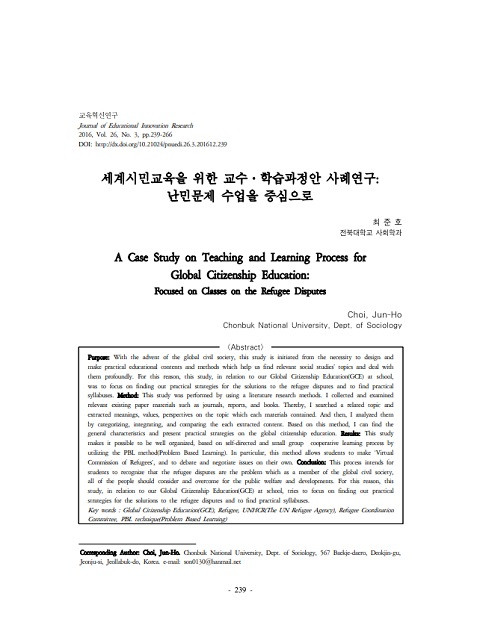 A Case Study on Teaching and Learning Process for Global Citizenship Education: Focused on Classes on the Refugee Disputes (Journal of Educational Innovation Research; Vol. 26, No. 3) Year of publication: 2016 Author: Junho Choi Corporate author: Pusan National University. Educational Development Institute Purpose: With the advent of the global civil society, this study is initiated from the necessity to design and make practical educational contents and methods which help us find relevant social studies’ topics and deal with them profoundly. For this reason, this study, in relation to our Global Citizenship Education(GCE) at school, was to focus on finding out practical strategies for the solutions to the refugee disputes and to find practical syllabuses. Method: This study was performed by using a literature research methods. I collected and examined relevant existing paper materials such as journals, reports, and books. Thereby, I searched a related topic and extracted meanings, values, perspectives on the topic which each materials contained. And then, I analyzed them by categorizing, integrating, and comparing the each extracted content. Based on this method, I can find the general characteristics and present practical strategies on the global citizenship education. Results: This study makes it possible to be well organized, based on self-directed and small group cooperative learning process by utilizing the PBL method(Problem Based Learning). In particular, this method allows students to make ‘Virtual Commission of Refugees’, and to debate and negotiate issues on their own. Conclusion: This process intends for students to recognize that the refugee disputes are the problem which as a member of the global civil society, all of the people should consider and overcome for the public welfare and developments. For this reason, this study, in relation to our Global Citizenship Education(GCE) at school, tries to focus on finding out practical strategies for the solutions to the refugee disputes and to find practical syllabuses.