
Resources
Explore a wide range of valuable resources on GCED to deepen your understanding and enhance your research, advocacy, teaching, and learning.
4 Results found
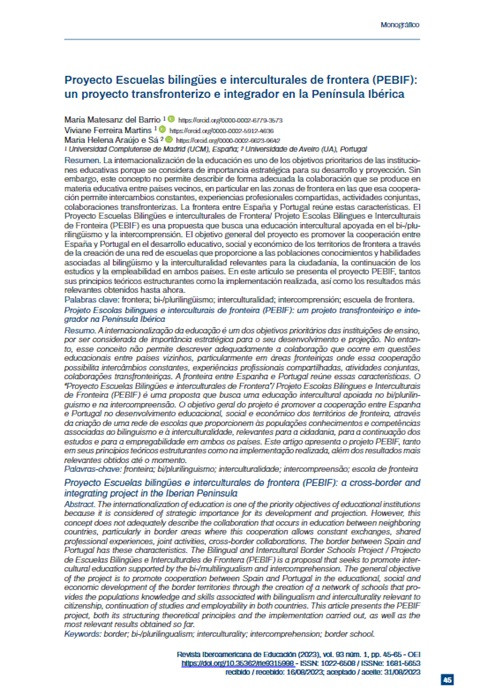 Bilingual and Intercultural Border Schools Project: A Cross-Border and Integrative Project in the Iberian Peninsula(Revista iberoamericana de educación; vol. 93, no. 1) Year of publication: 2023 Author: María Matesanz del Barrio | Maria Helena Araújo e Sá | Vivianne Ferreira Martins Corporate author: Revista Iberoamericana de Educación The Bilingual and Intercultural Border Schools Project / Projecto de Escuelas Bilingües e Interculturales de Frontera (PEBIF) is a proposal that seeks to promote inter-cultural education supported by the bi-/multilingualism and intercomprehension. The general objective of the project is to promote cooperation between Spain and Portugal in the educational, social and economic development of the border territories through the creation of a network of schools that pro-vides the populations knowledge and skills associated with bilingualism and interculturality relevant to citizenship, continuation of studies and employability in both countries. This article presents the PEBIF project, both its structuring theoretical principles and the implementation carried out, as well as the most relevant results obtained so far. Proyecto escuelas bilingües e interculturales de frontera (PEBIF): Un proyecto transfronterizo e integrador en la Península Ibérica (Revista iberoamericana de educación; vol. 93, núm. 1) Year of publication: 2023 Author: María Matesanz del Barrio | Maria Helena Araújo e Sá | Vivianne Ferreira Martins Corporate author: Revista Iberoamericana de Educación El Proyecto Escuelas Bilingües e interculturales de Frontera/ Projeto Escolas Bilingues e Interculturais de Fronteira (PEBIF) es una propuesta que busca una educación intercultural apoyada en el bi-/plu-rilingüismo y la intercomprensión. El objetivo general del proyecto es promover la cooperación entre España y Portugal en el desarrollo educativo, social y económico de los territorios de frontera a través de la creación de una red de escuelas que proporcione a las poblaciones conocimientos y habilidades asociadas al bilingüismo y la interculturalidad relevantes para la ciudadanía, la continuación de los estudios y la empleabilidad en ambos países. En este artículo se presenta el proyecto PEBIF, tantos sus principios teóricos estructurantes como la implementación realizada, así como los resultados más relevantes obtenidos hasta ahora.
 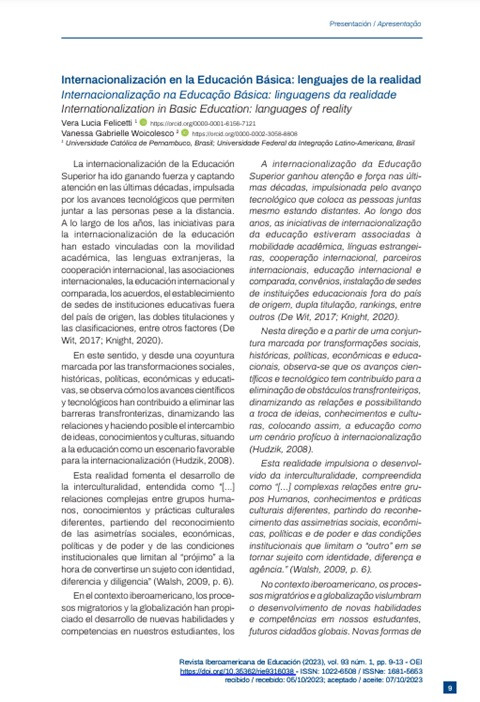 Internationalization in Basic Education: Languages of Reality(Revista iberoamericana de educación; vol. 93, no. 1) Year of publication: 2023 Author: Vera Lucia Felicetti | Vanessa Gabrielle Woicolesco Corporate author: Revista Iberoamericana de Educación The presence of internationalization practices in Basic Education schools has been quietly taking shape on the national, Ibero-American and international stage, but the absence of records of the actions that characterize them as internationalization continues to be a gap in their understanding. From these silent practices of internationalization we see the potential to build knowledge while respecting the interculturality that permeates the educational space. In this sense, we must recognize and understand these practices as internationalization processes, with a view to debating and reflecting on how they can contribute to the improvement of the educational system from an Ibero-American perspective. Internacionalización en la educación básica: Lenguajes de la realidad(Revista iberoamericana de educación; vol. 93, núm. 1) Year of publication: 2023 Author: Vera Lucia Felicetti | Vanessa Gabrielle Woicolesco Corporate author: Revista Iberoamericana de Educación La presencia de prácticas de internacionalización en los centros escolares de Educación Básica se ha ido configurando de forma silenciosa en el escenario nacional, iberoamericano e internacional, pero la ausencia de registros de las acciones que las caracterizan como internacionalización sigue siendo una laguna en su comprensión. A partir de estas prácticas silenciosas de internacionalización vemos el potencial para construir el conocimiento respetando la interculturalidad que impregna el espacio educativo. En este sentido, debemos reconocer y entender estas prácticas como procesos de internacionalización, con vistas a debatir y reflexionar sobre cómo pueden contribuir a la mejora del sistema educativo desde una perspectiva iberoamericana.